Really Easy Jacob’s Ladder

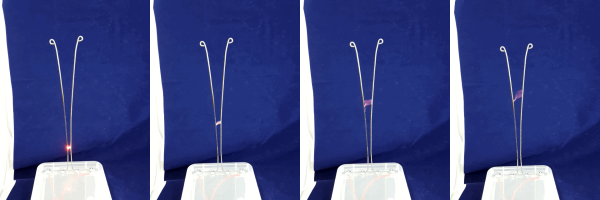
There was a time when making a high voltage project like a Jacob’s ladder took time to build or scrounge some kind of high voltage circuit. The neon sign transformer, Marx generator, or voltage multiplier was the hard part of the project. But nowadays you can get cheap high voltage modules that are quite inexpensive. [PaulGetson] picked up one for under $20 and turned it into a quick and easy Jacob’s ladder.

Honestly, once you have high voltage, making a Jacob’s ladder is pretty simple. [Paul] used a cheap plastic box, some coat hanger wire, and some stainless steel bolts.

Continue reading “Really Easy Jacob’s Ladder”

Raspberry Pi Hive Mind

Setting up a cluster of computers used to be a high-end trick used in big data centers and labs. After all, buying a bunch of, say, VAX computers runs into money pretty quickly (not even counting the operating expense). Today, though, most of us have a slew of Raspberry Pi computers.

Because the Pi runs Linux (or, at least, can run Linux), there are a wealth of tools out there for doing just about anything. The trick is figuring out how to install it. Clustering several Linux boxes isn’t necessarily difficult, but it does take a lot of work unless you use a special tool. One of those tools is Docker, particularly Docker Swarm Mode. [Alex Ellis] has a good video (see below) showing the details of a 28 CPU cluster.

Continue reading “Raspberry Pi Hive Mind”

Low Noise Floor Microphone

[Matt] likes to make videos (and he’s pretty good at it judging by the quality of his videos). But video isn’t much without audio. Handheld recorders with small built-in microphones have a fairly high noise floor so [Matt] has a Rode NT1-A — a pricey but very quiet microphone. However, for field work, it isn’t handy since it requires a power supply and preamp to go along with it.

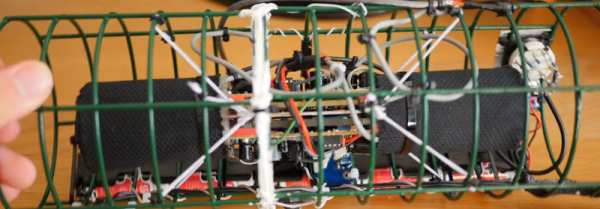
low-noise-floor-binaural-microphoneAnother problem is that for stereo recording you need two and because they are quiet, they tend to pick up handling noise so you probably need to mount them on tripods. That’s all too much to carry around, especially on a hike. So [Matt] cannibalized two microphones. He repackaged them in a shock mount (made from a bird feeder and elastic), and added a battery pack and a custom preamp. The shock mount eliminates the handling noise and the custom PC boards mean you don’t have to carry a lot of extra gear.

The end result (see the video below) looks like someone made a purse out of a tribble, but it does sound good. If you hang on through most of the video (of fast forward to about 7:25), you can hear the microphones picking up thunderstorms, the ocean, the wind, and even [Matt’s] heartbeat.

Continue reading “Low Noise Floor Microphone”

Amazing Carbon Foam Doesn’t Take Much Bread

A lot of people knew the Space Shuttle had ceramic tiles to protect its nose from reentry heat. That’s mostly because the tiles fell off a lot and each one was a unique shape, so it got a lot of press coverage. However, you didn’t hear as much about the parts of the orbiter that got really hot: the forward part of the wings and the tip of the nose. For those, NASA used an exotic material called RCC or reinforced carbon-carbon. Other uses include missile nose cones and Formula One brakes. A similar material, carbon fiber-reinforced silicon carbide appears in some high-end car brakes. These materials can take high temperatures, easily.

[AvE] wanted to make some carbon foam for experiments. It does take a little bread, though. Not money, but literal bread. To create the foam, he burns bread slices in a chamber full of argon. The stuff has some amazing properties.

In the video below, you can see the foam protecting a thermocouple from a torch flame and even holding melting aluminum. Not bad for a few pieces of bread.

Continue reading “Amazing Carbon Foam Doesn’t Take Much Bread”

VFD Clock Only Speaks Romanian

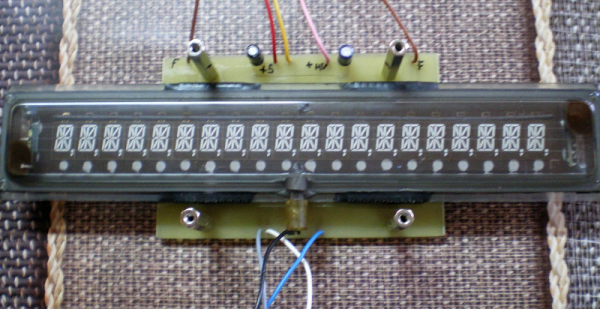
There’s no shortage of clock projects, but [niq_ro] has his own take using a vacuum fluorescent display (VFD), and Arduino, and a pair of MAX6921 ICs. Those chips are made to drive a VFD, and the use of two of the ICs required a bit of work. The Arduino is not a great time keeper, so the clock also uses a DS3231 clock module and a humidity and temperature sensor.

The clock is in Romanian, although there are some options for different text. You can find the code on GitHub and can see the result in the video below.

Continue reading “VFD Clock Only Speaks Romanian”

Building A DIY Heat Pipe

Once the secret design tool for aerospace designers, the heat pipe is a common fixture now thanks to the demands of PC CPU cooling. Heat pipes can transfer lots of energy from a hot side to a cold side and is useful when you need to cool something where having a fan near the hot part isn’t feasible for some reason. Unlike active cooling, a heat pipe doesn’t require any external power or pumps, either.

[James Biggar] builds his own heat pipes using copper tubing. You can see a video of one being made, below. There’s not much to it, just a copper pipe with some water in it. However, [James] gets the water boiling to reduce the pressure in the tube before sealing it, which is an interesting trick.

One limitation of his technique is that there is no internal wick. That means the tube can only be installed vertically. If you haven’t looked at heat pipes before, most of them do have a wick. The idea is that some working fluid is in the pipe. You select that fluid so that it boils at or below the temperature you want to handle. The hot vapor rushes to the cool side of the pipe (carrying heat) where you have a large heatsink that may have a fan or active cooling system. The vapor condenses and–in this case–drops back to the bottom of the tube. However, if there is a wick, capillary action will return the fluid to the hot end of the tube.

You might think that using water as the working fluid would limit you to 100°C, but remember, [James’] technique lowers the pressure in the tube. At a lower pressure, the water will boil at a lower temperature.

We’ve seen heat pipes and wine chillers used to cool a PC before. In fact, we’ve even seen them in builds of completely fanless PCs.

Continue reading “Building A DIY Heat Pipe”

The Turing Tapes

The recent movie “The Imitation Game” gave [Alan Turing] some well-deserved fame among non-computer types (although the historical accuracy of that movie is poor, at best; there have been several comparisons between the movie and reality). However, for people in the computer industry, Turing was famous for more than just helping to crack Enigma. His theoretical work on computing led to the Turing machine, which is still an important concept for reasoning about computers in a mathematical way. He also laid the foundation for the stored program computer that we take for granted today.

What’s a Turing Machine?

A Turing machine is deceptively simple and, like many mathematical models, highly impractical. Leading off the inpracticalities, the machine includes an infinite paper tape. There is a head that can read and write any symbol to the tape at some position, and the tape can move to the left or the right. Keep in mind that the head can write a symbol over another symbol, so that’s another practical difficulty, although not an insurmountable one. The other issue is that the symbol can be anything: a letter, a number, a jolly wrencher, or a bunch of dots. Again, not impossible, but difficult to do with practical hardware implementations.

Continue reading “The Turing Tapes”