Find A Drone

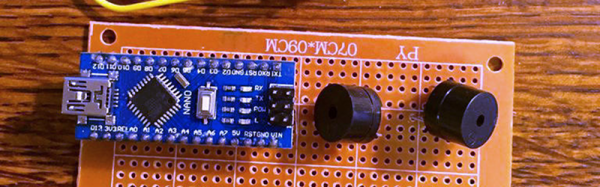
Flying a drone usually leads to–sooner or later–crashing a drone. If you are lucky, you’ll see where it crashes and it won’t be out of reach. If you aren’t lucky, you’ll know where it is, but it will be too high to easily reach. The worst case is when it just falls out of the sky and you aren’t entirely sure where. [Just4funmedia] faced this problem and decided to use some piezo buzzers and an Arduino to solve it.

Yeah, yeah, we know. You don’t really need an Arduino to do this, although it does make it easy to add some flexibility. You can pick two tones that are easy to hear and turn on the buzzers with a spare channel or sense a loss of signal or power.

Continue reading “Find A Drone” →

Virtually Free Rapsberry Pis

One of the nice things about the Raspberry Pi is that it runs Linux and you can do a lot of development right on the board. The converse of that is you can do a lot of development on a Linux desktop and then move things over to the Pi once you get the biggest bugs out. However, sometimes you really need to run code on the actual platform.

There is, however, an in-between solution that has the added benefit of upping your skills: emulate a Pi on your desktop. If you use Linux or Windows on your desktop, you can use QEMU to execute Raspberry Pi software virtually. This might be useful if you don’t have a Pi (or, at least, don’t have it with you). Or you just want to leverage your large computer to simplify development. Of course we would be delighted to see you build the Pi equivalent of the Tamagotchi Singularity but that’s a bit beyond the scope of this article.

Since I use Linux, I’m going to focus on that. If you insist on using Windows, you can find a ready-to-go project on Sourceforge. For the most part, you should find the process similar. The method I’ll talk about works on Kubuntu, but should also work on most other Debian-based systems, including Ubuntu.

Continue reading “Virtually Free Rapsberry Pis” →

Where (Almost) No GoPro Has Gone Before

What would it be like to ride a six foot rocket to nearly 400,000 feet at Mach 5.5? Thanks to UP Areospace and some GoPro cameras, you can find out.

The rocket was a test for the Maraia Capsule project. Mach 5.5, for reference, is 3,800MPH. It appears several different GoPro cameras took the footage. You can see the upward travel, some great views of Earth, and the return on the video below.

Continue reading “Where (Almost) No GoPro Has Gone Before” →

DIY USB Type C

For many years, the humble serial port was one of the best ways to communicate with an embedded system. Then USB ports became more popular and serial ports started to vanish. These days, even if you’re using a serial protocol to communicate with the microcontroller, it’s often over USB. And USB provides a convenient source of 5 V too. In short, we’ve made our peace with USB.

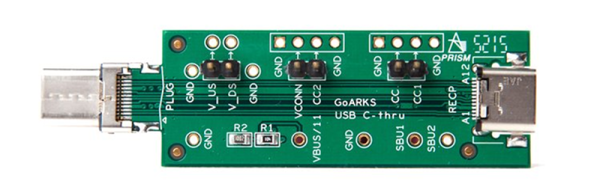
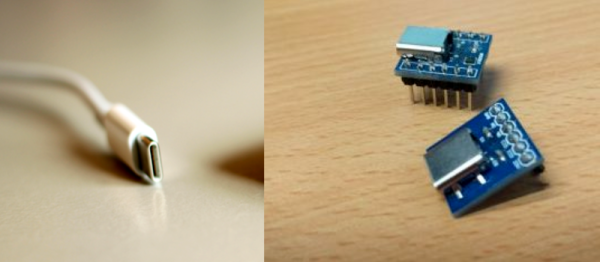
And then they go and change it. USB type C is a small connector that is reversible and has more options for power and connectivity. However, it is yet another new interface to figure out. [Scorpia] recently posted an article about USB type C that you may find useful.

Continue reading “DIY USB Type C” →

Hack A Bike Electroetching

[Melka] wanted a track bike, but never quite got around to buying a nice one. Then he found an inexpensive abandoned project bike for 10 Euro. He had to do a lot of work to make it serviceable and he detailed it all in a forum post. What caught our eye, though, was his technique for electroetching.

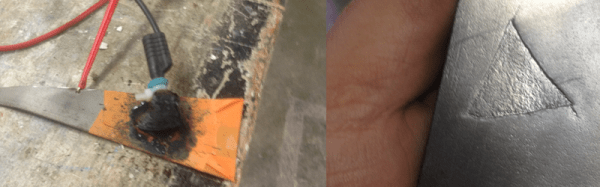
The process is simple, but [Melka] says the procedure caused hydrochloric acid fumes as a byproduct. Your lungs don’t like HCl fumes. Apart from the danger, you probably have everything you need. He used electrical tape to create a stencil on the metal (although he mentioned that Kapton tape might come off better afterward) and a saturated solution of common table salt as the electrolyte.

Power comes from a bench power supply set to about 24V. The positive lead was connected to the metal and the ground to the sponge. From the photos, it looks like the particular piece and solution caused about 600mA to flow. After 10 minutes, the metal etched out to about 0.2 mm. After the etching, [Melka] brazed some brass into the etched area to make an interesting looking logo.

If you have a laser cutter, you can skip the chemicals. We’ve even seen laser etching combine with a 3D printer to produce PCBs. [Melka’s] method is a little messier and probably would not do fine lines readily, but if you need to etch steel and you don’t mind the fumes, it should be simple to try.

One Dollar Board Targets Students

The Raspberry Pi was made to be inexpensive with an eye toward putting them into schools. But what about programs targeted at teaching embedded programming? There are plenty of fiscally-starved schools all over the world, and it isn’t uncommon for teachers to buy supplies out of their own pockets. What could you do with a board that cost just one dollar?

That’s the idea behind the team promoting the “One Dollar Board” (we don’t know why they didn’t call it a buck board). The idea is to produce a Creative Commons design for a simple microcontroller board that only costs a dollar. You can see a video about the project, below.

Continue reading “One Dollar Board Targets Students” →