What Came First? The Chicken Or The LASER?

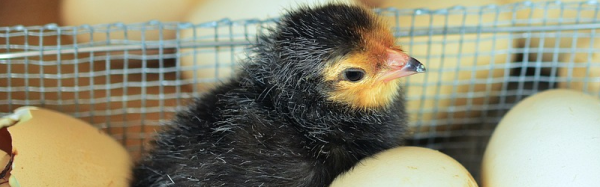
If you’ve had a child in the last few decades, you’ve had a choice to make: if you want to know the sex of the baby ahead of time. With ultrasound you can find out or–popular these days–you can have the result sealed and have a baker create a reveal cake. Apparently, researchers at the Dresden University of Technology and the University of Leipzig wanted to do the same trick with unborn chickens.

You might wonder why anyone cares (we did). Apparently, chickens that are bred for egg laying don’t produce roosters suitable for food use. This leads to about half of the chicks being “culled” (a less ugly euphemism than gassed or shredded) and used in–among other things–animal feed. Worldwide, billions of chicks are culled each year and that’s not counting other similar situations like male turkeys and female ducks.

Continue reading “What Came First? The Chicken Or The LASER?” →

Robo Face Speaks

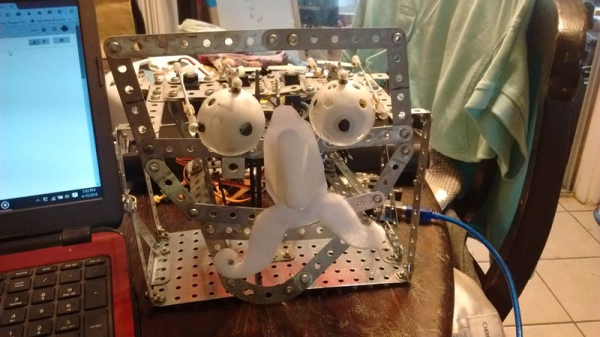
If you are doing a senior design project in engineering school, it takes some guts to make a robotic duplicate of the school’s president. He or she might be flattered, or completely offended. Us? We laughed out loud. Check out the video below. Spoiler: the nose/moustache wiggle at the end kills us every time.

The project uses a variety of parts including a plastic mask, an Erector set, and the obligatory Arduino with an MP3 shield. There are many articulated parts including eyes, nose, mouth, and wiggly moustache. The face uses RC servos, although [gtoombs] says he’d use stepper motors next time for smoother motion.

Continue reading “Robo Face Speaks” →

TV Stick Out-Raspberries Raspberry Pi

Android-based TV sticks should be in more projects. They are readily available and inexpensive. They have a lot of horsepower for the price, and they can even boot a mainline Linux kernel, unlike some single-board computers we know. They’re smaller than the Pi Zero, so they’ll fit almost anywhere.

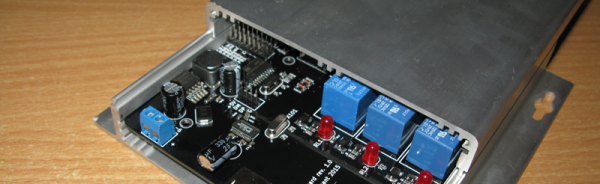
The one thing they don’t have, though, is I/O. Sure, it’s got a USB port, but that’s just about it. [Necromant] considered these problems and created a carrier board that fixes all that.

  • On-board 3A DC-DC. You can power the whole thing with anything from 7 to 24 volts DC
  • A 4-Port USB hub
  • An ATtiny 2313, connected to the hub via the V-USB stack
  • 2 USB ports on the back, with power control via GPIO lines
  • One USB port on the front (with power always on)
  • 3 relays
  • Fits a common anodized aluminum enclosure

The ATtiny code is on GitHub and allows for full I/O control, saving the state of the pins in EEPROM, and providing up to eight channels of servo control. The device connects through the USB port (consuming one port on the hub).

Repurposing consumer gear for embedded service is nothing new. We’ve seen it with phones. We’ve even seen remotes used as a mouse. But this is such a nice template for adding cheap and easy computing power to your projects that we’re surprised we don’t see it more often. Why aren’t you hacking a TV stick into your projects?

If You See Anything, Say Something? Math On A Plane

Remember September 2016 2015? That was the month that [Ahmed Mohamed] brought a modified clock to school and was accused of being a terrorist. The event divided people with some feeling like it was ignorance on the part of the school, some felt the school had to be cautious, some felt it was racial profiling, and others thought it was a deliberate provocation from his possibly politically active parents. In the end, [Ahmed] moved to Qatar.

Regardless of the truth behind the affair, this month we’ve seen something that is probably even less ambiguous. The Washington Post reports that a woman told an Air Wisconsin crew that she was too ill to fly. In reality, she was sitting next to a suspicious man and her illness was a ruse to report him to the crew.

Authorities questioned the man. What was his suspicious activity? Was he assembling a bomb? Carrying a weapon? Murmuring plans for destruction into a cell phone? No, he was writing math equations. University of Pennsylvania economics professor [Guido Menzio] was on his way to deliver a speech and was reviewing some differential equations related to his work.

[Menzio] says he was treated well, and the flight was only delayed two hours (which sounds better in a blog post then it does when you are flying). However, this–to me–highlights a very troubling indicator of the general public’s level of education about… well… everything. It is all too easy to imagine any Hackaday reader looking at a schematic or a hex dump or source code could have the same experience.

Some media has tried to tie the event to [Menzio’s] appearance (he’s Italian) but I was frankly surprised that someone would be afraid of an equation. The pen may be mightier than the sword, but a math equation won’t (by itself) down an aircraft. I’ve heard speculation that the woman might have thought the equations were Arabic. First of all, what? And secondly, what if it were? If a person is writing in Arabic on an airplane, that shouldn’t be cause for alarm.

It sounds like the airline (which is owned by American Airlines) and officials acted pretty reasonably if you took the threat as credible. The real problem is that the woman–and apparently, the pilot–either didn’t recognize the writing as equations or somehow feared equations?

Regardless of your personal feelings about the clock incident, you could at least make the argument that the school had a duty to act with caution. If they missed a real bomb, they would be highly criticized for not taking a threat seriously. However, it is hard to imagine how symbols on a piece of paper could be dangerous.

While the mainstream media will continue to focus on what this means for passenger safety and racial profiling, I see it as a barometer of the general public’s perception of science, math, and technology as dark arts.

3D Printing Bone

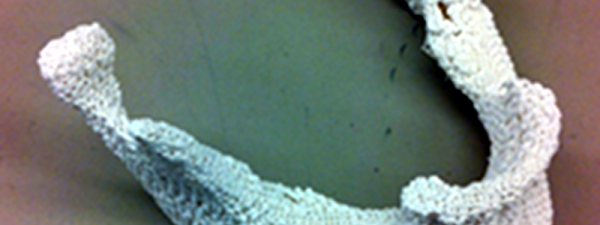
What do you print with your 3D printer? Key chains? More printer parts (our favorite)? Enclosures for PC boards? At Johns Hopkins, they want to print bones. Not Halloween skeletons, either. Actual bones for use in bodies.

According to Johns Hopkins, over 200,000 people a year need head or face bone replacements due to birth defects, trauma, or surgery. Traditionally, surgeons cut part of your leg bone that doesn’t bear much weight out and shape it to meet the patient’s need. However, this has a few problems. The cut in the leg isn’t pleasant. In addition, it is difficult to create subtle curved shapes for a face out of a relatively straight leg bone.

This is an obvious application for 3D printing if you could find a suitable material to produce faux bones. The FDA allows polycaprolactate (PCL) plastic for other clinical uses and it is attractive because it has a relatively low melting point. That’s important because mixing in biological additives is difficult to do at high temperatures.

Continue reading “3D Printing Bone” →

3D Printer Prints Sound

People like music, but they are also visual creatures. Perhaps that’s why music visualization is such a common project. Usually, you think of music visualization as using LEDs or a computer screen. However, [Gieeel] did his music visualization using a 3D printer.

Sure, the visualization is a little static compared to LEDs, but it does make an interesting conversation piece. The actual process isn’t very difficult, once you have the idea. [Gieeel] captured the waveform in Audacity, did a screen capture, and then converts the image to an SVG file using Inkscape.

From there, you can use many different CAD tools to convert the image into a 3D object. [Gieeel] used Autodesk Fusion 360 and had the resulting object professionally 3D printed.

We’ve seen other kinds of sound sculptures before. Of course, we’ve also seen a lot of traditional visualizations, as well.

Single Photon Source For Quantum Computing And Experimentation

One challenge to building optical computing devices and some quantum computers is finding a source of single photons. There are a lot of different techniques, but many of them aren’t very practical, requiring lots of space and cryogenic cooling. Recently, researchers at the Hebrew University of Jerusalem developed a scalable photon source on a semiconductor die.

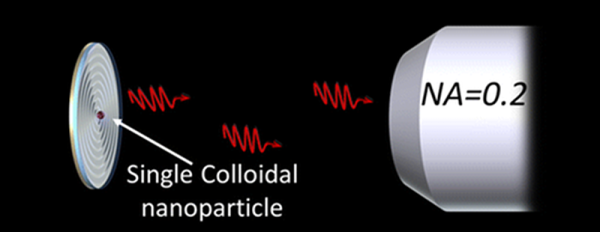
Using nanocrystals of semiconductor material, the new technique emits single photons, and in a predictable direction. The nanocrystals combine with circular nanoantennas made of metal and dielectric produced with conventional fabrication technology. The nanoantennas are concentric circles resembling a bullseye and is used to ensure that the photons travel the correct direction with little or no angular deviation.

A single IC could contain many photon sources and they operate at room temperature. We’ve talked about quantum tricks with photons before. Quantum mechanics is another popular topic.