PSoC VGA On A $10 Development Board

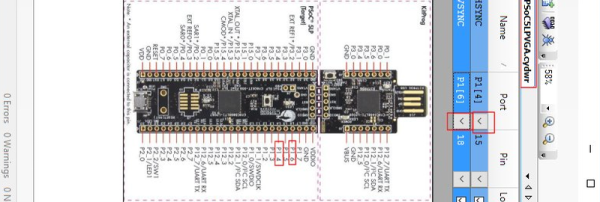
We’ve always found the Cypress PSoC an interesting beast. It’s a CPU with functional blocks that you can configure to build various I/O devices, including incorporating FPGA logic using Verilog. [MiguelVP] has an excellent multi-part project that produces VGA output from a PSoC. So far it just generates a fixed pattern, but a frame buffer is in the works, and there is plenty of detail about how to configure the PSoC for the task.

Although the PSoC has some analog capability, [MiguelVP] uses a cheap R2R DAC and VGA connector to interface to the VGA monitor. You can get the same PSoC board the project uses for about $10. The software, unfortunately, is Windows-only, so be prepared to fire up a virtual machine if you run Linux or Mac. Our own [Bil Herd] did a video introduction to PSoC that you can watch after the break.

Continue reading “PSoC VGA On A $10 Development Board” →

Little Helper: Open Source Hardware Hacker Multitool

We love a good multitool. There’s something seductive about knowing that if, for some reason, you need to saw down a tree on a moment’s notice, you have a tiny saw in your pocket. We also like electronic versions of the multitool: gadgets that serve a lot of purposes as you develop and debug hardware. One of the most polished-looking ones we’ve seen is [Phillip Schuster’s] Little Helper.

The open source gadget looks like an iPod (if an iPod had header pins sticking out of it). It has basic analog I/O capability, can generate PWM pulses, sniff I2C traffic, and do lots of other features. It is open source, so you can always add more capabilities if you need them.

Continue reading “Little Helper: Open Source Hardware Hacker Multitool” →

You Can Learn A Lot From A Dummy (Load)

If you work on RF circuits–even if you aren’t a ham radio operator–you ought to have a dummy load. A dummy load is a non-radiative “antenna” with known impedance that you can use to test your RF circuit without radiating. For radio work, you usually just need a 50-ohm resistor that is non-inductive (at least at the frequencies you are interested in) and that can dissipate the amount of power you’ll expect it to handle (at least for a short time). [VO1PWF] wanted a dummy load and built his own.
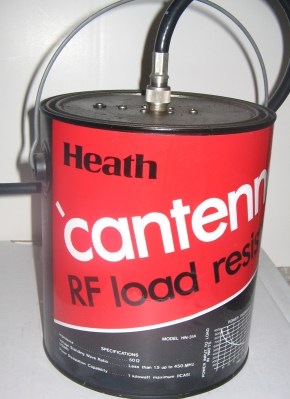
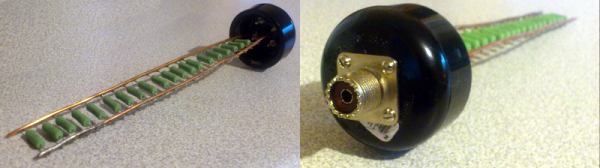
CantennaThe Cantenna (not the Pringle’s kind; see right) was a famous dummy load design when Heathkit was in business. It was a single carbon rod immersed in a paint can full transformer oil (which we now know was full of dangerous PCBs; and we don’t mean printed circuit boards). [VO1PWF’s] design is a little more practical, using some resistors in parallel (20 1K resistors), a plastic pipe housing, and mineral oil to keep it all cool.
The reason for the parallel resistors is to maximize the power handling capability. The resistors are 3W units, so the dummy load–in theory–can handle 60 watts. Often, high power resistors are wire wound and thus have a good bit of parasitic inductance that makes the dummy load reactive (not a good thing since that makes the load impedance vary by frequency). They do make non-inductive wire wound resistors, but these aren’t truly non-inductive. The wire winds in two different directions, so the inductance tends to cancel out. We wouldn’t trust them to be a pure resistance in a high-power dummy load design.

Continue reading “You Can Learn A Lot From A Dummy (Load)” →

3D Printed RC Servo To Linear Actuator Conversion

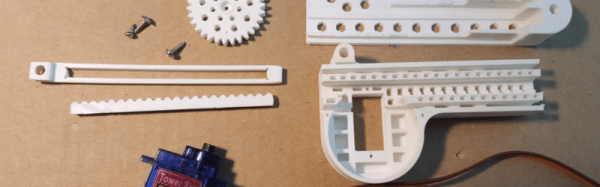
RC servos are handy when you need to rotate something. You can even modify them to rotate continuously if that’s what you need. However, [Roger Rabbit] needed linear motion, but wanted the simple control afforded by an RC servo. The solution? A 3D printed housing that converts a servo’s rotation into linear motion.

The actuator uses five different parts, a few screws, and a common RC servo. The video shows the actuator pushing and pulling a 200g load with a 6V supply. There’s some room for adjustment, so different servos should work.

Continue reading “3D Printed RC Servo To Linear Actuator Conversion” →

Electrolytic Capacitor Repair

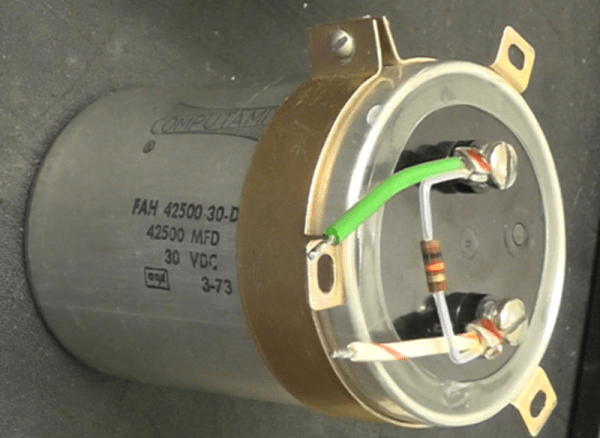
If you’ve ever worked on old gear, you probably know that electrolytic capacitors are prone to failure. [Dexter] undertook a repair of some four-decade-old capacitors in a power supply. He didn’t replace them. He fixed the actual capacitors.

The reason these units are prone to fail is the flip side of what people like about electrolytics: high capacitance in a small package. In a classic parallel plate capacitor, the capacity goes up as the distance between the plates shrinks. In an electrolytic, one plate is a rolled up spiral. The other plate is conductive fluid. The insulator between (the dielectric) is a very thin layer of oxide that forms on the spiral. Over time, the oxide degrades, but this degradation repairs itself when using the capacitor. If the capacitor isn’t powered up for an extended period, the oxide will degrade beyond the point of self-repair.

Continue reading “Electrolytic Capacitor Repair” →

Polarizing 3D Scanner Gives Amazing Results

What if you could take a cheap 3D sensor like a Kinect and increase its effectiveness by three orders of magnitude? The Kinect is great, of course, but it does have a limited resolution. To augment this, MIT researchers are using polarized measurements to deduce 3D forms.

The Fresnel equations describe how the shape of an object changes reflected light polarization, and the researchers use the received polarization to infer the shape. The polarizing sensor is nothing more than a DSLR camera and a polarizing filter, and scanning resolution is down to 300 microns.

The problem with the Fresnel equations is that there is an ambiguity so that a single measurement of polarization doesn’t uniquely identify the shape, and the novel work here is to use information from depth sensors like Kinect to select from the alternatives.

Continue reading “Polarizing 3D Scanner Gives Amazing Results” →

Before Google There Was The Chemical Rubber Company

Quick. What’s the difference in conductivity between silver and copper? Today, that’s easy to find out. You just ask Google (maybe even out loud if you have a phone handy). But it wasn’t that long ago that you needed another option. Before the Internet age, a big part of being “that guy” (or gal) was knowing where to go to find things. You had to be a master of the library’s reference section, know what might be in an encyclopedia or an almanac.

However if you were a hardcore math, science, or engineering geek you probably had, at least, one edition of CRC handbooks. Today, we usually think of CRC as cyclic redundancy check, but back then it was the Chemical Rubber Company.

The Chemical Rubber Company dates back to 1903 when brothers Arthur, Leo, and Emanuel Friedman were selling rubber lab aprons in Cleveland, Ohio (Arthur, apparently, had been in a similar business from 1900). In 1913, the brothers offered a short (116-page) booklet called the Rubber Handbook free with the purchase of a dozen aprons.

Continue reading “Before Google There Was The Chemical Rubber Company” →