Let’s Blow Up An Explosive Lightning Arrestor

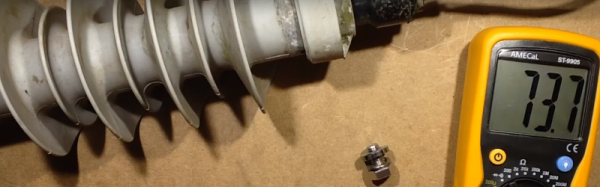
Lightning is some nasty stuff. Luckily, it doesn’t have a very long lifespan. [BigClive] decided to tear down an 11KV lighting arrestor used in power distribution systems. The fiberglass core has silicone rubber water-shedding disks that make the unit look sort of floppy, but inside is some serious hardware.

To protect the circuit, metal oxide varistors shunt high voltage from a lightning strike to ground as you’d expect. The interesting part is how the device deals with failure. It would be a disaster if the device shorted the 11KV power line to ground for any length of time due to a fault. To prevent that problem, a resistor heats up when struck by lightning and triggers an explosive charge that disconnects the ground wire and releases a flag to indicate the failure.

[BigClive] triggered the charge in the video below. So if you like to see things explode in a bucket of water, you’ll enjoy the video.

Continue reading “Let’s Blow Up An Explosive Lightning Arrestor” →
$20 Sip-and-Puff Mouse From E-Cig And 3D Printing

At Hackaday, we think the highest form of hacking is hacking for good. Sure, it’s fun to build robots and gadgets, and universal remotes. But it is even better to create things that make people’s lives better. In that spirit, we enjoyed seeing the Assistive Tech Challenge over on Thingiverse that ended last month. The winner was [0_o] who used 3D printing and an Arduino to produce a mouth-operated mouse for under $20.

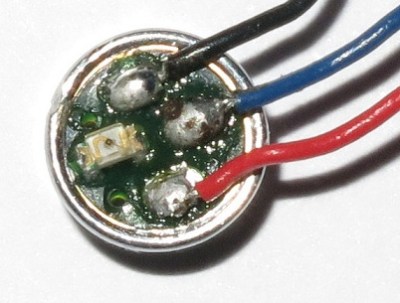
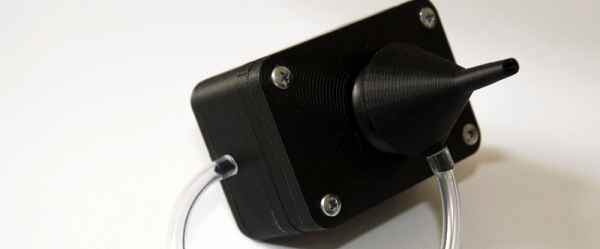
sip-sensor-from-ecigInstructions on Thingiverse can be spotty, but [0_o] did an excellent job of laying out what you need to buy and how to assemble it. One of the most interesting parts of the build is the blow sensor. [0_o] tore apart a $5 electronic cigarette and used the sensor within. The mouthpiece is moved like a joystick to actuate the cursor, and the user blows into it for the mouse clicks. Perhaps not a true sip-and-puff system but it made us wonder what other uses you might find for these sensors.

You can see a video about the mouse after the break. These kinds of projects have the power to make someone’s life better and what could be better than that?

Continue reading “$20 Sip-and-Puff Mouse From E-Cig And 3D Printing” →

Reverse Engineering The ARM ALU

[Dave] wanted to learn more about the ARM architecture, so he started with an image of the ARMV1 die. If you’ve had some experience looking at CPU die, you can make some pretty good guesses at what parts of the chip have certain functions. [Dave], however, went further. He reverse engineered the entire ALU–about 2,200 transistors worth.

Continue reading “Reverse Engineering The ARM ALU” →

3D Printed Hydraulics

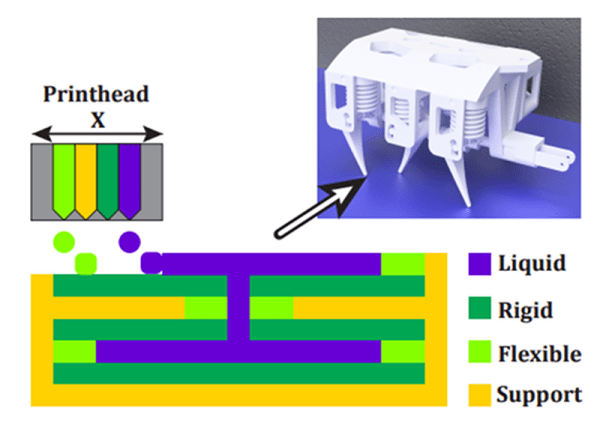
[Robert MacCurdy] at MIT wants to change how people think about hydraulics. Using fluid can be very useful in systems like robots, but it is often the case that the tubing that carries hydraulic fluid is not an integrated part of the overall design. [MacCurdy] and his colleagues have modified a 3D printer to allow it directly include hydraulic components as it prints.

The idea is simple. The team started with a printer that uses a liquid ink that is UV cured to produce solid layers. The printer has the ability to use multiple liquids, and [MacCurdy] uses hydraulic fluid (that does not UV cure) as one of the print materials. Just as you can use a 3D printer to build structures within other structures, printing the hydraulics allows for complex closed systems that use the UV-cured resin as mechanical parts that can transfer pressure to and from the hydraulic system.

Continue reading “3D Printed Hydraulics” →

SDR Pan Adapter

Ham radio operators have a long history of using pan adapters to visualize an entire range of the radio spectrum. Traditionally, an adapter was essentially a spectrum analyzer that shows a trace where the X-axis is the frequency, and the Y-axis shows the signal strength at any particular frequency. You can quickly find either busy frequencies or empty frequencies at a glance.

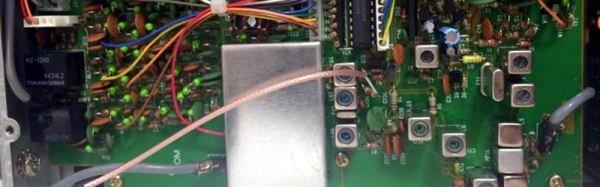
Although the pan adapter has been around since the 1930’s, they aren’t as common as you’d think with regular analog radios. However, if you’ve used an SDR (Software Defined Radio), a spectrum display is par for the course. [Mehdi Asgari] did what a lot of hams have been doing lately: he married an SDR and his traditional receiver to provide a great pan adapter with very little effort.

Continue reading “SDR Pan Adapter” →

Not Ready For FPGAs? Try A CPLD

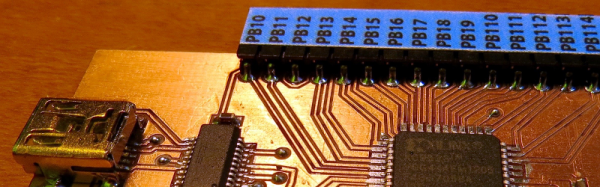
[Kodera2t]  wanted to experiment with programmable logic. Instead of going with an FPGA board, he decided to build his own CPLD (complex programmable logic device) board, with a built-in programmer. The CPLD is a Xilinx 9536 which is inexpensive and, though obsolete, still readily available. The programmer for the board uses an FT232RL and the total cost is very low ([kodera2t] says it is in the price range of a Raspberry Pi Zero or about $4).

From a user’s point of view, a CPLD is just a small FPGA. Internally, there is a significant difference in how they implement your design. Although there are differences between different product families, CPLDs usually use a sea of logic gates arranged as an AND/OR chain. By feeding inputs and inverted inputs into the AND gates and then ORing the results, you can build interesting logic circuits. However, modern CPLDs use Verilog or VHDL, so you describe what you want just like with an FPGA and the software figures out how to use the underlying circuits to give you what you want.

Continue reading “Not Ready For FPGAs? Try A CPLD” →

Reading Smart Cards From A PLC (with A Little Arduino Help)

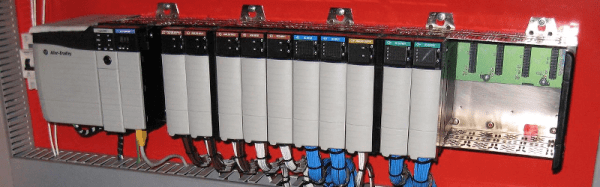
If you’ve spent any time on a factory or plant floor, it is a good bet you’ve run into PLCs (Programmable Logic Controllers). These are rugged computers that do simple control and monitoring functions, usually using ladder logic to set their programs. [plc4u] wanted to connect a smart card reader to an Allen Bradley PLC, so he turned to an Arduino to act as a go-between.

The Arduino talks to a USB card reader using a USB host shield. Then it communicates with the PLC using an RS232 link and the DF1 protocol that most Allen Bradley PLCs understand. You may not need a smart card, but once you know how to communicate between an Arduino and the PLC, you could do many different projects that leverage other I/O devices and code available on the Arduino and connects to existing PLC installations. Just remember that you’ll probably need to ruggedize the Arduino a bit to survive and be safe to the same level as a PLC (which might include a NEMA enclosure or even an explosion-proof box).

Continue reading “Reading Smart Cards From A PLC (with A Little Arduino Help)” →