Flying High With Zynq

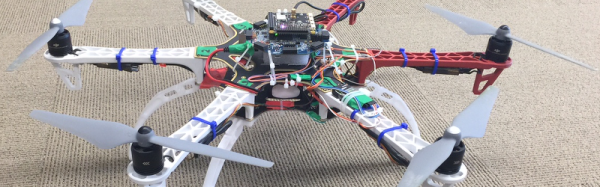
[Aerotenna] recently announced the first successful flight of an unmanned air vehicle (UAV) powered by a Xilinx Zynq processor running ArduPilot. The Zynq is a dual ARM processor with an onboard FPGA that can offload the processor or provide custom I/O devices. They plan to release their code to their OcPoC (Octagonal Pilot on a Chip) project, an open source initiative that partners with Dronecode, an open source UAV platform.

Continue reading “Flying High With Zynq”

Triple Frequency VFO On A Bamboo Breadboard

Historically when hams built low power (QRP) transmitters, they’d use a crystal to set the frequency. Years ago, it was common to find crystals in all sorts of radios, including scanners and handheld transceivers. Crystals are very stable and precise and it is relatively easy to make a high quality oscillator with a crystal and a few parts.

The big problem is you can’t change the frequency much without changing crystals. Making a high quality variable frequency oscillator (VFO) out of traditional components is quite a challenge. However, today you have many alternatives ranging from digital synthesis to all-in-one IC solutions that can generate stable signals in a wide range of frequencies.

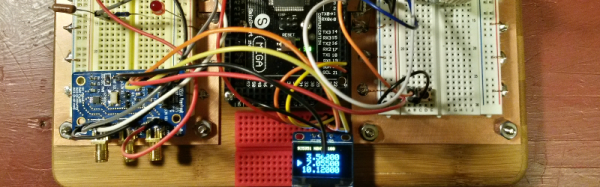
[N2HTT] likes to build radio projects and he decided to take an Si5351 clock generator and turn it into a three frequency VFO for his projects. The Si5351 uses a crystal, so it is very stable. However, you can digitally convert that crystal frequency into multiple frequencies over a range of about 8kHz to 160MHz.

Continue reading “Triple Frequency VFO On A Bamboo Breadboard”

Scratch Your Itch For 3D Modeling With BeetleBlocks

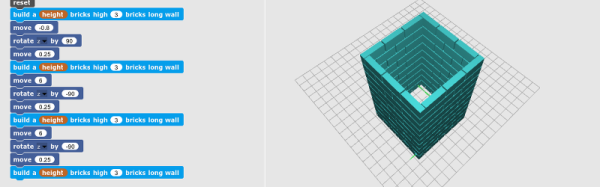
If you want to create a 3D model, you’ll probably either use a graphical CAD tool or a programming-based tool (like OpenSCAD). Although BeetleBlocks is graphical, it is more akin to OpenSCAD than a graphical CAD program. That’s because BeetleBlocks is–more or less–Scratch for 3D modeling.

Scratch is the graphical block-structured language developed by MIT for teaching kids to program. You may have seen Lego robots programmed with similar blocks as well as Android App Inventor. In this incarnation, the blocks control a virtual robot (the beetle) that can extrude a tube behind it as it moves. The beetle is reminiscent of the Logo turtle except the beetle moves in three dimensions. The system is actually closer to Snap, which is a reimplementation of Scratch that allows custom blocks.

Continue reading “Scratch Your Itch For 3D Modeling With BeetleBlocks”

Serial Data From The Web To An Arduino

In the old days, a serial port often connected to an acoustic coupler that gripped a phone handset and allowed a remote connection to a far away serial port (via another phone and acoustic coupler) at a blistering 300 baud or less. The acoustic coupler would do the job of converting serial data to audio and reconstituting it after its trip through the phone lines. Modems advanced, but have mostly given way to DSL, Cable, Fiber, and other high speed networking options.

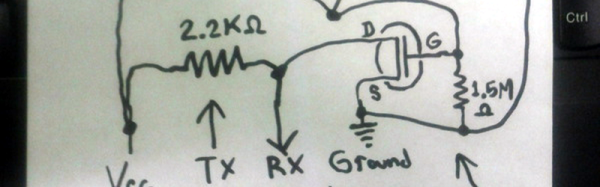
In a decidedly retro move, [James Halliday] and [jerky] put a modern spin on that old idea. They used the webaudio API to send serial data to a remote Arduino. The hack uses a FET, a capacitor, and a few resistors. They didn’t quite build a real modem with the audio. Instead, they basically spoof the audio port into sending serial data and recover it with the external circuitry. They also only implement serial sending (so the Arduino receives) so far, although they mention the next step would be to build the other side of the connection.

Continue reading “Serial Data From The Web To An Arduino”

What To Do With Old LCD Screens: Hack Your Own Electrochromatic Glass

There’s something decidedly science fiction-like about electrochromatic glass. A wave of a hand or a voice command and the window goes dark (or goes transparent). You can get glass like this today or you can add (pricey) film to existing glass, if you prefer.

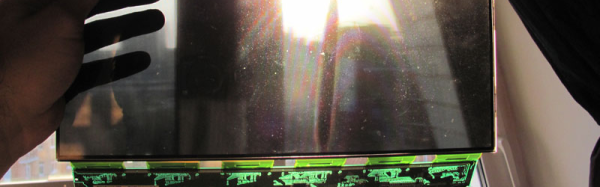
[Artem Litvinovich] thought about using LCDs as window panes twenty years ago, but the cost was, of course, prohibitive. He recently realized that he had easy access to LCDs out of broken laptops and decided to see if it would be useful as a small window.

Continue reading “What To Do With Old LCD Screens: Hack Your Own Electrochromatic Glass”

Open Source FPGA Pi Hat

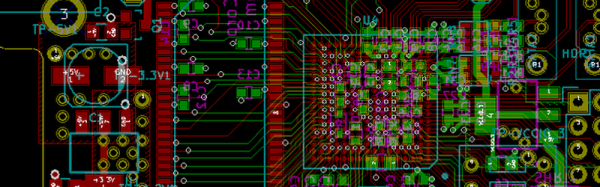
Over on Hackaday.io, [Dave Vandenbout] has posted the CAT board, a Raspberry Pi daughterboard hat that features a Lattice FPGA, 32 MB of RAM, EEPROM, and a few Grove and PMOD connectors. The CAT takes advantage of the open source tool chain available for Lattice including the Python-based MyHDL (although, you could just use Verilog directly, if you prefer) and Icestorm. One interesting point: you can run the tool chain on the Raspberry Pi, resulting in a self-contained and largely portable FPGA development environment.

Continue reading “Open Source FPGA Pi Hat”

FRDM-K22F ARM Board Doesn’t Have An SD Card Socket? Not So Fast!

The Freescale Freedom development boards come in several different flavors and at several different price points. It is pretty clear that Freescale counts up pennies to hit their desired target price. For example, the costlier boards with bigger processors (like the K64F which costs about $35) has sockets to fit an Arduino shield or other external connections. Many of the cheaper boards (like the KL25Z for $13) just has PCB holes. If you want to add sockets, that’s on you.

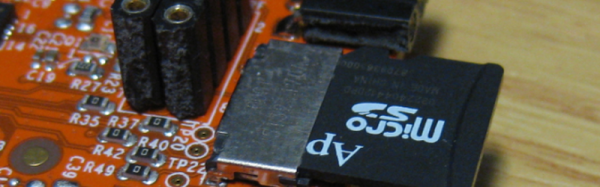
The $30 K22F board has the sockets, but it also omits a few components that are on the PCB. [Erich Styger] noted that there was a micro SD card socket footprint on the board and wondered if he could add an SD card to the board by just soldering on the socket. The answer: yes!

Continue reading “FRDM-K22F ARM Board Doesn’t Have An SD Card Socket? Not So Fast!”