Removing The Air Gap From An IPad Display

Some recent models of the Apple iPad have a rather annoying air gap in between the display and the outer touch surface. This can be particularly frustrating for users that press hard or use the Apple Pencil regularly. It is possible to eliminate this gap in the iPad 9, at least, as demonstrated by [serg1us_eng]. (Warning: TikTok)

Doing the job well takes some finesse, however, and plenty of fancy equipment. The iPad’s front touch glass was first covered to avoid scratches during the work, and then heated to 60 C to remove it. The display was also removed, with several glued-down ribbon cables having to be carefully pried off to avoid damage. A layer of transparent material was then cut to size to fit in the gap between the display and the front glass, with the stack laminated together. Getting this result without air bubbles or dust particles spoiling the result involved the use of a heated press and a clean room, which are now widely used in phone repair shops around the world.

For the average user, it might not be a big deal. For power users and touch-and-feel fanatics, though, there’s great appeal in an iPad without this annoying flaw. Video after the break.

Continue reading “Removing The Air Gap From An IPad Display”

Badminton String Winder Gets The Tension Just Right

If you want to keep your badminton game at its peak, you’ll need a good racket with a proper set of strings. When an injury kept [Antonie Colin] off the court for a few months, building a restringing machine helped pass the time.

The design is straightforward, using commonly-available motion components and 3D-printed parts. The round assembly at one end is used to hold the racket during the restringing process. A leadscrew mechanism driven by a stepper motor is used to apply tension to the strings, anywhere from 18 lbs to 34 lbs. Strings can also be prestretched if so desired. The stringing process is managed by an Arduino, which uses a loadcell to monitor tension placed on the strings. An LCD screen on the device provides feedback on the process and allows various functions to be selected. Flying clamps are used to hold strings in place during the process, either fitted from above or below the device as needed.

If you find yourself regularly restringing your badminton racket, or you simply don’t trust your local pro shop to do so, you might find this build useful. You might also like to build a shuttlecock launcher for training if your practice partners aren’t available on the regular. Our badminton department is looking rather bare at the moment, so don’t hesitate to send your own nifty hacks in to the tipsline!

Screech Owl Is A Tribute To The Eowave Persephone

The Eowave Persephone was a beautiful thing—a monophonic ribbon synth capable of producing clean, smoothly varying tones. [Ben Glover] used to own a nice example that formerly belonged to Peter Christopherson, but lost it in the shifting sands of time. His solution was to build one of his own from scratch.

It’s a simple build, but the final result puts out a nice pleasant sound.

Known as the Screech Owl, the build is based around a custom shield designed to suit the Arduino Leonardo. The primary control interface is a Softpot 500 mm membrane potentiometer, layered up with a further thin film pressure sensor which provides aftertouch control. The Leonardo reads these sensors and synthesizes the appropriate frequencies in turn.

All the electronics is wrapped up inside a tidy laser-cut enclosure that roughly approximates the design of the original Eowave device. [Ben] noted the value of services like Fiverr and ChatGPT for helping him with the design, while he also enjoyed getting his first shield design professionally manufactured via JLCPCB.

It’s a tidy build, and in [Ben’s] capable hands, it sounds pretty good, too. We’ve seen some other great ribbon controlled synths before, too. Video after the break.

Continue reading “Screech Owl Is A Tribute To The Eowave Persephone”

Nifty MIG Welder Built From Scrap

A MIG welder is a great tool to have. With machine fed wire and gas protecting the arc, it can make it easy to weld well without requiring a lot of manual skill from the operator. [PROFESSOR PARDAL BRASIL] decided to build his own MIG welder using scrap parts, and it’s an inspiring bit of work.

The build is along the lines of so many YouTube contraptions, using bits and pieces thrown together in oddball ways. A windscreen wiper motor is used to create a wire feeder, with jammed-up ball bearings acting as rollers. Speed control of the wiper motor appears to be via a variable resistor created by moving two plates closer together in a bath of salt water. This enables the wire feed rate to be easily controlled, albeit in a wet and messy fashion. The build includes a device for producing carbon dioxide for use as shielding gas, too. This is achieved by mixing a solution of water and bicarbonate soda with vinegar, and then pumping the resulting carbon dioxide into an inner tube for storage. The power supply for actually creating an arc comes courtesy of car batteries.

The resulting welder is janky as all heck, but it does successfully weld some steel plates together. Job done, as they say. Video after the break.  Continue reading “Nifty MIG Welder Built From Scrap”

Could Moon Dust Help Reduce Global Temperatures?

The impacts of climate change continue to mount on human civilization, with warning signs that worse times are yet to come. Despite the scientific community raising an early warning as to the risks of continued air pollution and greenhouse gas output, efforts to stem emissions have thus far had minimal impact. Continued inaction has led some scientists to consider alternative solutions to stave off the worst from occurring.

Geoengineering has long been touted as a potential solution for our global warming woes. Now, the idea of launching a gigantic dust cloud from the moon to combat Earth’s rising temperatures is under the spotlight. However, this very sci-fi solution has some serious implications if pursued, if humanity can even achieve the feat in the first place.

Continue reading “Could Moon Dust Help Reduce Global Temperatures?”

Robotic Mic Swarm Helps Pull Voices Out Of Crowded Room Of Multiple Speakers

One of the persistent challenges in audio technology has been distinguishing individual voices in a room full of chatter. In virtual meeting settings, the moderator can simply hit the mute button to focus on a single speaker. When there’s multiple people making noise in the same room, though, there’s no easy way to isolate a desired voice from the rest. But what if we ‘mute’ out these other boisterous talkers with technology?

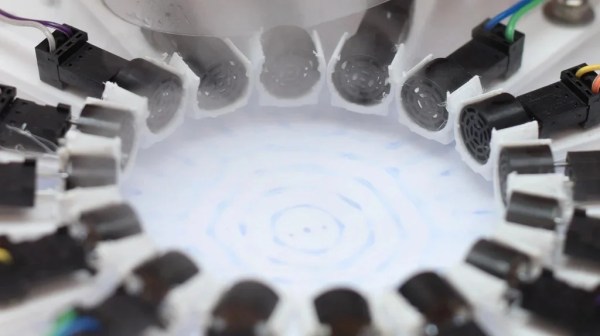
Enter the University of Washington’s research team, who have developed a groundbreaking method to address this very challenge. Their innovation? A smart speaker equipped with self-deploying microphones that can zone in on individual speech patterns and locations, thanks to some clever algorithms.

Continue reading “Robotic Mic Swarm Helps Pull Voices Out Of Crowded Room Of Multiple Speakers”

Why Walking Tanks Never Became A Thing

The walking tank concept has always captured imaginations. Whether you’re talking about the AT-AT walkers of Star Wars, or the Dreadnoughts from Warhammer 40,000, they are often portrayed in fiction as mighty and capable foes on the battlefield. These legged behemoths ideally combine the firepower and defense of traditional tanks with the versatility of a legged walking frame.

Despite their futuristic allure, walking tanks never found a practical military application. Let’s take a look at why tracks still rule, and why walking combat machines are going to remain firmly in the realm of fiction for the foreseeable future.

Continue reading “Why Walking Tanks Never Became A Thing”