Flashpen Is A High Fidelity Pen Input Device

Pen input has never really taken off in the computing mainstream, though it’s had somewhat of a renaissance in the last decade or so. Various smartphones and tablets are shipping with the technology, and some diehard users swear by it as the best way to take notes on the go. Recently, researchers at the Sensing, Interaction and Perception Lab at ETH Zurich have been working on Flashpen, a high-fidelity pen interface for a wide range of applications. 

The fundamental technology behind the pen is simple, with the device using an optical flow sensor harvested from a high-end gaming mouse. This is a device that uses an image sensor to detect the motion of the sensor itself across a surface. Working at an update rate of 8 KHz, it eclipses other devices in the market from manufacturers such as Wacom that typically operate at rates closer to 200Hz. The optical sensor is mounted to a plastic joint that allows the user to hold the pen at a natural angle while keeping the sensor parallel to the writing surface. There’s also a reflective sensor on the pen tip which allows cameras to track its position in space, for use in combination with VR technology.

The team show off the device being used in several ways, primarily in VR tasks, but also in simple handwriting and coloring work. It’s a project that could readily be replicated by any eager experimenter by gutting a gaming mouse and getting down to work; our writers will expect six of your submissions by June 1st to the tipsline. Those eager to learn more can check out the project paper, and may also find the team’s TapID technology interesting. Video after the break. Continue reading “Flashpen Is A High Fidelity Pen Input Device” →

Mining Bitcoin On The Nintendo Game Boy

Mining cryptocurrency is a power intensive business, with big operations hoarding ASIC rigs and high-end GPUs in an endless quest for world domination money. The Bitcoin-mining Game Boy from [stacksmashing] is one of them. (Video, embedded below.)

The hack is relatively straightforward. The Game Boy is hooked up to a PC via a Raspberry Pi Pico and a level shifter to handle the different voltage levels. The Game Boy runs custom software off a flash cart, which runs the SHA hash algorithm on incoming data from the PC and reports results back to the PC which communicates with the Bitcoin network.

[stacksmashing] does a great job of explaining the project, covering everything from the Game Boy’s link port protocol to the finer points of the Bitcoin algorithm in explicit detail. For the technically experienced, everything you need to know to recreate the project is there. While the Game Boy manages just 0.8 hashes per second, trillions of times slower than cutting edge hardware, the project nonetheless is amusing and educational, so take that into consideration before firing off hot takes in the comments below. If you’re really interested in the underlying maths, you can try crunching Bitcoin hashes with pen and paper.

Continue reading “Mining Bitcoin On The Nintendo Game Boy” →

Classic Triumph Gets A Modern Digital Dash

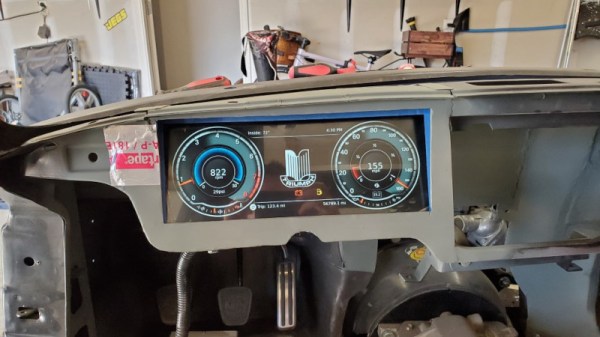
Analog gauges gave way to all manner of fancy electroluminescent and LED gauges in the ’80s, but the trend didn’t last long. It’s only in the last decade or so that LCD digital gauges have really started to take off in premium cars. [Josh] is putting a modern engine and drivetrain into his classic Triumph GT6, and realised that he’d have to scrap the classic mechanical gauge setup. After not falling in love with anything off the shelf, he decided to whip up his own solution from scratch.

The heart of the build is a Raspberry Pi 4, which interfaces with the car’s modern aftermarket ECU via CANBUS thanks to the PiCAN3 add-on board. Analog sensors, such as those for oil pressure and coolant temperature, are interfaced with a Teensy 4.0 microcontroller which has the analog to digital converters necessary to do the job. Display is via a 12.3″ super-wide LCD sourced off Aliexpress, with the graphics generated by custom PixiJS code running in Chromium under X.

The result is comparable with digital displays in many other modern automobiles, speaking to [Josh]’s abilities not just as a programmer but a graphic designer, too. As a bonus, if he gets sick of the design, it’s trivial to change the graphics without having to dig into the car’s actual hardware.

Gauge upgrades are common on restomod projects; another route taken is to convert classical mechanical gauges to electronic drive. If you’re cooking up your own sweet set of gauges in the garage, be sure to drop us a line! Video after the break.

Continue reading “Classic Triumph Gets A Modern Digital Dash” →

The Difference Between 4WD And AWD

Car manufacturers will often tout a vehicle’s features to appeal to the market, and this often leads to advertisements featuring a cacophony of acronyms and buzzwords to dazzle and confuse the prospective buyer. This can be particularly obvious when looking at drivelines. The terms four-wheel drive, all-wheel drive, and full-time and part-time are bandied about, but what do they actually mean? Are they all the same, meaning all wheels are driven or is there more to it? Let’s dive into the technology and find out.

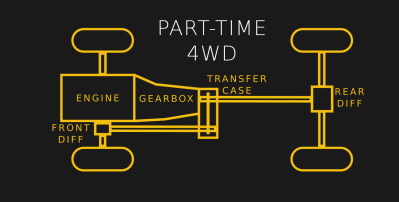
Part-Time 4WD

Part-time four-wheel drive is the simplest system, most commonly found on older off-road vehicles like Jeeps, Land Cruisers and Land Rovers up to the early 1990s, as well as pickup trucks and other heavy duty applications. In these vehicles, the engine sends its power to a transfer case, which sends an equal amount of torque to the front and rear differentials, and essentially ties their input shafts together. This is good for slippery off-road situations, as some torque is provided to both axles at all times. However, this system has the drawback that it can’t be driven in four-wheel drive mode at all times. With the front and rear differentials rotating together, any difference in rotational speed between the front and rear wheels — such as from turning a corner or uneven tyre wear — would cause a problem. The drive shaft going to one differential would want to turn further than the other, a problem known as wind-up.

Continue reading “The Difference Between 4WD And AWD” →

Sawblade Turned Beyblade Looks Painful To Tangle With

Beyblades were a huge craze quite some years back. Children battled with spinning tops in small plastic arenas, or, if their local toy stores were poorly merchandised, in salad bowls and old pie dishes. The toys were safe enough, despite their destructive ethos, by virtue of being relatively small and lightweight. This “Beyblade” from [i did a thing] is anything but, however. 

The build begins with a circular saw blade over 1 foot in diameter, replete with many angry cutting teeth that alone portend danger for any individual unlucky enough to cross its path. Saw blades tend to cut slowly and surely however, so to allow the illicit Bey to deal more traumatic blows, a pair of steel scraps are welded on to deliver striking blows as well. This has the added benefit of adding more mass to the outside of the ‘blade, increasing the energy stored as it spins.

With the terrifying contraption spun up to great RPM by a chainsaw reeling in string, it’s able to demolish cheap wood and bone with little resistance. Shrapnel is thrown in many directions as the spinner attacks various objects, from a melon to an old CRT TV. We’d love to see the concept taken further, with an even deadlier design spun up to even higher speeds, ideally with a different tip that creates a more aggressive motion across the floor.

As aggressive as this saw blade looks in action, not all are so scary. Even paper can do the job under the right conditions. Video after the break.

Continue reading “Sawblade Turned Beyblade Looks Painful To Tangle With” →

Pneumatic Actuator Made Out Of Lasercut Plastic

Pneumatics are a great solution for all kinds of actuators, and can even be used for logic operations if you’re so inclined. Typically, such actuators rely on nicely machined metal components with airtight rubber seals. But what if you did away with all that? [Richard Sewell] decided to investigate.

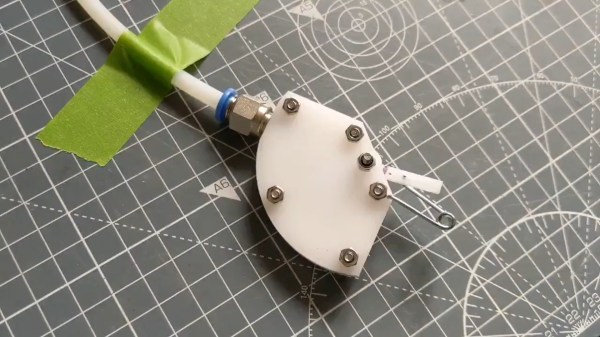
The result is a pneumatic actuator built out of lasercut acetal parts. The mechanism consists of of two outer layers of plastic acting as the enclosure, and a cut-out middle layer which creates the air chamber and houses the actuating arm itself. It’s a single-acting design, meaning the air can push the actuator one way, with a spring for return to the neutral position. The action is quite fast and snappy, too.

[Richard] aims to tweak the design further by improving the registration between the features of each layer and reduce the rubbing of the actuator’s rotor on the surrounding parts. If you’ve got the know-how, sound off in the comments. Alternatively, consider looking into soft pneumatics as well. Video after the break.

Continue reading “Pneumatic Actuator Made Out Of Lasercut Plastic” →