RC Lawn Mower Cuts With Impunity

Grass is a lovely thing to have, but unfortunately it tends to grow excessively long if left unattended. Obviously, one can use a regular lawn mower, but [Daniel] of [rctestflight] decided to build something remote-control instead. (Video, embedded below.)

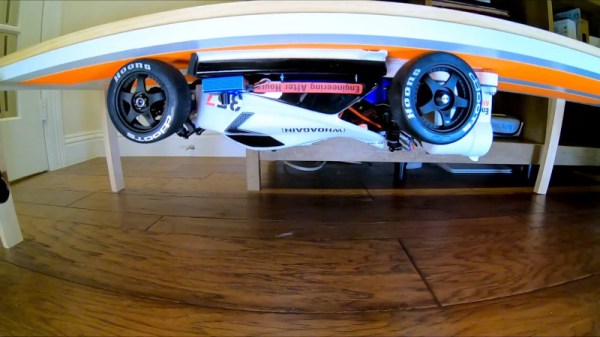
To get started, [Daniel] fitted X-acto blades to a brushless outrunner motor, and tested their ability to cut grass. Satisfied with the performance, he built a trailer to tow behind an RC tank mounted to such a setup, with some success. With the concept beginning to bear fruit, he went with a clean sheet design for maximum performance.

The final build relies on an RC rock-crawler chassis, fitted with a brushless motor using field oriented control for maximum torque at low speeds. This allows the RC mower to slowly push through the grass without overwhelming the cutter heads. As for the cutter heads, the final rig has eight motors, each sporting two blades to chop down long field grasses with impunity.

[Daniel] notes that it’s remarkably fun to cut the grass in this way, and is surprised not to have seen more builds in this area. (Editor’s note: he needs to read more Hackaday.) Of course, we’ve seen plenty of autonomous builds, too.

Continue reading “RC Lawn Mower Cuts With Impunity”

Micro:bit Put On Plant Minding Duty

The BBC has a long history of supporting technology education in schools. The BBC Micro introduced a whole generation of students to computers, and more recently the Micro:bit is teaching today’s children about embedded systems. [Michael Klements] happens to be a grown adult, but has whipped up a project using the little board to build an automatic plant watering system.

Rather than a simple timer-based system, [Michael’s] build measures soil moisture using a capacitive sensor. This has the benefit of not needing to be in direct contact with the soil as resistive sensors do, and thus the sensor can be built in a fashion that minimises corrosion. The Micro:bit reads this sensor using an analog input, and displays the moisture level using its inbuilt LED matrix as a graph. Once levels dip below a set threshold, a pump is activated to deliver water to the plant until the soil is suitably moist again.

It’s a simple project, but one that would be a great way to teach students about interfacing with pumps and sensors, as well as the basics of control systems. [Michael] also notes that further work could involve interfacing multiple Micro:bits using their onboard wireless hardware. We’ve thus far seen the Micro:bit used for everything from handheld gaming to gumball delivery. Video after the break.

Continue reading “Micro:bit Put On Plant Minding Duty”

Radio Controlled Hovercraft Apes The SR.N1

Hovercraft never really caught on as regular transportation, but they are very cool. The Saunders-Roe SR.N1 was the very first practical example of the type, and served as a research vehicle to explore the dynamics of such vehicles. [mr_fid] was looking for a lockdown project, and set about crafting a radio controlled replica of his own.

The build is crafted out of a canny combination of plywood and balsa, the latter substituted in sections within the plywood hull to save weight. A pair of brushless outrunner motors are mounted in the central duct to provide lift, fitted with counter-rotating propellers in order to avoid torque effects on handling. Steering is via puff ports a la the original design, which allows the craft to spin very quickly in place to much amusement and no practical effect. The skirt is of a colorful design, carefully assembled out of polyurethane-coated nylon.

While it’s not the quickest way to build a hovercraft, it’s all the more beautiful for its attention to the details and function of the original prototype craft. We particularly like the sharp handling thanks to the puff port design. If you’re looking for a weirder design however, consider this Coanda Effect build. Video after the break.

Continue reading “Radio Controlled Hovercraft Apes The SR.N1”

Mouse-Controller Hybrid Aims To Dominate In First-Person Shooters

The first person shooter genre found its feet in the PC world, relying on the holy combination of the keyboard and mouse for input. Over time, consoles have refined their own version of the experience, and the gamepad has become familiar territory for many FPS fans. [Tech Yesterday] was a die hard controller player, but after trying out  a mouse, didn’t want to go back. Instead, he built a truly impressive hybrid device.

The build begins with a standard Xbox 360 wired controller, somewhat of a defacto standard for PC gamepads. The left analog stick and triggers remain untouched, however the face buttons are all relocated using mechanical keyboard switches. The D-pad has been relocated to the left hand side with tactile switches, and the right analog stick removed entirely. In its place, a cut-down optical mouse is used on a flat 4″x4″ mousepad attached to the controller, strapped to the player’s thumb.

The resulting controller combines the benefit of analog stick movement and the precision aiming of a mouse. We’re amazed at how comfortable the controller looks to use, particularly in the improved second revision. While currently only used on PC, we can imagine such controllers shaking up the console FPS scene in a serious way.

We see some great controller hacks around these parts; the force-feedback mouse is a particularly amusing example. Video after the break.

Continue reading “Mouse-Controller Hybrid Aims To Dominate In First-Person Shooters”

SpaceX Starship Replica Attempts The Bellyflop

SpaceX are perhaps most well known for their vertically-landing reusable rocket technology. The latest such effort is the Starship, which recently underwent a fiery test in the last month to attempt a bellyflop maneuver. [Nicholas Rehm] wanted to attempt a similar flight profile in the local park, and set to building an RC Starship of his own.

The build is like a few we’ve seen before, in which electric power is used to propel a rocket-like craft straight upwards using propellers and active stabilization. In this case, there’s a pair of twin motors with counter-rotating propellers which can pivot to direct their thrust, as well as four external control surfaces. These are all under the command of [Nicholas]’s custom flight controller.

Upon testing the rig, [Nicholas] was able to execute a smooth ascent, followed by a bellyflop, before a smooth return to vertical flight and descent. Landing vertically on the grass was out of the question, due to the rough surface, but we imagine it would be doable with the right landing gear attached.

While flight without wings in this manner isn’t particularly efficient, it’s great to see what can be achieved with smart use of control systems engineering to keep a craft stable. We look forward to seeing [Nicholas]’s next attempts, too. Video after the break.

Continue reading “SpaceX Starship Replica Attempts The Bellyflop”

An Easy DIY Pedal Set For Racing Sims

The racing sim scene has always had a strong DIY subculture, as enthusiasts seeking the most realistic-feeling peripherals set out to modify off-the-shelf offerings for greater authenticity. Others go further and craft their own builds from the ground up. [ilge] has done just that, putting together his own set of pedals for sim racing.

The build relies primarily on 3D printed components, with a few springs and some nuts and bolts to hold everything together. Gear teeth on the pedal arms interface with matching gears mounted on potentiometers. These are then wired into an Arduino Pro Micro, which reads the individual pots via analog inputs and then acts as a USB Human Interface Device to the computer.

[ilge] tests the setup with a variety of games, including the popular Euro Truck Simulator and iRacing. It’s a great cheap way to get started with a pedal set for a sim rig. From here, the sky really is the limit; we’d love to see an upgraded version with a load-cell on the brake for better pedal feel. We’d be surprised if an H-shifter isn’t in the works, too. Video after the break.

Continue reading “An Easy DIY Pedal Set For Racing Sims”

Save Your Original Xbox From A Corrosive Death

Fans of retro computers from the 8-bit and 16-bit eras will be well aware of the green death that eats these machines from the inside out. A common cause is leaking electrolytic capacitors, with RTC batteries being an even more vicious scourge when it comes to corrosion that destroys motherboards. Of course, time rolls on, and new generations of machines are now prone to this risk. [MattKC] has explored the issue on Microsoft’s original Xbox, built from 2001 to 2009.

Despite looking okay from above, the capacitor inside the Xbox had already started leaking underneath. Leaving this in the console would inevitably cause major damage.

The original Xbox does include a real-time clock, however, it doesn’t rely on a battery. Due to the RTC hardware being included in the bigger NVIDA MCPX X3 sound chip, the current draw on standby was too high to use a standard coin cell as a backup battery. Instead, a fancy high-value capacitor was used, allowing the clock to be maintained for a few hours away from AC power. The problem is that these capacitors were made during the Capacitor Plague in the early 2000s. Over time they leak and deposit corrosive material on the motherboard, which can easily kill the Xbox.

The solution? Removing the capacitor and cleaning off any goop that may have already been left on the board. The fastidious can replace the part, though the Xbox will work just fine without the capacitor in place; you’ll just have to reset the clock every time you unplug the console. [MattKC] also points out that this is a good time to inspect other caps on the board for harmful leakage.

We’ve seen [MattKC] dive into consoles before, burning his own PS1 modchip from sourcecode found online. Video after the break.

Edit: As noted by [Doge Microsystems], this scourage only effects pre-1.6 Xboxes; later models don’t suffer the same problem, and shouldn’t be modified in this way.

Continue reading “Save Your Original Xbox From A Corrosive Death”