Reupholstering A Couch, With No Prior Experience

Upholstery is a craft that dates back far longer than many we feature on Hackaday. It requires patience, attention to detail, and a series of specialised skills. If you fancy yourself to be like a young Jack White, you might have considered trying your hand at a piece or two. [darkpine] did just that, and the results are impressive.

The couch was sourced from an online bartering platform, and was in a sad and sorry state after years of use. According to the original owner, the couch was over 100 years old and had been passed down through several generations. Last reupholstered in the 1970s, it was in dire need of repair. Wooden trim was falling off, fabric was fading, and resident cats had been sure to leave their mark.

[darkpine] set about things the right way, stripping the couch back to its bare bones. Taking careful note of the original construction, diagrams were made to ensure the springs could be retied in the correct fashion. Fresh burlap was installed, followed by foam and a layer of cotton batting. Careful attention was then paid to the fabric covering, with hand stitching used along the arms to get an absolutely perfect pattern match along the seams. With the hard part done, the wood was then restored and waxed to a glorious shine.

The final results are astounding, especially when noting that this was [darkpine]’s first ever upholstery project. We don’t see a lot of this kind of thing around here, but it’s not completely unknown.


[via Reddit]

This Two-Wheeled RC Car Is Rather Quick

Radio control cars have always been fun, it’s true. With that said, it’s hard to deny that true speed was unlocked when lithium polymer batteries and brushless motors came to the fore. [Gear Down For What?] built himself a speedy RC car of his own design, and it’s only got two wheels to boot (Youtube link, embedded below).

The design is of the self-balancing type – if you’re thinking of an angry unmanned Segway with a point to prove, you’re in the ballpark. The brains of the machine come thanks to a Teensy 3.6, which runs the PID loops for balancing and control. An MPU6050 gyroscope & accelerometer provide the necessary sensing to enable the ‘bot to keep itself upright in varied conditions. Performance is impressive, with the car reaching speeds in excess of 40 MPH and managing to handle simple ramps and bumps with ease. It’s all wrapped up in a 3D printed frame which held up surprisingly well to many crashes into tripods and tarmac.

Such builds are not just fun; they’re an excellent way to learn useful control skills that can serve you well in industry and your own projects. You can pick up the finer details of control systems in a university engineering course, or you could give our primer a whirl. When you’ve whipped up your first awesome project, we’d love to hear about it. Video after the break.

Continue reading “This Two-Wheeled RC Car Is Rather Quick” →

PocketPi Is Exactly What It Sounds Like

The Raspberry Pi line of single-board computers are remarkably useful things, but they generally require some accessories to be hooked up to become a useful computing platform. [Ramin Assadollahi] wanted a pocket-sized computer to work on without the distractions so common on smartphones, so whipped up the PocketPi to do the job.

It’s a testament to the popularity of the Raspberry Pi platform that [Ramin] was able to put this project together with so many off-the-shelf parts. A Pi Zero W was chosen for its compact size, while a HyperPixel 4.0 screen was chosen for its high resolution in a small package. These parts were combined with a 3000 mAh battery, Adafruit Powerboost 1000C and a small USB keyboard and hub. It’s all wrapped up in a tidy 3D printed package, giving the pocket-sized computer a classic late-1980s look, albeit with much more horsepower under the hood.

It looks like a fun and useful machine to have when out and about, and the full QWERTY keyboard makes input easy. We’ve seen [Ramin]’s work before – with last year’s StickPi implementing an e-paper display. Video after the break.

Continue reading “PocketPi Is Exactly What It Sounds Like” →

Air Compressor From Fridge Parts Gets An Upgrade

Air compressors are often loud, raucous machines – but they don’t have to be. [Eric Strebel] built a remarkably quiet compressor using parts salvaged from an old fridge. After several years of use, it was due for an upgrade (Youtube link, embedded below}.

While performance of the original setup was good, [Eric] desired a compressor with more capacity for his resin casting activities. A 15 gallon air tank was sourced from a damaged Craftsman brand compressor, and pressed into service. The build involved plenty of sheet metal work to mount the various components, as well as an upgrade to the pressure regulator.

During the refit, [Eric] takes the time to answer questions from the audience about his original build. He notes that the fridge compressor has worked well without using any noticeable amount of oil, and that there was a problem with water build up in the original tank which has been solved in the new rig.

It’s a great example of building your own tools, which can provide years of service if done right. Check out our write up on [Eric]’s first build, or his work on photogrammetry. Video after the break.

Continue reading “Air Compressor From Fridge Parts Gets An Upgrade” →

An Open Source ESC For Brushless Motors

For something basic like a brushed DC motor, speed control can be quite simple, and powering up the motor is a simple matter of just applying voltage. Brushless motors are much more demanding in their requirements however, and won’t spin unless driven just right. [Electronoobs] has been exploring the design of a brushless speed controller, and just released version 1.0 of his open-source ESC design.

The basic design is compact, and very similar to many off-the-shelf brushless ESCs in the low power range. There’s a small PCB packing a bank of MOSFETs to handle switching power to the coils of the motor, and a big capacitor to help deal with current spikes. The hacker staple ATMEGA328 is the microcontroller running the show. It’s a sensorless design, which measures the back EMF of the motor in order to determine when to fire the MOSFETs. This keeps things simple for low-torque, low-power applications.

It’s a tidy build, and the latest revision shows a lot of polish compared to the earlier prototypes. If you’re interested to learn more, try building it yourself, or consider building a thrust testing rig for your bench at home. Video after the break.

Continue reading “An Open Source ESC For Brushless Motors” →

Emotigun Sends A Stinging Message

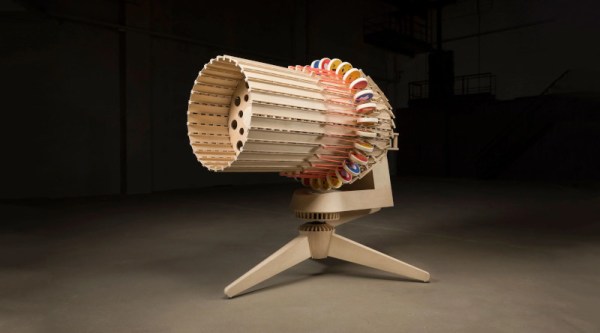
Emojis, the graphical descendants of textual emoticons, are everywhere these days. They’re commonly used on social media platforms as a way of indicating a basic emotional response to a post. That wasn’t enough for [Tadas Maksimovas], who built the Emotigun to really get the point across.

Fundamentally, the Emotigun is akin to a Gatling cannon for small foam emojis. Firing over ten rounds per second, it’s built primarily out of wood, using Precise anti-cold rubber bands to fling its ammunition at targets. This was a practical choice, as the original Thera-Band green rubber tubes became inelastic in the cold temperatures of the testing environment. The finer details of the build are laid out in a document for those eager to know more.

The build was a team effort, with many pitching in, and even [Jorg Sprave] lending his expertise to the build. Given [Jorg]’s expertise, we’re not surprised the final result is so impressive. Reports are that filming the machine in action was quite an ordeal, with [Tadas] taking over 200 rounds to the face during the course of the shoot. Video after the break.

Continue reading “Emotigun Sends A Stinging Message” →

LED Panel Lamp Is A Great Way To Use Protoboard

It’s now possible to source chip-on-board LED modules that have huge light output in a simple, easy to use package. However they can have major power requirements, and cheaper modules are also susceptible to dead spots.  [Heliox] put together a great LED lamp design the old-school way, showing there’s more than one way to get the job done.

Standard SMD LEDs are the order of the day here. The LEDs are laid out on protoboard in neat rows, making them easy to solder in place. This also makes power distribution a cinch, with the copper traces carrying the power to each row. Power is courtesy of 18650 lithium batteries installed in the back of the 3D printed housing. A GoPro-style mount is printed as part of the case, allowing the lamp to be easily mounted in a variety of ways.

It’s a quick, cheap and easy way to build a versatile LED lamp. With a diffuser installed and integrated USB charging, we could see this making an excellent portable device for on-the-go videographers or technicians. We’ve seen [Heliox]’s LED creations before, too. Video after the break.

Continue reading “LED Panel Lamp Is A Great Way To Use Protoboard” →