LED Jewelry Makes Neat Use Of Brass

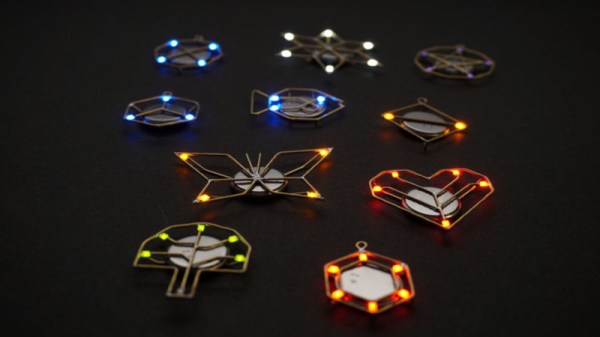
Wearable electronics can be both fun and fashionable. However, there are certain challenges involved in neatly integrating electronic components in a way that is both functional and comfortable for the wearer. In this vein, [Jiri Praus] has managed to create some glowing earrings that are remarkably simple to boot.
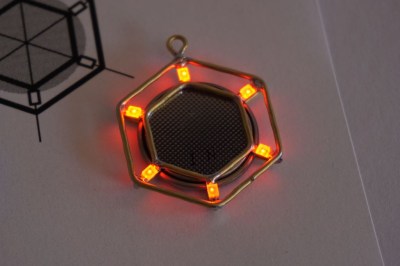
The body of the earring also acts as the conductor and battery holder, all in one.

The earrings start out with brass rod, bent with pliers and soldered at the ends. By following a paper template, it’s possible to get neat and accurate bends by hand, which is necessary to make a matching pair. Through careful design, the brass rods are soldered to the LEDs, and more rod is then used to create an integrated holder for a coin cell battery, which powers the lights.

Thanks to [Jiri]’s smart designs — which we’ve featured before in the form of a blooming wireframe tulip — no wires are needed. The brass rods which make up the body of the jewelry also act as the conductors to pass current to the LEDs. The internal resistance of the coin cell battery also eliminates the need for an in-line resistor. In combination, this serves to create a simple and attractive finished product that should shine for several hours.

We’ve seen other LED earring designs before, too. There are plenty of ways to experiment with glowing jewelry, and if you’ve done something novel, be sure to let us know.
Video Doorbell Focuses On Quality, Aesthetic

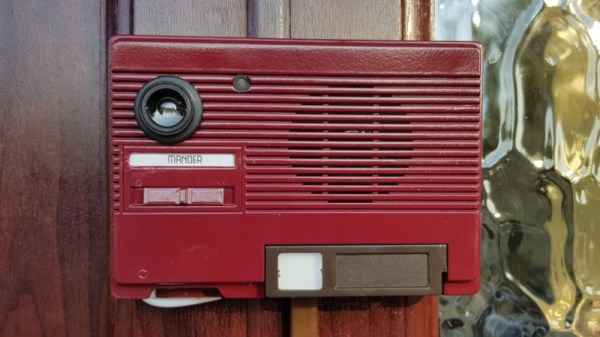
One of the most popular futurist tropes of the 20th century was the video intercom. Once this technology was ready, it would clearly become a mainstay of modern living overnight. Our lived reality is however somewhat different. For [MisterM], that simply wouldn’t do, so he set about producing a retro-themed video doorbell that is sure to be the envy of the neighbourhood.

Not one to settle for second best, [MisterM] wanted to focus on quality in video and sound. A Microsoft LifeCam 3000HD handles video and audio capture, with a Raspberry Pi 3B+ providing plenty of grunt to run the show. The Pimoroni pHAT BEAT add-on provides audio output. It’s all integrated into a 1980s vintage intercom, which is painted a deep shade of maroon for an extra classy look. Further parts are integrated into a classic Sony tape deck, with LEDs shining out from under the cassette door for added visual appeal.

The doorbell works by making calls to Google Duo, which allows the user to answer the door from anywhere in the house, or indeed – anywhere with an Internet connection! [MisterM] reports this has already proved useful for communicating with couriers delivering packages to the house. There’s also a standard wireless doorbell and chime integrated into the unit which alerts those within the house in the usual way.

It’s a project that is both highly functional and looks particularly swish. Integrating new brains into old-school enclosures is a great way to give your project a cool look. These aircraft surplus clocks are a great example. Video after the break.

Continue reading “Video Doorbell Focuses On Quality, Aesthetic” →

Modular CNC Build Gets You Both A Mill And A Laser Cutter

CNC builds come in all shapes and sizes. There’s delta manipulators, experimental polar rigs, and all manner of cartesian builds, large and small. After completing their first CNC build, [jtaggard] took what they learned and applied it in the development of a new machine.

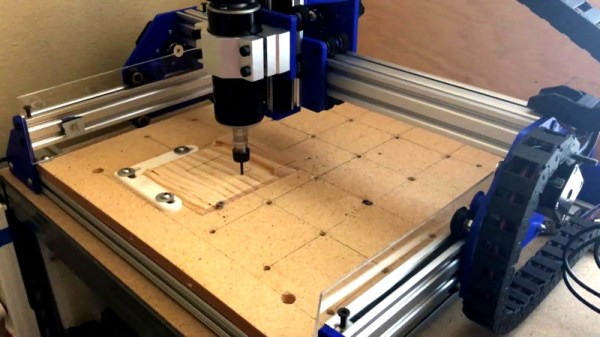
It’s a desk-sized cartesian design, with a frame built from V-slot extrusion cut to size by circular saw. This is a great way to get quality extrusion for a custom build, and is readily available and easy to work with. The gantry rides on wheels, with the X and Y axes being belt driven, plus a screw drive for Z. A couple of NEMA 17s and a NEMA 23 provide motive power, and an Arduino Uno with stepper drivers is the brains of the operation. 1/4″ thick PLA plates are used to assemble everything, and while [jtaggard] intended to replace these with aluminium down the track, so far the plastic has proved plenty rigid enough for early tests of both machining and engraving wood.

It’s a great entry-level CNC build, which has proved usable with both a 500W spindle and a 2.5W laser for engraving. Being modular in nature, it would be easy to add other tools, such as a pen plotter or vinyl cutting blade for further versatility.

DIY CNC builds are always popular, as you end up with a useful tool as a reward for your hard work. Video after the break.

Continue reading “Modular CNC Build Gets You Both A Mill And A Laser Cutter” →

Better Debating Through Electronics

Watch any news panel show these days, and you’ll see that things can very quickly become unruly. Guests compete for airtime by shouting over one another and attempting to derail their opponent’s talking points. [cutajar.sacha] had encountered this very problem in the workplace, and set about creating a solution.

The result is the Debatable Deliberator, and it combines the basics of “Talking Stick” practices with behavioural training through humiliation. Two participants each wear a headband, fitted with electronics. The holder of the magic ball may speak for as long as the timer counts down. If their opponent speaks during this time, their headband reprimands them with gentle slapping to the face. If the holder speaks over their assigned time, they are similarly treated to mechanical slapping.

It’s an amusing way to help police a discussion between two parties, and it’s all made possible with a trio of WeMos D1 ESP8266 boards. The headbands act as clients, while the ball acts as a server and keeps track of how many times each speaker has broken the rules.

WiFi projects such as this one have become much easier in the past few years with the wide availability of chips like the ESP8266. Of course, if you need more grunt, you can always upgrade to the ESP32.

Continue reading “Better Debating Through Electronics” →

3D-Printed Mobius Strip Of Gears

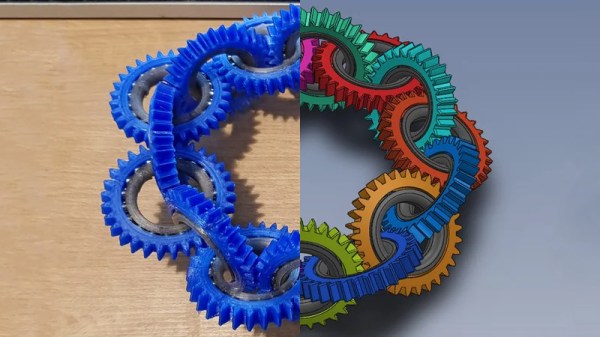
Exploring the mathematics behind everyone’s favourite unorientable single-sided surface can be quite the mind-bending exercise, so it’s nice that it’s so easy to make a Mobius strip out of paper and a single piece of tape. That demonstration was far from enough for [elmins]. who printed this Mobius strip of gears. The teeth fit together, and all the gears move, but there is still only one side and one edge (we think).

This animation helped spawn the project.

The idea to tackle the project came from seeing an animation of Mobius gears. Wondering if it would be possible to actually create such a thing, [elmins] got to work. The design is printed in 60 pieces, 30 each for the inner and outer parts. The entire assembly is printed in PETG, an unconventional choice but by no means unsuitable. 285 ball bearings help the rings rotate.

The gears use a standard involute bevel profile, though [elmins] suspects this could be an area of further optimisation. The parts were printed in an orientation to ensure the print lines run around the races, allowing for minimal finishing and smooth rolling of the bearings. This is a good study of just what can be achieved with some smart modelling and perseverance.

If you’re thirsty for more madcap machining, consider exploring the concept of the Reuleaux triangle bearing.

Build A Sprint Race Timer To Help Your Training

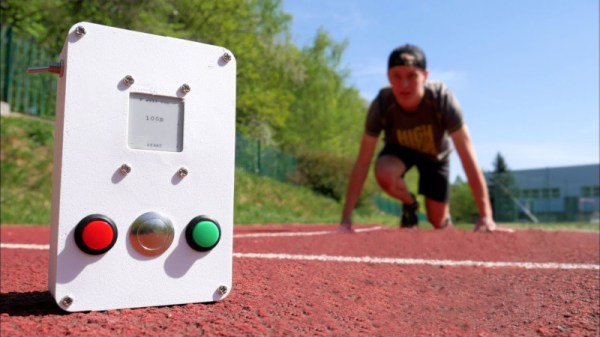
Any exercise is a positive thing, but if you’re looking to improve over time, you’ve got to measure your performance. [Nikodem Bartnik] is a runner and is looking to improve his sprinting abilities. Naturally, an Arduino is the perfect companion to help in this quest (YouTube link, embedded below).

The Arduino is built into a 3D printed enclosure, with several buttons for input. Rather unconventionally, a small e-paper display was chosen for the interface. This has the benefits of being easily readable outdoors during the day, as well as using very little power.

The device is simple to use, and makes training alone a breeze. The distance to be run can be selected, and the unit emits a series of beeps to indicate to the runner when to begin. The timer is placed at the finish line, and detects the runner passing by with an ultrasonic sensor.

It’s a useful build for sprint timing, and could be made even more versatile with a remote start function. If you need to time Hot Wheels instead of sprinters, don’t worry – there’s a build for you too. Video after the break.

Continue reading “Build A Sprint Race Timer To Help Your Training” →

Repairing And Upgrading A HP 16533A Scope Card

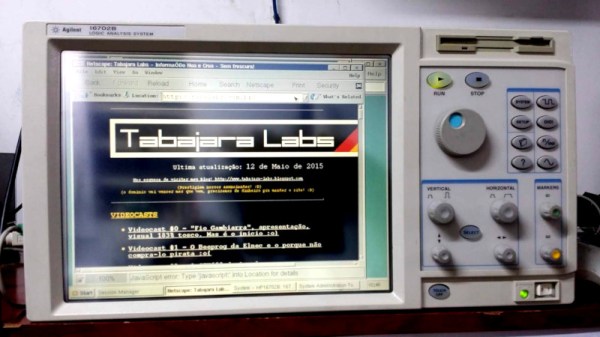
In the world of oscilloscopes, as in the rest of the test equipment world, there’s always some trickery afoot. Companies will often offer different models to the market at different price points, in an effort to gain the widest possible customer base while also making the most profit. Cheaper, less capable models are often largely identical to more expensive hardware, save for some software or a couple jumpers that disable functionality. [Alexandre] found just this when working to repair his HP 16533A scope card.

Work began when [Alexandre] received his HP 16533A in the mail after a long wait, only to find the trigger functionality was inoperable. This is crucial on a digital scope, so this simply wouldn’t do. After some research online, a post was found discussing which signals to probe to troubleshoot the issue. It noted that corrosion is a common problem on these units, and that occasionally, a certain resistor goes open circuit and causes problems. Initial measurement showed there was still resistance there, but reading closer, [Alexandre] noted this fateful line:

You might not be able to measure it accurately in circuit. 

Removing the 100K resistor from the board, the part was indeed open circuit. After replacement with a new component, the trigger circuit was again fully operational. With the scope still open, it was then a simple job to execute a further resistor swap which gives the 16533A the functionality and range of the higher-spec 16534A model.

It’s very common for oscilloscopes and other test hardware to be configured this way from the factory. Rigol scopes are particularly popular with hackers for this very reason.

[Thanks to jafinch78 for the tip!]