A Quite Obscure C128 Video Mode Hack

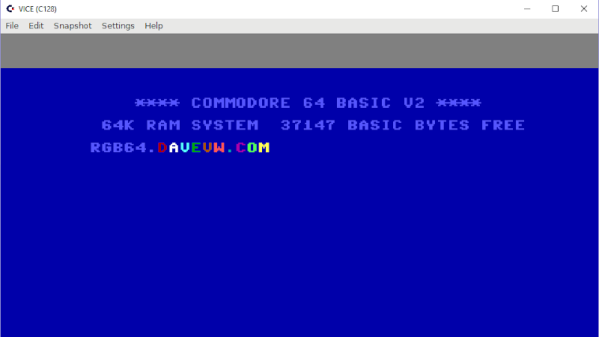
30 years ago, [Dave] found himself up a C128D creek without a paddle. His main monitor was on the fritz, and he needed to use his C128D in 40-column mode to run old C64 programs for development purposes. Normally this is only possible through the low quality composite out, but no composite monitor was available. Needs must, so he got to coding a workaround that would allow the C128D to output in 40 column mode through the higher-quality RGBI output. 

It’s a proper old-school hack in the spirit of the 8-bit era. The C64 ROM is copied into RAM, where it’s then modified to instead update a 40-column image that’s sent to the RGBI display hardware. The original C64 character ROM is also copied over to ensure everything displays correctly.

It’s not bulletproof, and a few pokes to the wrong memory locations have a high likelihood of crashing the system, seeing as the ROM is now in RAM. However, it does allow the user to enable FAST mode and use all the C128 extended keys. [Dave] recommends experimenting in an emulator first, lest you scare your vintage monitor with angry signals it can’t understand.

The C128 was Commdore’s last 8-bit computer on the market, and there’s a heck of a story behind its creation.

Supercapacitors Propel Rocket To The Skies

OK, so this isn’t really a rocket. In the strictest definition, rockets are vehicles or projectiles that propel themselves through jettisoning mass, usually through the combustion of fuel. But with electric motors getting stronger and stronger, folks are building craft that look a lot more like rockets than airplanes. [Tom Stanton] is one such person (Youtube link, embedded below).

We’ve seen “electric rocket” builds before, but where others have used lithium batteries, [Tom] has used supercapacitors instead. Six supercaps are installed in a 3D printed mount, and supply power to a 500 W brushless outrunner motor which gives the rocket the thrust to climb into the sky.

In testing, [Tom] estimates the rocket was able to reach an altitude of approximately 60 m, or 200 ft. That’s not particularly astounding, but it does prove that supercaps can run a high current load in a real world situation. Additionally, their fast recharge rate allows [Tom] to make a repeat flights in just about the time it takes to repack the parachute. Video after the break.

Continue reading “Supercapacitors Propel Rocket To The Skies” →

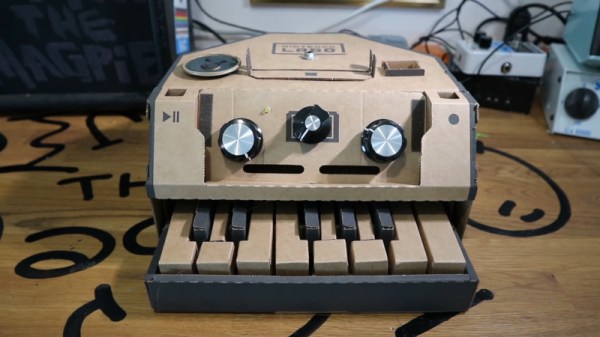
Nintendo’s Cardboard Piano Becomes A Real Working Instrument

Nintendo’s LABO piano is a strange kind of instrument. Hewn out of cardboard and used in combination with some advanced software, it’s entirely passive, with all the sound generation and smarts coming from the Switch console which slots into the body. [Simon the Magpie] decided that this simply wouldn’t do, and set about turning the LABO piano into a real synthesizer (Youtube link, embedded below).

In order to pull off this feat, [Simon] sourced an OKAY synth kit– a basic monophonic synthesizer designed to fit inside a 3D printed case. Instead, here it’s built inside the LABO’s roomy cardboard housing. The keyboard is reinforced with duct tape and tweaked to accept those common and horrible red SPST buttons, and the front panel is fitted with control dials where the Switch would usually sit.

After some careful crafting, the piano is ready to rock. It’s not the most responsive instrument, with the flexible cardboard struggling to reliably trigger the installed buttons, but it does work. [Simon] performs a small instrumental piece over a drum track to demonstrate that you don’t need a Nintendo Switch to have fun with the LABO piano.

Expect to see similar builds on stage at chiptune shows in the next few years – at least until mold gets the better of them. There are other ways to hack the LABO piano, too. Video after the break.

Continue reading “Nintendo’s Cardboard Piano Becomes A Real Working Instrument” →

3D Printed Weather Station Gets A Wireless Upgrade

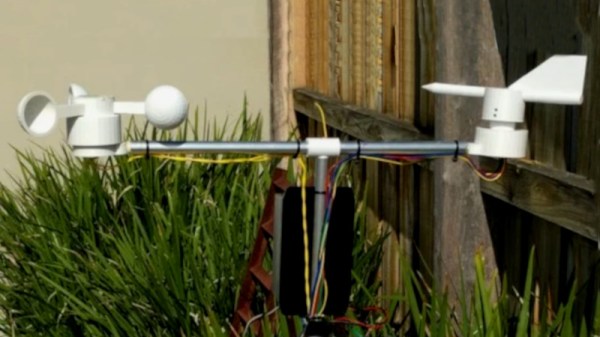
A weather station can be anything from a fun home science exercise, all the way up to a useful tool for planning and weather prediction. [Rob Ward] is one such person who has developed their own weather station, and it recently got a wireless upgrade.

We first featured [Rob]’s work back in 2018, noting that a largely 3D-printed weather station was a particularly useful tool for the home experimenter. The utility of this is now improved, with the addition of a 433 MHz wireless link from the weather sensors back to the base station. Over on Github, [Rob] does a great job of explaining the basics of the Manchester encoding scheme used, and has developed a system that can decode signals from Oregon Scientific weather stations, too.

[Rob] uses the weather station to report weather conditions at Lake Tyers Beach, providing useful information for anyone in the area who might be considering a visit to the coast. It’s not quite as fun as asking whoever’s around on the CB road channel, but it’s a darn sight more accurate for your trouble. Video after the break.

Continue reading “3D Printed Weather Station Gets A Wireless Upgrade” →

How To Build A Small Metal Furnace At Home

Casting is a great way to make your own custom metal parts. However, casting requires some manner of furnace capable of generating high enough temperatures to melt the metal in question. Few of us have these just lying around, but never fear. It’s possible to build a basic gas-powered furnace at home, with commonly available materials (Youtube link, embedded below).

This furnace is the work of [Ahmed Ghr], and is as simple a build as they come. The idea is to produce a mold in which to cast concrete to create the furnace. A steel bucket is cut up and used as the outside of the mold, with a pipe inserted in the base to act as a feeder for air and gas. A plastic bucket is then inserted within the steel bucket and held in place with spacers, to create the inner combustion cavity. Concrete is poured in and allowed to set. Once finished, the steel bucket is cut away, and a fire is built over the furnace to melt away the plastic inside. Similar techniques are used to produce the lid, and the furnace is completed.

It’s a build that is executed with the most basic of tools, and should serve as a capable furnace for lower melting point metals at the very least. We’ve seen a lot of cement projects lately, as it turns out. Video after the break.

Continue reading “How To Build A Small Metal Furnace At Home” →

Rotary Phone Gets Bluetooth Upgrade

Rotary dial phones have a certain romantic charm about them; something never quite captured in the post-Touch Tone era. With landline phone services less popular than ever, these old workhorses aren’t really cut out for daily use anymore. However, with a modern brain transplant, they can still get the job done just fine.

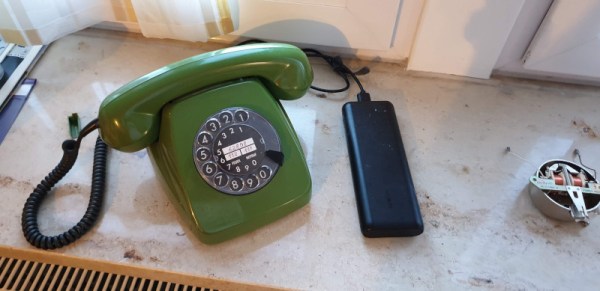
[Xabier Zubizarreta] has undertaken to retrofit his FeTAp-611 rotary phone with a Bluetooth rig, allowing it to be used with smartphones to place and receive calls. A Raspberry Pi Zero W serves as the brains of the operation, chosen for its compact size and onboard Bluetooth and WiFi. Getting the Pi to work effectively with an Android phone as a Bluetooth audio device requires some trickery, but it’s nothing that can’t be fixed by custom compiling a few off-the-shelf tools. [Xabier]’s next big hurdle is finding a tidy way to generate a 30 VAC signal to drive the original ringer, something that proves difficult for most similar projects.

We love to see these telecommunication relics kept ticking, so if you happen to be building a vintage telephone exchange in your garden shed – be sure to let us know.

A Mainframe Tape Drive Emulator

Retro computer fans come in all shapes and sizes. Some like the big name machines from the dawn of the home computer era, others like collecting quirky pieces like early laptops and handheld devices. Even more obscure are those who choose to collect old mainframe hardware. This can be challenging, due to its relative obscurity and the limited resources available. [skaarj] is just one such fanatic, however, and has begun creating a PERTEC tape drive emulator for his Cold War era mainframe.

For those of us who didn’t work in industrial computing back in the 1980s, the PERTEC interface is an unfamiliar beast. It became somewhat of a defacto standard for connecting tape drives to mainframes. [skaarj] aims to understand and emulate this interface, creating a device with a full suite of capabilities. The PERTEC Whisperer is intended to be capable of reading and writing from PERTEC tape drives, including dumping tapes to an integrated SD card. The device will also be able to emulate a drive when connected to a mainframe.

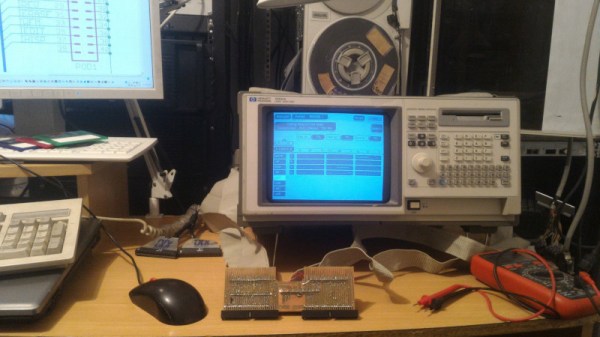
Thus far, the adventure has already netted some successes. [skaarj] learned useful tricks, like rewinding a 9-track Qualstar 1260 with VHS tape, and how to pull apart the protocols involved using an old-school HP1662 logic analyzer. We can’t wait to see where the project goes next, and it might just have us hunting for a mainframe to call our very own.