Stalking Last.fm Streams On Spotify

Back in the early days of social media and Web 2.0, Last.fm was one of the premier music sites on the internet. With a huge library containing what felt like every song ever, along with an excellent algorithm for recommending new tracks, it quickly gained a large following. Unfortunately, its business model and following changed over the years, but there’s still a diehard userbase. [Hexalyse] was unhappy with Spotify’s algorithms, so built a tool to allow her to shadow what Last.fm users were listening to in real time.

Last.fm’s major feature is that it allows you to tell others what you’re listening to, by “scrobbling” your tracks as you play them. It’s possible to scrape this live data from any user via the Last.fm API, making the project possible. [Hexalyse] whipped up a Python script to query a selected user’s current playing track via Last.fm, before then handing the song data to the Spotify API to play the music locally.

It’s a fun way to find new music, relying on human taste rather than a pile of data center algebra. [Hexalyse] has uploaded the code to Github if you’re eager to try it for yourself. Of course, you get bonus points if you integrate it with Spotify on the Macintosh SE/30.

Driving A Controllerless LCD With The Humble Arduino Uno

These days, you could be forgiven for thinking driving an LCD from a microcontroller is easy. Cheap displays have proliferated, ready to go on breakout boards with controllers already baked in. Load up the right libraries and you’re up and running in a matter of minutes. However, turn your attention to trying to drive a random LCD you’ve yanked out of a piece of old equipment, and suddenly things get harder. [Ivan Kostoski] was in just such a position and decided to get down to work.

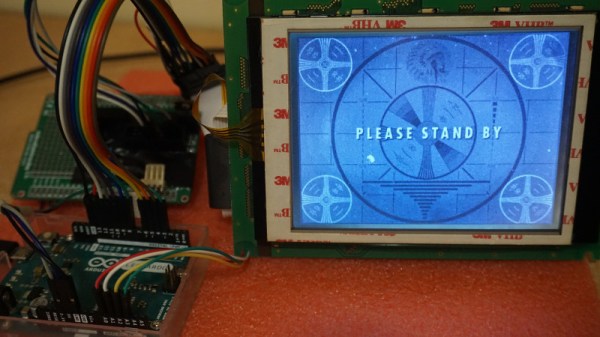
[Ivan]’s LCD was a 320×240 STN device salvaged from an old tape library. The display featured no onboard controller, and the original driver wasn’t easily repurposed. Instead, [Ivan] decided to drive it directly from an Arduino Uno.

This is easier said than done. There are stringent timing requirements that push the limits of the 8-bit platform, let alone the need for a negative voltage to drive the screen and further hardware to drive the backlight. These are all tackled in turn, with [Ivan] sharing his tips to get the most flexibility out of the display. Graphics and text modes are discussed, along with optimizations that could be possible through the varied use of available RAM and flash.

The code is available on Github. If you need inspiration for your own controllerless LCD driver. [Ben Heck] has done similar work too, using FPGA grunt to get the job done.

Model Car Indicates Door Is Ajar

The amount of technology in modern cars is truly staggering. Heated seats, keyless entry, and arrays of helpful cameras are all becoming increasingly common in all but the cheapest of models. [mathisox] drives a slightly older Volkswagen van, which has been converted into a camper. Unfortunately, it lacks a proper door ajar display. Nevermind that, though – there’s a charming solution to this problem.

Rather than stick to the automotive standard of boring indicator lights and low-resolution LCD displays, [mathisox] took a more analogous approach. A small model car matching his van was sourced and quickly gutted for the project. It was then fitted with servos to open and close the doors and rear hatch. The servos are controlled by an Arduino Nano, which reads the door switches in the vehicle and actuates the appropriate parts on the model.

With the model car stuck prominently on the dashboard, it serves as a clear visual indicator of the current status of the vehicle’s doors. It’s far less intrusive than those old Chryslers which repeatedly insisted that a door is a jar.

[Thanks to Raffael for the tip!]

Continue reading “Model Car Indicates Door Is Ajar” →

This Cardboard Box Can Tell You What It Sees

It wasn’t that long ago that talking to computers was the preserve of movies and science fiction. Slowly, voice recognition improved, and these days it’s getting to be pretty usable. The technology has moved beyond basic keywords, and can now parse sentences in natural language. [Liz Meyers] has been working with the technology, creating WhatIsThat – an AI that can tell you what it’s looking at.

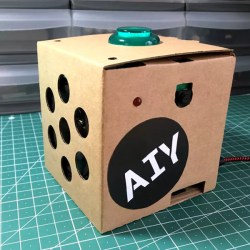
Adding a camera to Google’s AIY Voice Kit makes for a versatile object identification system.

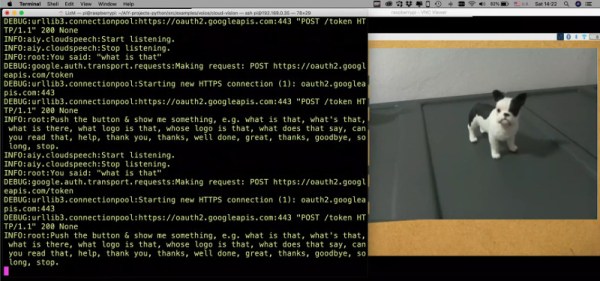
The device is built around Google’s AIY Voice Kit, which consists of a Raspberry Pi with some additional hardware and software to enable it to process voice queries. [Liz] combined this with a Raspberry Pi camera and the Google Cloud Vision API. This allows WhatIsThat to respond to users asking questions by taking a photo, and then identifying what it sees in the frame.

It may seem like a frivolous project to those with working vision, but there is serious potential for this technology in the accessibility space. The device can not only describe things like animals or other objects, it can also read text aloud and even identify logos. The ability of the software to go beyond is impressive – a video demonstration shows the AI correctly identifying a Boston Terrier, and attributing a quote to Albert Einstein.

Artificial intelligence has made a huge difference to the viability of voice recognition – because it’s one thing to understand the words, and another to understand what they mean when strung together. Video after the break.

[Thanks to Baldpower for the tip!]

Continue reading “This Cardboard Box Can Tell You What It Sees” →

Speedrunning Windows 95

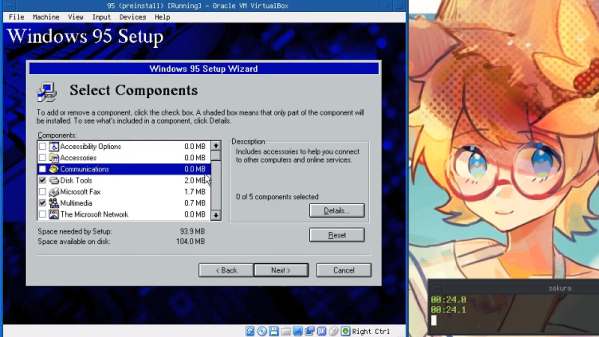
Speedrunning is the practice of attempting to beat a videogame in as short a time as possible. There are a huge variety of methods and styles. There are 100% completion speedruns, tool-assisted speedruns, and speedruns that just focus on getting to the game over screen as quickly as possible by hook or by crook. Now, there’s a world record speedrun, installing Windows 95B in just 1 minute 10.9 seconds.

The current best attempts are collected in a Google Sheets document. So far, there have been few competitors but we expect to see more activity in future. The current rules for world record competition require original floppy and CD-ROM images to be used, but there are no limits on hardware, so records should tumble as time goes on. All the top times have been completed in virtual machines, but we’d love to see an attempt made on raw hardware.

It all kicked off when [oscareczek] grew tired of trying to compete in traditional gaming speedruns, so invented a new category instead. Competition has already come a long way from that original 4 minute time, and competitors are now considering advanced techniques such as RAM disks to speed their runs. All keystrokes are by hand at the moment, but we could see a tool-assisted competition starting up in future.

We’ve seen speedrunning techniques pushed to impressive limits before – like running Pong within Super Mario World, just for fun. Video after the break.

Continue reading “Speedrunning Windows 95” →

Polygonia Helps You Laser Cut Beautiful Patterns

Lasercutters are amazingly versatile tools that can help you build all manner of complicated structures if you can break them down into a series of planar parts. [David] had spotted artworks at the Smithsonian which caught his eye, using planar shapes with interesting repeating patterns. Wanting to make similar works himself, he set out to create software to help make it possible. 

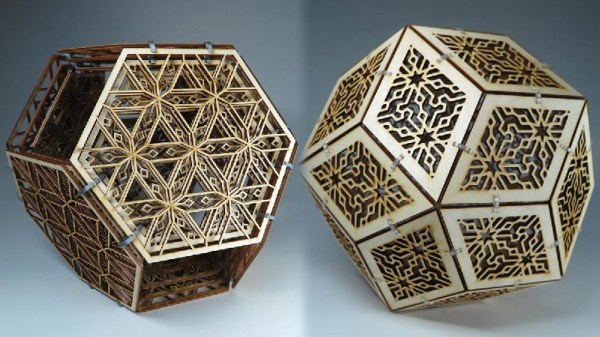
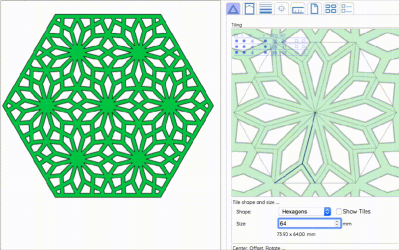
The tool makes it easy to generate complex profiles and export them for lasercutting.

The result of [David]’s work is the Polygonia Design Suite. It’s a tool that aims to make creating geometric patterns for lasercutting easy and simple. The web interface designer has a wide variety of options for drawing shapes and patterns, and the frame size can also be controlled. [David] demonstrates these features with all manner of creations. The project’s Instagram page features basic rectangular panels with inset cubic and triangular motifs, all the way up to an ornate octahedron built from many panels held together with 3D printed clips.

It’s all whipped up in Javascript, handrolled CSS and HTML. Cloud storage and authentication is all handled via Amazon Web Services, which makes handling such features easy. [David] made a special effort to create a separate test site so code experiments won’t effect the live site – crucial for any commercial endeavor.

If you’re in the mood to create some geometric lasercut artworks, check out the tool online. The first 3 exports are free, with a variety of subscription models available for heavy users. We fully expect to see an explosion in fancy lasercut homewares at the weekend markets in years to come.

If your thirst for lasercut art isn’t yet satiated, check out this colorful edgelit acrylic technique.

Saving Your Vision From Super Glue In The Eyes

Super glue, or cyanoacrylate as it is formally known, is one heck of a useful adhesive. Developed in the 20th century as a result of a program to create plastic gun sights, it is loved for its ability to bond all manner of materials quickly and effectively. Wood, metal, a wide variety of plastics — super glue will stick ’em all together in a flash.

It’s also particularly good at sticking to human skin, and therein lies a problem. It’s bad enough when it gets on your fingers. What happens when you get super glue in your eyes?

Today, we’ll answer that. First, with the story of how I caught an eyeful of glue. Following that, I’ll share some general tips for when you find yourself in a sticky situation.

Continue reading “Saving Your Vision From Super Glue In The Eyes” →