What Happens When You Cross A Brick With A Pixel?

There are a great many technologies we use to display information every day. We’re all familiar with plasma displays and LCDs, and then there’s more esoteric hardware like the split flap displays on municipal buses and around train stations.  However, Breakfast have been working on something that turns architectural features into a display at the same time. Enter Brixels.

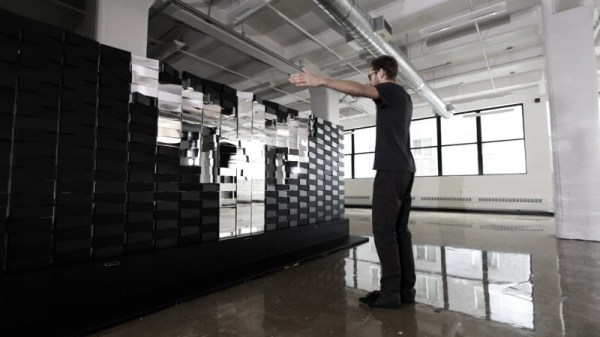
The name is a portmanteau of brick and pixel, indicating that each individual brick can be independently addressed as a visual element. A Brixel installation consists of a series of columns, stacked with Brixel elements. Each individual brick on the column contains a stepper motor which can set the rotational position of the brick. The outer appearance of the individual bricks is highly customizable, as the motor hardware is integrated into the column itself. A Linux machine is used as a primary controller, which passes commands to each column’s controller over RS485, and the column controllers then pass instructions to each individual Brixel.

The Brixels are capable of continuous 360 degree rotation and also contain LEDs for various illumination based effects. The largest current installation is the Brixel Mirror, standing at 18 feet wide, 6 feet high, and containing 540 individually addressable Brixels. These are built with one half covered in a mirror finish, and combined with a depth-sensing camera for all kinds of fun interactive effects.

Brixels show that architectural features don’t have to be static – they can become kinetic, living things that can be aesthetically beautiful and also useful. Breakfast are known for their installations which use modern electronics to push the limits in their artistic installations. Their work on high-speed flip dot displays is particularly impressive. Video after the break.

[Thanks to Sheldon for the tip!]

Continue reading “What Happens When You Cross A Brick With A Pixel?” →

12 Year Old Builds Successful Fusor At Home

Nuclear fusion, as a method of power generation, continues to elude humanity. It promises cheap, virtually limitless energy, if only we could find a way to achieve it. On the other hand, achieving nuclear fusion of a few atoms just for the fun of it is actually quite doable, even in the home lab. [Jackson Oswalt] is one of the youngest to pull it off, having built a working fusor at home at the age of 12.

The fusor consists of a cross-shaped chamber, which is pumped down to a high vacuum to enable the fusion reaction to occur. Deuterium is then pumped into the chamber, and confined by an applied electric field from a power supply in the vicinity of 50 kV. With the right combination of geometry, vacuum and other factors, it’s possible to fuse atoms and observe the characteristic glow of the reaction taking place.

In order to be recognised as having achieved fusion by the Open Source Fusor Research Consortium, one must typically have proof of the release of neutrons from the fusion reaction. [Jackson] showed this with a neutron detector setup, by inserting and removing it during a run to demonstrate the fusor was the source of the signal. Photos of the glowing fusor don’t go astray, either, and [Jackson] was more than happy to deliver.

We’ve seen fusor builds before – [Erik]’s build got him into the Plasma Club back in 2016.

[via Fox News]

Hexagonal Lamp Is A Stylish Application Of Plywood

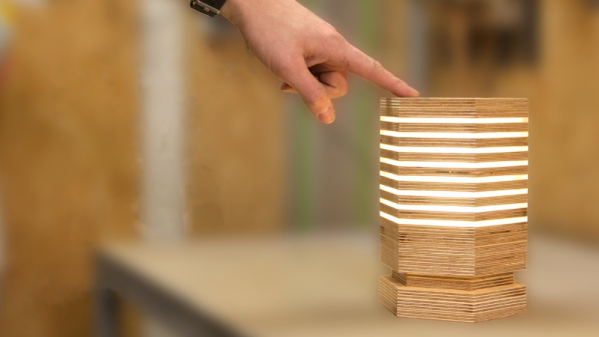
Lamps are useful things, and can be a great way to add style and lighting options to a room. Where overhead lights have to provide enough illumination for all manner of tasks, a subtle table lamp can add a nice moody glow to a room when it’s time to kick back and relax. Oftentimes, a stylish lamp can be let down by having a run of the mill plastic switch hanging off the power lead, but it doesn’t always have to be the case. [Emiel] designed this hexagonal lamp with a hidden switch, which works remarkably well.

[Emiel] starts by laying out hexagonal paper templates on plywood and perspex sheet. The plywood is cut on the bandsaw, while the interior cuts on the perspex are made on a scroll saw to avoid unsightly cut entry lines. The outer half of the lamp slides up and down on a pair of steel rods. Springs hold the outer half up, and it can be pressed down to activate a switch inside to turn the lamp on and off.

The build has a clean and attractive aesthetic, with the LEDs hidden inside, glowing through the perspex slices built into the body. It looks like something you’d find in the rooms at the Tranquility Base Hotel & Casino. If regular lamps aren’t enough for you, however, you could always consider building something interactive. Video after the break.

Continue reading “Hexagonal Lamp Is A Stylish Application Of Plywood” →

Death Generator Makes Game Over More Personal

“Game over”. In this day and age of complex games with storylines and career modes that last for tens of hours, it’s not really a concept that has a lot of relevance. However, in the golden age of the arcade, those two words made it very clear that your time was up and it was time to find another quarter. Home games of this era were similarly blunt, and if you couldn’t rise to the challenge, you’d be seeing the death screen more often than not.

[foone] was a fan of Sierra’s classic adventure games, and decided to create a tool to generate custom versions of these Game Over/YOU DIED screens. Aptly named Death Generator, the tool is programmed in JavaScript and quickly expanded to cover a wide realm of classic titles. There are King’s Quest IV and V, Gold Rush!, and even modern titles like Cave Story+ and Undertale. There’s plenty of fun to be had typing in completely ridiculous quotes for various screens; our personal favourite is Skate or Die, though Police Quest comes a close second.

[foone] continues to maintain the site, and adds new games from time to time. Animated GIF support has been a recent addition for screens like Metroid and Bad Dudes, and there are even character choices for Super Mario Bros. The code is available on Github if you feel the need to tinker yourself.

Eurorack Gets A Wireless MIDI Connection

Modular synthesizers have been around since the early 1960s, delivering huge tonal possibilities from their impressive and imposing patchbays. In 1996, the Eurorack standard was launched, and has become the go-to choice for enthusiasts new to the world of modular synthesis. [Rich Heslip] is just one such enthusiast, and has brought Bluetooth MIDI to Eurorack with his Motivation Radio module.

[Rich]’s module is built around the ESP32, which provides plenty of processing power, along with all the necessary radio hardware to communicate over Bluetooth. The unit packs plenty of connectivity into an 8HP wide panel, with four gate inputs and outputs, four CV inputs and outputs, and serial MIDI in and out.

Thanks to its Bluetooth connection, Motivation Radio makes it easy to pass note and gate data into a Eurorack setup, and can be used with the wide variety of tablet and smartphone MIDI software on offer. If you’re eager to build your own, PCB and panel designs are available courtesy of [jakplugg] and [Rich] has shared the software on Github.

Of course, if you prefer MIDI over USB, [little-scale] has the build for you. Video after the break.

Continue reading “Eurorack Gets A Wireless MIDI Connection” →

A Modern Solution To Tea Bag Inventory Management

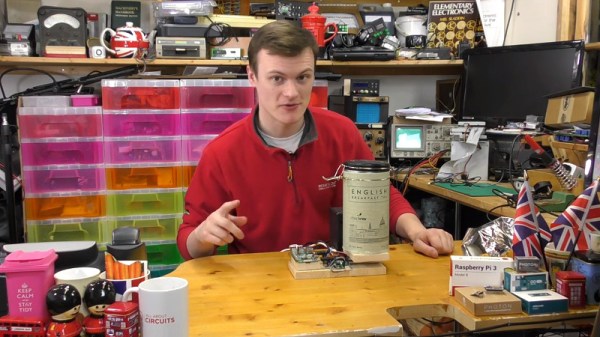
Britain is famously known as a land of manners and hospitality. Few situations could make an Englishman’s stiff upper lip quiver, short of running out of tea bags while entertaining house guests. Thankfully, [The Gentleman Maker] is here and living up to his name – with a helpful tea monitor to ensure you’re never caught out again.

The Intelli-T, as it has been dubbed, monitors tea inventory by weight. An Arduino Uno combined with a HX711 IC monitors a load cell mounted under a canister, with a reed switch on the lid. Upon the canister being open and closed, the Arduino takes a measurement, determining whether tea stocks have dipped below critical levels. If the situation is dire, a Raspberry Pi connected over the serial port will sound an urgent warning to the occupants of the home. If there is adequate tea, the Raspberry Pi will instead provide a helpful tea fact to further educate the users about the hallowed beverage.

It’s a fun project, and one that has scope for further features, given the power of the Raspberry Pi. A little more work could arrange automatic ordering of more tea online, or send alerts through a service like IFTTT. We’ve seen [The Gentleman Maker]’s uniquely British hacks before, such as the umbrella that tells you the weather. Video after the break.

Continue reading “A Modern Solution To Tea Bag Inventory Management” →

OptoGlitch Is An Optocoupler Built For Distortion

When we are concerned with the accurate reproduction of a signal, distortion and noise are the enemy that engineers spend a great deal of time eliminating wherever possible. However, humans being the imperfect creatures that we are, we sometimes desire a little waviness and grain in our media – typically of the analog variety, as the step changes of digital distortion can be quite painful. Tired of Instagram filters and wanting to take a different approach, [Patrick Pedersen] built the OptoGlitch – a hardware solution for analog distortion.

Changing the number of samples per pixel varies the accuracy of reproduction of the original image, left.

The concept of operation is simple – pixel values of a digital image are sent out by varying the intensity of an LED, and are then picked up by a photoresistor and redigitized. The redigitized image then bears a variety of distortion and noise effects due to the imperfect transmission process.

In the OptoGlitch hardware, the LED and photoresistor are intentionally left open to ambient light to further allow noise and distortion to happen during the transmission process. A variety of calibration methods are used to avoid the results being completely unrecognizable, and there are various timing and sampling parameters that can be used to alter the strength of the final effect.

It’s possible to introduce distortion more intentionally, too – such as this project that hides metadata in malformed glyphs.