Know Your Fits And Tolerances

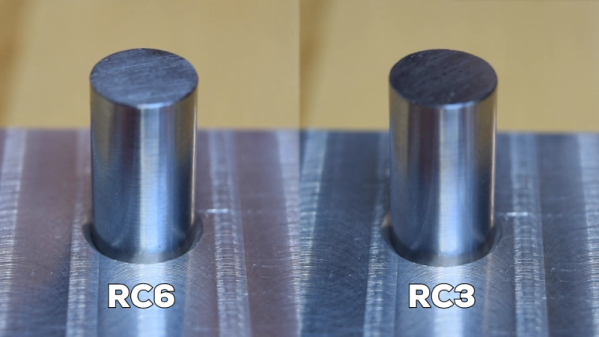
When designing parts on a screen, it’s very easy to type in a bunch of nice round numbers and watch everything slot together in perfect harmony. Unfortunately, the real world is not so kind. A 10mm shaft will not readily fit in a 10mm hole, and producing parts to perfect dimensions simply isn’t possible. This is where fits and tolerances come in, and [tarkka] have created a practical demonstration of this on Youtube.
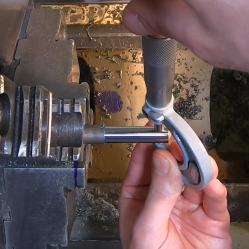
Tighter tolerances require more care and thus increase production costs significantly.

Hole and shaft tolerances are important to ensure parts mate correctly and as intended. If a shaft is to fit into a hole easily and the dimensions aren’t critical, a clearance fit is called for. If assembly should be easy but the part is required to locate accurately, a running fit is called for. Alternatively, if the parts are intended to be pressed together permanently, an interference or force fit should be used.

The video covers the basics of fits and tolerances in an easy to understand way, with visual examples. The fits discussed are based in Imperial measurements, but the metric standard of hole and shaft tolerances (ISO 286-2) is also noted.

Getting your tolerances right is key to making good parts – we’ve covered common issues such as tolerance stacking before. Video after the break.

Continue reading “Know Your Fits And Tolerances” →

Infinite Build Volume With RepRap On Wheels

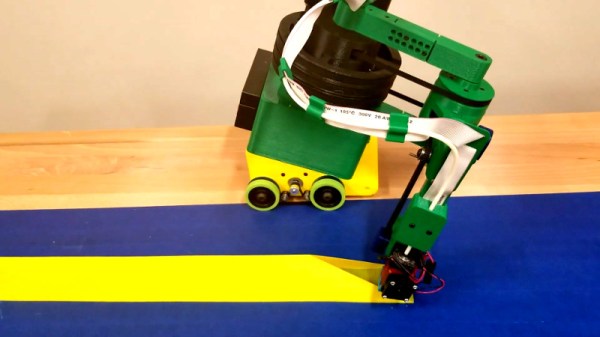
The average 3D printer is a highly useful tool, great for producing small plastic parts when given enough time. Most projects to build larger 3D printed objects use various techniques to split them into smaller parts which can fit inside the limited build volume of most Cartesian-based printers. However, there’s no reason a printer need sit inside a box, and no reason a printer can’t roam about, either. Hence, we get the RepRap HELIOS on wheels.

[Nicholas Seward] created the HELIOS and entered it into the Hackaday Prize in 2017, using a SCARA arm to build a printer with a large build volume and no moving steppers. One of [Nicholas]’s students then did a test, in which the HELIOS was mounted on an angled motorized cart, giving the printer potentially infinite build volume in one axis.

[Nicholas] expects the current basic setup to be capable of prints 200mm wide, 100mm high, and theoretically infinite length. There’s also potential to enable the device to create large curved parts by allowing the printer to steer itself with independently controlled motors.

There’s more work to be done, particularly to allow the printer to locate itself relative to its work space to avoid dimensional issues on large prints, but the preliminary results are highly impressive. We’ve seen other infinite volume printers, too – like this build using a conveyor belt design. Video after the break.

[Thanks to smerrett79 for the tip!]

Continue reading “Infinite Build Volume With RepRap On Wheels” →

Mustang Dash Becomes Bookshelf Art Piece

Despite most of the common gauges remaining the same over the last 60 years, the automotive dashboard of days past used very different technology to those today. Cable driven speedometers were common, along with mechanical drive for the odometer, too. Fuel and temperature gauges were often wired directly to their senders, and some oil pressure gauges actually ran an oil line right up to the back of the dash. Now, things are mostly handled over the CAN bus, which inspired [Thomas]’s bookshelf-based Mustang build.

The idea behind the project is to build a nice piece of bookshelf art, using a modern CAN-driven Mustang dashboard. Through research and much trial and error, [Thomas] was able to figure out the CAN messages necessary to interface with a 2009 Mustang dashboard. There were innumerable hiccups along the way – [Thomas] had to 3D print his own connectors, reflash CAN bus interfaces, and make more than a few educated guesses to get things working.

The dash is combined with an Arduino with an MP3 shield and a 30 watt audio system, which provides both CAN signals to drive the dash as well as the obligatory sound effects of a Mustang tearing about town. It’s all finished up with an ignition keyswitch and 3 LED-lit buttons in the traditional Mustang colors.

It’s a fun build which does a great job of showcasing the basic tools and techniques required to interface with modern automotive subsystems. Salvaging an instrument cluster can be a great way to add immersion to your home racing sim, too. Video after the break.

Continue reading “Mustang Dash Becomes Bookshelf Art Piece” →

Flying Convenience Not So Convenient

It’s a situation that plays out every day, all over the world – you walk into work, and there’s a full-scale foam toilet sitting on the bench, demanding to be used in a crackpot project. This time, it happened to be at the [FliteTest] workshop, and naturally, they set about making it fly.

The team at [FliteTest] are well resourced, with a laser cutter being used to quickly produce a set of custom foam board wings. However, after wing failures on their previous projects, this time the team opted for a riveted aluminium wing spar to add strength. A twin-boom tail is used to try to avoid the cistern from interfering with airflow over the elevator, and careful attention is paid to make sure the center of gravity is in the right position for stable flight.

Despite the team’s laudable efforts, the toilet (somewhat unsurprisingly) flies like crap. It just goes to show, you can strap a brushless power system on to just about anything, but aerodynamics will still be standing ready to bring it all crashing down to Earth.

We’ve seen some great builds from [FliteTest] over the years – before the throne, it was an IKEA chair that soared amongst the clouds. Video after the break.

[Thanks to Baldpower for the tip!] Continue reading “Flying Convenience Not So Convenient” →

Charging LiPos With USB Power Delivery

DC power bricks were never a particularly nice way to run home electronics. Heavy and unwieldy, they had a tendency to fall out and block adjacent outlets from use. In recent years, more and more gadgets are shipping with USB ports for power input. However, power over USB has always been fraught with different companies using all manner of different methods to communicate safe current limits between chargers and hardware.

These days, we’re lucky enough to have the official USB Power Delivery standard in place. Even laptop chargers are using USB now, and [FPVtv DRONES] decided to see if it was possible to use such a device as a high current power supply to charge batteries.

The test starts with a MI brand USB C laptop charger. A USB power meter is plugged inline to determine voltage and current output of the charger, while a small microcontroller device is used to speak with the laptop charger and set it to high voltage, high current delivery mode. A lithium battery charger is then plugged in, and the setup is tested by charging two large 4-cell LiPos at over 1.4 amps concurrently.

The setup demonstrates that, with the right off-the-shelf modules, it’s possible to use your laptop charger to run high-current devices, as long as you can spoof it into switching into the right mode. This is the natural evolution of USB power technology – a road which started long ago with projects like the MintyBoost, way back when. Video after the break.

Continue reading “Charging LiPos With USB Power Delivery” →

Building An Optically Pumped Laser Pointer

As a society, we’ve largely come together to agree that laser pointers are mostly useless. They’re now the preserve of university lecturers and those destined to wind up in a jail cell for harassing helicopter pilots. Most pointers are of the diode-pumped solid state variety. However, [Zenodilodon] treads a different path.

The laser cavity glows in operation, though it’s probably inadvisable to look directly at it.

Instead of the usual DPSS build, this pointer packs an optically pumped semiconductor laser, or OPSL. These lasers have the benefit of a wider selection of output wavelengths, and can be built to offer less variance in beam parameters such as divergence.

The build is an attractive one, with the pointer chassis being manufactured out of brass, with several components plated in yellow and rose gold. There’s even a sliding window to observe the laser cavity, which glows brightly in operation. [Zenodilodon] goes into great detail during the machining process, showing all the steps required to produce a visually appealing device.

It’s certainly one of the prettiest laser builds we’ve seen, and it’s always nice to see makers exploring different technologies. Similarly to our recently featured 1.4 W laser pointer, it’s largely a packaging operation, but if you’re building your own laser diodes at home – you know where to send ’em. Video after the break.

Continue reading “Building An Optically Pumped Laser Pointer” →

Nerf Mods Via 3D Printing

Nerf guns are a great way to annoy parents. Simply give them as a gift to any child, and watch precious family heirlooms tumble to the ground as little Holly commando rolls behind the couch to avoid enemy combatants invading the loungeroom. Adults may find them lacking in stopping power and firing rate, but not to worry – there’s plenty to be done about that. [3D Printing Nerd] took a trip to visit the [Out of Darts] workshop, to check out some seriously hardcore blasters.

[Out of Darts] runs as a store that sells all manner of tools and components for hopping up Nerf blasters, but they also sell complete original builds as well. The video showcases all manner of hardware, from powered backpack ammunition hoppers, to drain blaster shotguns and multirocket launchers. The workshop also contains 22 Prusa i3 printers that run 24/7 producing parts, barring breakdowns. Injection moulding, eat your heart out.

Things have come a long way since the old days of swapping in big springs to Hasbro blasters and crossing fingers that nothing breaks. 3D printing allows the home maker to produce just about any part imaginable without requiring advanced machine tools or special skills beyond the use of garden variety CAD software. It’s not the first time we’ve seen 3D printed Nerf blasters, and we’re sure it won’t be the last either. As always, tip ’em if you got ’em. Video after the break.

Continue reading “Nerf Mods Via 3D Printing” →