Microwave Parts Become Quick And Nasty Jacob’s Ladder

The Jacob’s Ladder is an electrical device named after a biblical “ladder to Heaven”, consisting of a pair of vertically oriented conductors that spread apart vertically. These conductors are charged with high voltage, which creates the repeatedly climbing arc we’ve all come to know and love from science fiction movies of yesteryear.

[LOOK MUM NO COMPUTER] was on a scavenger hunt for electronic junk, and came across a microwave in a skip that was begging to be hacked. After kicking around a few ideas, it was decided that the microwave would donate its high voltage transformer to create a Jacob’s ladder. The transformer is first bolted down to a piece of wood, and creates some sparks on the bench when shorted. The output is then wired to a pair of copper pipes to create the classic effect.

Unfortunately, the device isn’t self starting, requiring the electrodes to be temporarily short circuited to generate the initial arc. We suspect that increasing the voltage may help things somewhat, either with another transformer in series or with a voltage multiplier.

It goes without saying that high voltage projects do bring certain risks to life and limb that should not be overlooked. If you’ve still got a thirst for danger, check out this home built X-ray machine. Video after the break.

Continue reading “Microwave Parts Become Quick And Nasty Jacob’s Ladder” →

This Blinken Grid Is All Analog

The personal computers of today are economical with their employ of the humble LED. A modern laptop might have a power LED, and a hard drive indicator if you’re lucky. It was the mainframes of the ’60s and ’70s that adhered to the holy Doctrine of Blinken, flickering lamps with abandon to indicate machine activity to the skilled operators of yore. [Matseng] wanted to recreate this aesthetic, and went about it in an entirely analog fashion.

The project is built around an 8×8 LED grid, that was soldered up using a 3D printed jig for dimensional accuracy. Fitted to each column is a PNP flip flop that pulls the column to VCC, while each row has an NPN flip flop which pulls it to ground. Due to variances in component values and tolerances, the oscillators are all out of sync, leading to a remarkably pleasing blinkenlights effect.

We’re a big fan of the raw aesthetic, but [Matseng] has also fitted the grid with a diffuser which more clearly represents that vintage computer aesthetic. We’re a big fan of the blinken here, such as this loving recreation of the PDP-8/I. Video after the break. Continue reading “This Blinken Grid Is All Analog” →

This Chromecast Volume Knob Has A Certain ’70s Chic

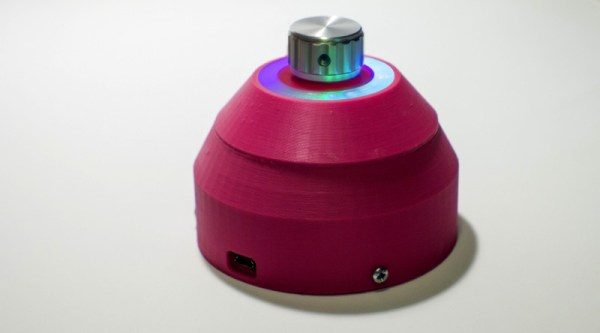
Chromecast devices have become popular in homes around the world in the last few years. They make it easy to cast audio or video from a smartphone or laptop, to a set of speakers or a display connected to the same network. [Akos] wanted to control the volume on these devices with a single, simple piece of equipment, rather than always reaching for a smartphone. Thus was built the CastVolumeKnob.

The project began by using Wireshark to capture data sent by the pychromecast library. Once [Akos] understood the messaging format, this was implemented in MicroPython on an ESP8266. A rotary encoder is used as a volume knob, and a Neopixel ring is used for visual feedback as to the device being controlled and the current volume level.

Further work was done to improve usability, with an ATtiny85 microcontroller being used to monitor the encoder for button presses before waking up the ESP8266, greatly reducing power consumption. The device is also rechargeable, thanks to an 18650 lithium polymer battery, and charger and boost converter boards. It’s all wrapped up in a sleek 3D printed case, with a translucent bezel for the LEDs and a swanky machined aluminium knob as the cherry on top.

It’s a homemade device that nonetheless would be stylish and unobtrusive in the living room environment. We imagine it proves very useful when important phone calls come in and it’s necessary to cut the stereo down to a more appropriate volume.

For another take, check out this USB volume knob with a nice weighty feel, courtesy of lead shot.

This Satellite Finder Can Watch Amateur TV

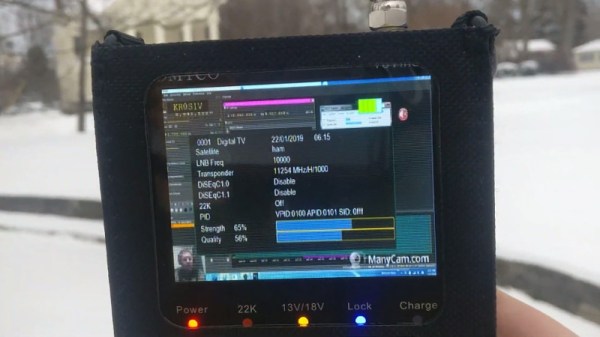
Setting up satellite dishes can be a finicky business. To aid in the alignment of these precision antennas, satellite finders are often used which can display audio and video feeds from the satellite while also providing signal strength readouts for accurate adjustment. However, these devices can also be used in interesting ways for more terrestrial purposes (Youtube link).

Using the DMYCO V8 Finder, [Corrosive] demonstrates how to set up the device to pick up terrestrial amateur streams. Satellite reception typically involves the use of a low-noise block downconverter, which downconverts the high frequency satellite signal into a lower intermediate frequency. Operating at the 1.2GHz amateur band, this isn’t necessary, so the device is configured to use an LNB frequency of 10000, and the channel frequency entered as a multiple of ten higher. In this case, [Corrosive] is tuning in an amateur channel on 1254 MHz, which is entered as 11254 MHz to account for the absent LNB.

[Corrosive] points out that, when using an F-connector to BNC adapter with this setup, it’s important to choose one that does not short the center pin to the shield, as this will damage the unit. This is due to it being designed to power LNBs through the F-connector for satellite operation.

By simply reconfiguring a satellite finder with a basic scanner antenna, it’s possible to create a useful amateur television receiver. If you’re wondering how to transmit, [Corrosive] has that covered, too. Video after the break.

Continue reading “This Satellite Finder Can Watch Amateur TV” →

Interfacing The Sidewinder Joystick To AVRs

The Sidewinder line was a series of gaming peripherals produced by Microsoft, starting in the 1990s. After some initial stumbles, several cutting edge joysticks were released, at a time when the home computer market was in a state of flux, transitioning from legacy interfaces like serial and parallel to the more modern USB. In this interim period, Sidewinder joysticks used a special method to communicate digitally over the game port interface, which more typically used a kludge to read joysticks in an analog manner. [MaZderMind] managed to reverse engineer this protocol, and implemented the interface on an AVR microcontroller.

The technology is loosely described in US Patent 5628686, which discusses the method used to communicate bidirectionally with the Sidewinder joystick. [MaZderMind] found that the patent documents didn’t correspond exactly with how the Sidewinder Precision Pro communicated, but it was close enough that the operation could be reverse engineered.

The plan is to use the vintage joystick to control a quadcopter, so the interface was implemented on an AVR, and a graphical LCD installed to act as a display for testing the operation. [MaZderMind] also captured data on an oscilloscope to indicate in detail the quirks of the joystick’s operation.

Yes, it’s entirely possible to use a more modern microcontroller with a USB joystick. However, there are few that measure up to the standards of the old Sidewinder hardware, and sometimes the best tool for the job is the one you’ve got with you. A traditional single joystick is a different take on quadcopter control, but there’s other options – gesture control is possible, too.


Under The Hood Of Leica Camera Firmware

There’s nothing quite like waiting for something you’ve ordered online to arrive. In [Alex]’s case, he’d ordered a new Leica camera, only to find out there was a six month backlog in shipping. Wanting to whet his thirst regardless, he decided to investigate the Leica website, and reverse engineered a whole heap of camera firmware. As you do.

[Alex] didn’t stop at just one camera, instead spreading his interest across whatever firmware Leica happened to have online at the time. This approach led to improved effectiveness, as there were similarities in the firmware used between different cameras that made it easier to understand what was going on.

There are plenty of surprise quirks – from firmwares using the Doom WAD data format, to compression methods used by iD software in old game releases. [Alex]’s work runs the gamut from plotting out GUI icons on graph paper, to building custom tools to tease apart the operation of the code. Sample components were even sourced from connector manufacturers to reverse engineer various accessories, too.

[Alex]’s methodical approach and perseverance pays off, and it’s always interesting to get a look under the hood of the software underpinning consumer devices. We’ve even seen similar work done to decode the mysteries of Pokemon cries.

[Thanks to JRD for the tip!]


Reworking MT3608 Boost Converters For Lower Idle Current Draw

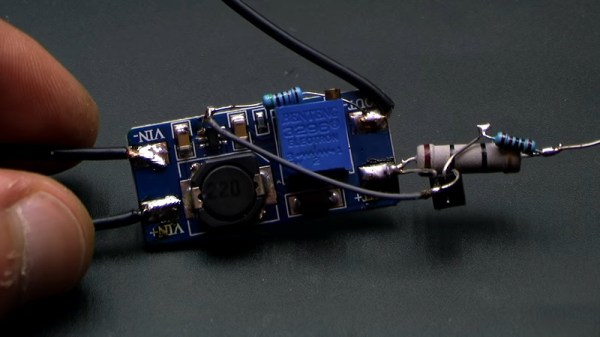
The MT3608 is a popular boost converter, able to easily step up DC voltages in useful ranges, at an incredibly low cost. Modules can be sourced from eBay for less than $2, built on a PCB, ready to go. One drawback of these modules, particularly when working with batteries, is the idle current draw, on the order of 1 to 1.5mA. Fear not, however — there is a workaround, courtesy of [Aka Kasyan]. (Video, embedded below.)

The trick is to modify the behavior of the converter when no load is connected. The enable pin of the boost converter is held low through a pull-down resistor, keeping the boost converter switched off. In this state, the output voltage is equal to the input voltage. A current sense resistor is then installed in the output path. When a load is connected, this causes a voltage drop across the current sense resistor. This is then used to switch a transistor, which then connects the enable pin to the positive rail, switching the converter on, leading to the full boosted output voltage being reached.

[Aya] reports that this drastically cuts the idle current draw, which is particularly useful for battery powered projects. It’s important to note that the current sense resistor must be appropriately sized for the given load, however. If you’re a little hazy on the background, fear not — we’ve discussed the nature of boost converters before. Video after the break.

[Thanks to Baldpower for the tip!]
Continue reading “Reworking MT3608 Boost Converters For Lower Idle Current Draw” →