Air Knife Keeps GoPro Lens Clean In Messy Environments

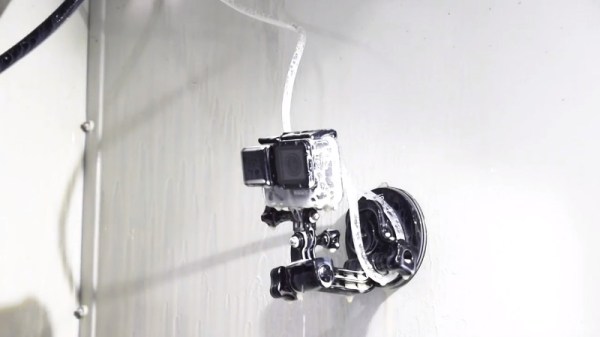
Before the GoPro, shooting video of messy, fast-paced, or dangerous things was very different. There were commercial sports camera rigs and various industrial solutions, but the GoPro, with its waterproof housings and diminutive size, was the revolutionary, stick-it-anywhere camera. Despite this, the team at [tarkka] were having issues with the lens getting covered in coolant while shooting videos of their CNC machining projects. To solve this, they created an air knife to clean the lens.

The air knife consists of a wide, flat nozzle that is designed to blow fluid off of the lens. It’s a tidy 3D printed design, which wraps around the GoPro housing. Felt pads are used to give a snug fit, so the device simply slides into place and stays there. The device is fed from a hand-operated nozzle at present, though the team notes that this could be changed to a more permanent connection.

In testing, the device has performed well, even when under a constant barrage of coolant spray. This should make shooting CNC videos much easier for the team, who were formerly required to manually wipe the camera down several times during a shoot. The build was actually inspired by an earlier build by [Edge Precision], which used machined aluminum parts to create a similar tool.

The GoPro remains a popular camera wherever a small and rugged device is required. Consider mounting one to a toy car for a weekend’s worth of fun. Video after the break.

Continue reading “Air Knife Keeps GoPro Lens Clean In Messy Environments” →
The Voice Of Dave, Now In Toy Form

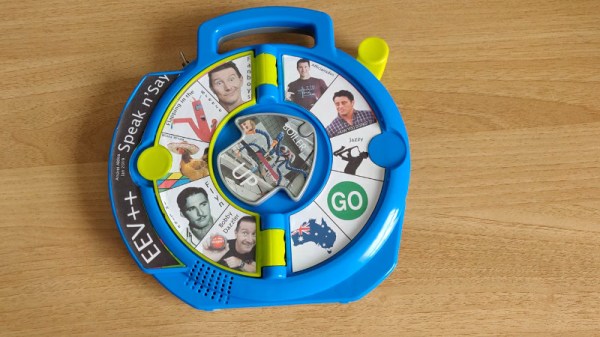
Dave Jones is something of a celebrity in the hacker and maker communities, bringing his considerable knowledge and experience to bear on a wide variety of electronic and engineering topics. His unique voice and candor have endeared him to many, and he’s one of the more quotable YouTubers currently on the scene. With that in mind, [Andrei Aldea] decided to build a Speak ‘n’ Say in his honor.

The build was inspired by an earlier effort by [Ben Heck]. [Andrei] started by disassembling the Speak ‘n’ Say, and determined that there was a simple button matrix that would allow the toy’s position to be read easily. These buttons were wired into an Arduino Nano, which then reads an SD card and plays sound samples using the MP3 Module from DFR Robot.

[Andrei] made sure the toy was replete with custom graphics, which complete the look. Additionally, each Dave quote on the board has a series of soundbites, chosen randomly by the Arduino, giving a little more variety than the original toy.

It’s a fun build, and we’d love to see a version with line-out or some bigger speakers to blast the Gospel of Dave at a truly impressive volume. We’ve seen other speaking Arduinos, too – like this imposing HAL build. Video after the break.

Continue reading “The Voice Of Dave, Now In Toy Form” →

Brushless R/C Rocket Tests Different Flight Regimes

Quadcopters are familiar, and remote control planes are old hat at this point. However, compact lightweight power systems and electronic flight controllers continue to make new flying vehicles possible. In that vein, [rctestflight] has been experimenting with a brushless electric rocket craft, with interesting results. (Youtube, embedded below.)

The build uses a single large brushless motor in the tail for primary thrust. Four movable vanes provide thrust vectoring capability. To supplement this control a quadcopter was gutted, and its motors rearranged in the nose of the craft to create a secondary set of thrusters which aid stabilization and maneuverability.

The aim is to experiment with a flight regime consisting of vertical takeoff followed by coasting horizontally before returning to a vertical orientation for landing. Preliminary results have been positive, though it was noted that the body of the aircraft is significantly reducing the available thrust from the motors.

It’s a creative design which recalls the SpaceX vertical landing rockets of recent times. We’re excited to see where this project leads, and as we’ve seen before – brushless power can make just about anything fly. Even chocolate. Video after the break.

Continue reading “Brushless R/C Rocket Tests Different Flight Regimes” →

A Genesis Inspired Synthesizer That Has Nothing To Do With Phil Collins

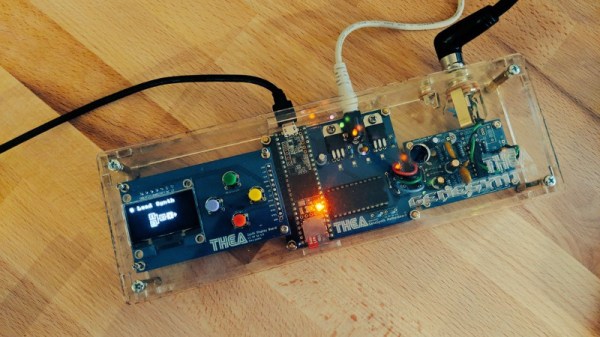
Chiptune is a musical genre built upon the creation of music through the use of chip-based sound synthesizers, found in early game consoles. The Commodore 64’s venerable SID chip and the Game Boy Sound System are the by far the most popular on the scene. However, the Sega Genesis took a different path at the end of the videogame chipmusic era, packing a YM2612 FM synthesis chip to deliver fat basslines and searing solos. [Thea] has always been a fan of these electric 90s sounds, and thus decided to build the Genesynth.

The synth initially allowed only for playback of existing video game scores, but its capability has been expanded as [Thea] took the project from breadboard to protoboard to custom PCBs – with anime artwork, to boot. The synth uses a Teensy 3.5 as the brains, speaking USB to enable the synth to receive MIDI commands from music software. All parameters are exposed over the interface, and [Thea] has several videos showing the Genesynth under control from an Ableton Push.

The sound capabilities of the YM2612 are of an entirely different character to most chiptunes, by virtue of the FM synthesis engine. FM synthesis is a little less intuitive then classical additive synthesis, but we still see it crop up now and then.


Resurrecting An Amiga 500+

Recently, I was lucky enough to receive a big haul of retro computer gear from a friend who was emptying out his garage. Even better, the haul was almost entirely old Amiga gear — my favorite computing platform of all time. Upon returning home, I gleefully sorted through the boxes, powering things up one by one. Amazingly, everything worked… except for one lonely Amiga 500+. I was greeted by a dull grey screen. This wouldn’t do, so naturally, I got to work.

It seemed like a shame to be opening the machine, as after almost 30 years of life, this one still had its warranty seal intact. Regardless, nothing ventured, nothing gained – the Torx bits were at hand and the screws were coming out.

Continue reading “Resurrecting An Amiga 500+” →

SNES Portable Leverages Flash Cart For More Games

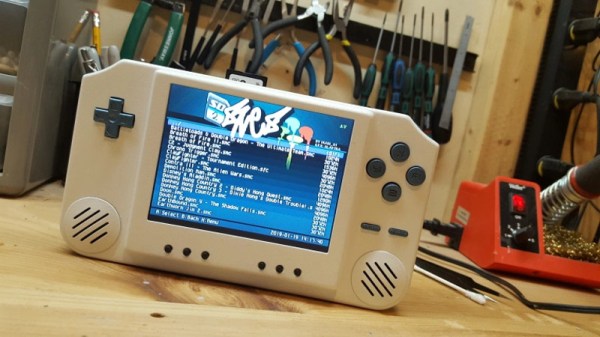
Handheld consoles have to make a lot of design choices that their TV connected brethren don’t have to worry about. Battery life is important, as is screen visibility, and the games can’t be too bulky or unwieldy if you’re going to be carrying them around all day. [Chris] is no stranger to building handheld versions of home consoles, and took a few of these lessons on board in his latest portable SNES build.

The motherboard was provided by a SNES Jr., a lightweight, compact model released towards the end of the console’s reign. This was small enough that it required no trimming, however [Chris] elected to replace the inefficient 7805 with a more modern switching regulator. The case was 3D printed on a typical FDM setup, while the buttons were produced on a Form 2 for better dimensional accuracy and surface finish.

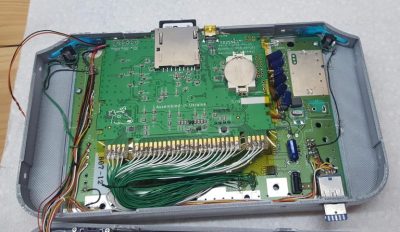
The flash cart PCB is permanently wired to the motherboard.

The real party piece, however, is the use of an SD2SNES flash cart. This allows a huge variety of ROMs to be loaded onto a single SD card, and played on the original console hardware. This is particularly useful in a portable build, as it becomes possible to carry all the games you could want, rather than having to juggle several full-sized SNES cartridges. The SD2SNES is wired in place permanently inside the console, with an impressive number of patch wires between the motherboard and the cartridge PCB. Despite the long lead length, [Chris] reports no issues with the connection.

There are some limitations – the flash cart doesn’t work properly for games using extra chips on the cartridge, like the SuperFX in Star Fox, for example. Despite this, it’s an excellent, high quality build that we’re sure is a lot of fun to play out and about.

We’ve seen [Chris]’s work before – this portable N64 is a particularly nice example. Video after the break.

Continue reading “SNES Portable Leverages Flash Cart For More Games” →

Robot Can’t Take Its Eyes Off The Bottle

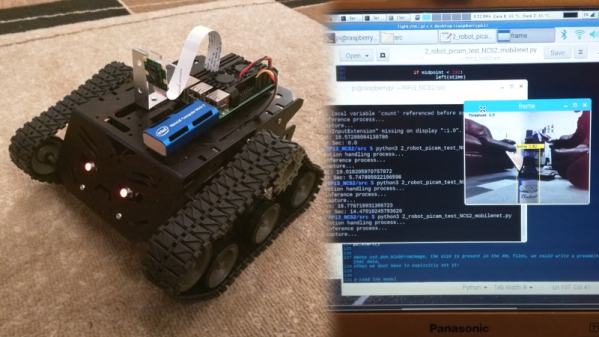
Robots, as we currently understand them, tend to run on electricity. Only in the fantastical world of Futurama do robots seek out alcohol as both a source of fuel and recreation. That is, until [Les Wright] and his beer seeking robot came along. (YouTube, video after the break.)

A Raspberry Pi 3 provides the brains, with an Intel Neural Compute stick plugged in as an accelerator for neural network tasks. This hardware, combined with the OpenCV image detection software, enable the tracked robot to identify objects and track their position accordingly.

That a beer bottle was chosen is merely an amusing aside – the software can readily identify many different object categories. [Les] has also implemented a search feature, in which the robot will scan the room until a target bottle is identified. The required software and scripts are available on GitHub for your perusal.

Over the past few years, we’ve seen an explosion in accelerator hardware for deep learning and neural network computation. This is, of course, particularly useful for robotics applications where a link to cloud services isn’t practical. We look forward to seeing further development in this field – particularly once the robots are able to open the fridge, identify the beer, and deliver it to the couch in one fell swoop. The future will be glorious!


Continue reading “Robot Can’t Take Its Eyes Off The Bottle” →