Accurate Coffee Billing Through Reverse Engineering

If you’ve ever worked in a stingy office, you’ve become familiar with the communal coffee maker that runs on some variant of the honor system. There’s bits of paper, a coin jar shabbily sealed with sticky tape, and the routine note every six months telling people off for not paying for their daily brew. It all gets a bit much. Thankfully, if you work with [Fabian], it’s no longer a problem (PDF link).

The project forms the basis for [Fabian]’s thesis, in which a DeLonghi coffee maker is reverse engineered. This is undertaken with the explicit goal of properly metering the amount of consumables (coffee beans) used per beverage, to more fairly charge users depending on their brew of choice. This involves breaking down and understanding the coffee maker’s internal communications, as well as implementing a system to record and handle billing. For reasons of simplicity, [Fabian] decided that this should be handled using his colleague’s existing computer accounts. Easy!

It’s a highly academic approach to what we’re sure was a very stimulating project with lots of delicious aromas. Coffee’s a popular topic among hackers, that’s for sure – check out this roaster to take your game to the next level.


 

Stock Market Prediction With Natural Language Machine Learning

Machines – is there anything they can’t learn? 20 years ago, the answer to that question would be very different. However, with modern processing power and deep learning tools, it seems that computers are getting quite nifty in the brainpower department. In that vein, a research group attempted to use machine learning tools to predict stock market performance, based on publicly available earnings documents. 

The team used the Azure Machine Learning Workbench to build their model, one of many tools now out in the marketplace for such work. To train their model, earnings releases were combined with stock price data before and after the announcements were made. Natural language processing was used to interpret the earnings releases, with steps taken to purify the input by removing stop words, punctuation, and other ephemera. The model then attempted to find a relationship between the language content of the releases and the following impact on the stock price.

Particularly interesting were the vocabulary issues the team faced throughout the development process. In many industries, there is a significant amount of jargon – that is, vocabulary that is highly specific to the topic in question. The team decided to work around this, by comparing stocks on an industry-by-industry basis. There’s little reason to be looking at phrases like “blood pressure medication” and “kidney stones” when you’re comparing stocks in the defence electronics industry, after all.

With a model built, the team put it to the test. Stocks were sorted into 3 bins —  low performing, middle performing, and high performing. Their most successful result was a 62% chance of predicting a low performing stock, well above the threshold for chance. This suggests that there’s plenty of scope for further improvement in this area. As with anything in the stock market space, expect development in this area to continue at a furious pace.

We’ve seen machine learning do great things before, too – even creative tasks, like naming tomatoes. 

Spellcasting Gun Uses POV Display, Not Magic

Persistence of Vision, or POV, displays are ever popular around these parts. Spin a few LEDs and you can make images appear in almost-thin air – just don’t stick your finger in the way. [FriskP] found a great application for this hardware – creating an anime-styled spellcasting gun.

The basic gun is built around a Nerf blaster, which is common in a lot of this type of steampunk and anime build. A Phantom3D POV display is then bolted on to the front along with some 3D printed components for style. The ensemble is then painted in a suitably awesome fashion.

We’re not sure on the software used, but [FriskP] has the gun displaying some amazing spell-type graphics that appear to hover in the air when the user pulls the trigger. The artwork is stunning, showing off some of the best graphics we’ve seen in the POV arena.

Overall, it’s a highly aesthetically pleasing build that any cosplayer would be more than proud to wield. It relies on the builder’s strong finishing and integration abilities more than raw electronic skill, but the end result is truly impressive.

We’ve seen plenty of POV displays around here before – you can get started with something as simply as a PC fan! Video after the break.

Continue reading “Spellcasting Gun Uses POV Display, Not Magic” →

A Smarter PSU Converter Leaves The Magic Smoke Inside

Over the years, computers have become faster, but at the same time, more power hungry as well. Way back around the 386 era, most PCs were using the AT standard for power supplies. Since then, the world moved on to the now ubiquitous ATX standard. Hobbyists working on older machines will typically use these readily available supplies with basic adapters to run old machines, but [Samuel] built a better one.

Most AT to ATX adapters are basic passive units, routing the various power lines where they need to go and tying the right pin high to switch the ATX supply on. However, using these with older machines can be fraught with danger. Modern supplies are designed to deliver huge currents, over 20 A in some cases, to run modern hardware. Conversely, a motherboard from the early 90s might only need 2 or 3A. In the case of a short circuit, caused by damage or a failed component, the modern supply will deliver huge current, often damaging the board, due to the overcurrent limit being set so high.

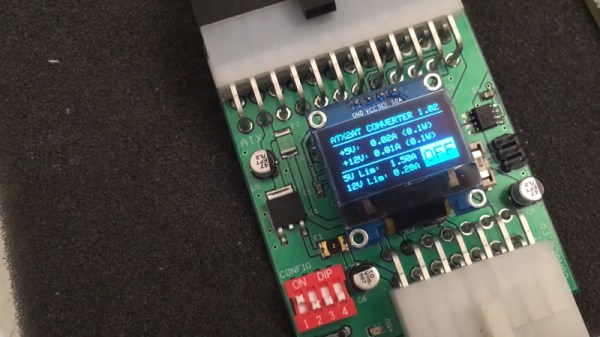
[Samuel]’s solution is to lean on modern electronics to build an ATX to AT adapter with programmable current protection. This allows the current limit to be set far lower in order to protect delicate boards. The board can be set up in both a “fast blow” and a “slow blow” mode to suit various working conditions, and [Samuel] reports that with alternative cabling, it can also be used to power up other old hardware such as Macintosh or Amiga boards. The board is even packed with extra useful features like circuitry to generate the sometimes-needed -5V rail. It’s all programmed through DIP switches and even has an OLED display for feedback.

It’s an adapter that could save some rare old hardware that’s simply irreplaceable, and for that reason alone, we think it’s a highly important build. We’ve talked about appropriate fusing and current limiting before, too – namely, with LED strips. 


Quiet Your Car The Cheap And Effective Way

If you’ve been on the Earth for a couple of decades or more, or have just grown up riding around in some older metal, you’d know that cars can be incredibly noisy. If you’re unfamiliar, buy yourself a nice car like a 2000 Honda Civic, strip out all the carpet and interior panels, and go for a drive. Huge amounts of research and development have gone into making modern cars as quiet and comfortable as possible. Through the correct use of sound deadening materials and techniques, a car can be made much quieter and audio quality from the sound system can be improved too. [camerajack21] decided to get to work on their Volkswagen to see what could be done.

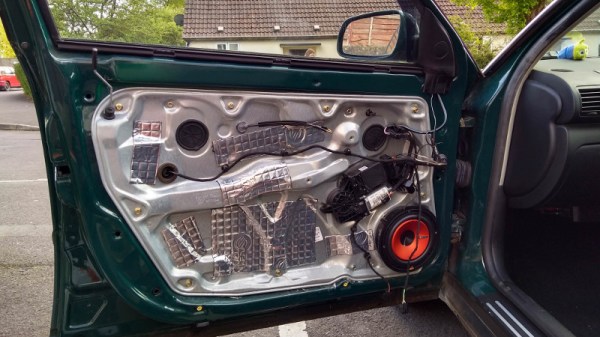
The project in question pays special attention to the door panels. These are where the primary speakers are housed, and there were issues with rattles if the speakers were allowed to operate at frequencies below 100 Hz. Weather stripping, foam, and improved fasteners were pressed into service to reduce this issue.

Think of a musical bell. If you touch a small part of the bell with just your finger, it no longer can ring true. You don’t need to wrap your entire hand around a bell to keep it from ringing. Your finger is not absorbing sound, just preventing the bell from ringing.

Focus then moved to the body panels. Special sound deadening material (in this case, Silent Coat brand) was then applied to the insides of the doors and trunk to bring the sound level down. The key to effective application of such materials is not to waste money covering entire panels – the Reddit comments are particularly enlightening here. It only takes a small amount of material to stop a panel from vibrating, with most testing suggesting anymore than 30% coverage of a panel brings diminishing returns.

With your car’s sound environment tidily improved, you might be looking for ways to improve your sound system. There’s plenty of ways to go about it – you can even use guitar effects.

3D Printed Tank Scores Suspension

Tanks are highly capable vehicles, with their tracks giving them the ability to traverse all manner of terrain at speed. An important part of a tank is its suspension setup, without which its treads are far less capable. When [Ivan]  began work on his 3D printed tank project, he couldn’t ignore the comments. His tank would need a suspension system.

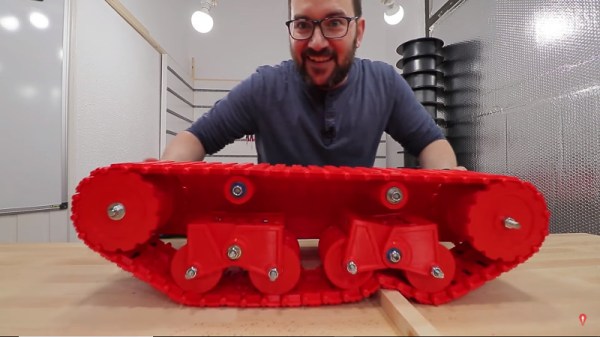
The tank build itself is impressive, consisting almost entirely of 3D printed components held together with off-the-shelf bearings and threaded rod. [Ivan] retools the tank from the beginning to fit a pivoting suspension system which is surprisingly simple in its design, yet capable in operation. Particularly impressive are the 3D printed springs, which [Ivan] tunes the stiffness of to suit the weight of the vehicle.

It’s a build that shows just how far you can go when you master the basics of 3D printing and mechanical design. It doesn’t take a lot of advanced theory to design cool things, just a willingness to learn and experiment and the right set of tools behind you. [Ivan]’s tank treads are worth taking a look at, too. Video after the break.

Continue reading “3D Printed Tank Scores Suspension” →

Smooth PLA Through The Fire And Flames

3D printing makes it easy to produce complex geometries, but the fused deposition methods generally create parts with poor surface finish, largely due to the layers being highly visible in the finished part. There are a wide variety of ways to deal with this, often involving sanding parts after production, or the use of fillers and paints. [XerotoLabs] has another solution. (YouTube, video below the break.)

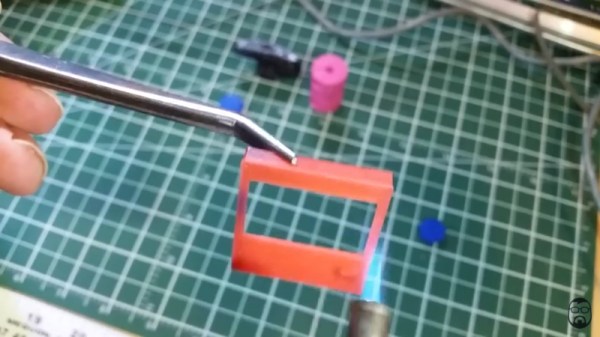
To smooth the parts, a butane torch is pressed into service. The flame temperature is kept fairly low, and the torch is used almost like a brush to evenly apply heat to the surface of the part. As the PLA reaches its melting temperature, surface tension helps to smooth the part out. This is very similar to flame polishing which is commonly used in the fabrication of acrylic plastics.

It is a technique that requires some finesse – too much heat or focus on a single area, and you’re liable to end up with a molten plastic blob instead of a nice shiny finished part. Precautions must also be taken to avoid burning yourself or your workshop to the ground. But it’s a useful tool to have in your kit when you’re producing PLA parts that you want to look their best.

We’ve seen other techniques for smoothing PLA, too – the solvent method is particularly interesting. Continue reading “Smooth PLA Through The Fire And Flames” →