For Such A Small Program, ZX81 1K Chess Sure Packs A Lot In

The Sinclair ZX81 was hardly the most accomplished of 1980s 8-bit microcomputers, but its ultra-low-budget hardware was certainly pressed into service for some impressive work. Perhaps the most legendary piece of commercial software in this vein was 1K Chess, which packed an entire chess engine into the user-available bytes in the unexpanded 1K ZX’s memory map. [MarquisdeGeek] has taken this vintage piece of code in 2026 and subjected it to a thorough analysis, finding all the tricks along the way.

Though hackers have since found ways to trick the ’81 into displaying bitmap graphics, using it as intended is text-only with some limited block graphics. The chess board then is text-only, and its illusion of “thinking” about moves comes courtesy of the on-screen board doubling as the play area memory. In the GitHub repository you can find decompiled and annotated versions as well as the original ZX binary, with as a bonus a screen capture of the game as it appears as BASIC with the ZX’s odd means of storing Z80 code in REM statements.

If that wasn’t enough, in his note giving us the tip he reveals that much of the work was done in a ZX emulator running in a Dragon emulator, and gives us a fun glimpse of the game running in an emulator on a Cheap Yellow Display inside 1K Chess cassette box. We like it, a lot!

If you need a greater ZX81 fix, take a look at how this machine chased the beam to make TV graphics on the cheap.


Hackaday Podcast Episode 364: Clocks, Cameras, And Free Will

This week, Hackaday’s Elliot Williams and Kristina Panos met up over assorted beverages to bring you the latest news, mystery sound results show, and of course, a big bunch of hacks from the previous seven days or so.

In the news, there’s quite a bit to talk about. Regarding Hackaday Europe, you can rest assured that the talks will be announced soon. The Green-Powered Challenge is still underway, and we need your entry to truly make it a contest. You have until April 24th to enter, so show us what you can do with power you scrounge up from the environment!

As usual, we published a handful of April Fool’s posts, which you may or may not find amusing. And finally — no fooling — our own Tom Nardi wrote up the Artemis moon launch, and is going to update the post every day until the mission ends.

On What’s That Sound, we can score one for Kristina, which brings her record to approximately three wins and sixty-eight losses. She knew without a doubt that the dialogue was from the Day the Earth Stood Still (1951). Oh, what? There was a remake in 2008? Kristina should get bonus points, then.

After that, it’s on to the hacks, beginning with the basics of making clean enclosures that are decidedly not 3D-printed, a couple of sweet lo-fi cameras, and a nice way to tame the tape when it comes to SMT parts. We also discuss a clock that marks time in a mathematical way, watch an electro-permanent magnet in action, and improving soda by turning it into mead. Finally, we discuss the solar balconies taking Europe by storm, and Copilot’s terrifying terms of service.

Check out the links below if you want to follow along, and as always, tell us what you think about this episode in the comments!

Download in DRM-free MP3 and savor at your leisure.

Continue reading “Hackaday Podcast Episode 364: Clocks, Cameras, And Free Will”

Fixing An E-Waste ASUS P5A-B Socket 7 Mainboard

A fun part of retro computing is saving ‘e-waste’ that was headed for certain destruction. These boards can have any number of defects, modifications and more that have to be remedied prior to using them. In the case of the Asus P5A-B Socket 7 mainboard that [Bits und Bolts] rescued from the scrapheap at least one issue was obvious: someone had ripped off the plastic part of the ZIF socket, leaving only the metal pins poking out like an awkward kind of LGA socket.

In addition to the busted PGA ZIF socket there was additional damage, including a broken SMT capacitor and missing resistor. Interestingly, someone had apparently modded the ATX power connector to permanently power on the system by removing a pin and bridging to the power-on signal. Obviously this mod had to be undone by removing the bridge and installing a new pin. After this cracked solder joints had to be addressed, before the tedious task of removing the stray PGA socket pins one by one started.

Exactly what was done to this mainboard and why will likely forever remain a mystery, but at least there didn’t seem to be any serious damage. After installing a CPU it was possible to boot and access the BIOS as well as run a couple of tools, confirming that one more Socket 7 board has been saved from the scrapper.

Continue reading “Fixing An E-Waste ASUS P5A-B Socket 7 Mainboard”

This Week In Security: The Supply Chain Has Problems

The biggest story of the week is a new massive supply chain breach, which appears to be unrelated to the previous massive supply chain breaches, this time of the Axios HTTP project.

Axios was created as a more developer-friendly Javascript HTTP interface for node.js, giving a promise-based API instead of the basic callback API. (Promise-based programming allows for simpler coding workflows, where a program can wait for a promise to be fulfilled, instead of the developer having to manage the state of every request manually.) Javascript has since provided a modern Fetch API that provides similar functionality, but Axios remains one of the most popular packages on the node.js NPM repository, with 100 million weekly downloads.

The lead developer of Axios believes he was compromised by a collaboration request – a common tactic for phishing specific targets: a project for an IDE like VS Code can include code that executes on the developers system when the project is run. Even outside a traditional IDE, common development tools like configure scripts and makefiles can easily run commands.

Socket.dev breaks down the attack in detail. Once the attackers had credentials to publish to the Axios NPM, they inserted malware as a new dependency to Axios, instead of modifying Axios itself. This likely helped the attack bypass other security checkers. The dependency – plain-crypto-js – is itself simply a copy of a popular encryption utility library, but one which executes additional code during the post-installation process available to all NPM packages. Continue reading “This Week In Security: The Supply Chain Has Problems”

DC In The Data Center For A More Efficient Future

If you own a computer that’s not mobile, it’s almost certain that it will receive its power in some form from a mains wall outlet. Whether it’s 230 V at 50 Hz or 120 V at 60 Hz, where once there might have been a transformer and a rectifier there’s now a switch-mode power supply that delivers low voltage DC to your machine. It’s a system that’s efficient and works well on the desktop, but in the data center even its efficiency is starting to be insufficient. IEEE Spectrum has a look at newer data centers that are moving towards DC power distribution, raising some interesting points which bear a closer look.

A traditional data center has many computers which in power terms aren’t much different from your machine at home. They get their mains power at distribution voltage — probably 33 KV AC where this is being written — they bring it down to a more normal mains voltage with a transformer just like the one on your street, and then they feed a battery-backed uninterruptible Power Supply (UPS) that converts from AC to DC, and then back again to AC. The AC then snakes around the data center from rack to rack, and inside each computer there’s another rectifier and switch-mode power supply to make the low voltage DC the computer uses.

The increasing demands of data centers full of GPUs for AI processing have raised power consumption to the extent that all these conversion steps now cost a significant amount of wasted power. The new idea is to convert once to DC (at a rather scary 800 volts) and distribute it direct to the cabinet where the computer uses a more efficient switch mode converter to reach the voltages it needs.

It’s an attractive idea not just for the data center. We’ve mused on similar ideas in the past and even celebrated a solution at the local level. But given the potential ecological impact of these data centers, it’s a little hard to get excited about the idea in this context. The fourth of our rules for the responsible use of a new technology comes in to play. Fortunately we think that both an inevitable cooling of the current AI hype and a Moore’s Law driven move towards locally-run LLMs may go some way towards solving that problem on its own.


header image: Christopher Bowns, CC BY-SA 2.0.

Chicken Coop Door Performs In Harsh Environment

One of the pitfalls of modern engineering is that it’s entirely possible to end up in a situation where a product or solution has been designed by someone who has never left a desk. Which wouldn’t be a problem if things didn’t have a tendency to work differently in real life than they do in theory.

One of those things is automatic chicken coop doors, which have to operate reliably in not only a wide range of climates but with a number of possible physical limitations as well. [Vinnie] has taken on the challenge of building one which actually accomplishes all of these tasks, after realizing that the off-the-shelf solutions were victims of design over practicality.

[Vinnie] designed this door to be operated by the one thing that’s always 100% reliable: gravity. A linear actuator lifts the door at the beginning of the day, and then at night it’s allowed to fall back down in its track. A latch secures it against smarter intruders like raccoons. [Vinnie] has found that this lifting mechanism holds up much better in mud, snow, ice, and other difficult conditions than any other method he’s tried so far.

The system is built around a ATmega1284P, and calculates the sunrise and sunset times each day to know when to open or close the door. He’s built the system as a state machine which makes it more robust during power outages, which is a necessity since his chicken coop is mobile and is frequently out of range of WiFi and is battery powered.

The approach [Vinnie] takes to automation is something that has application outside of his own farmstead. Using state machines instead of schedules, ensuring the design is as simple as possible and works within its environment, and minimizing reliance on electric and data infrastructure can go a long way to solving problems that might not appear when designing something on paper.

He’s been automating many other things on his farm as well, and it’s worth checking it out if you haven’t seen it already.

Addressing The Divisive Topic That Is Boiling Water

The topic of boiling water is apparently a rather divisive topic, with plenty of strong opinions to go around on what is safe and the most efficient way to go about it. Thus in a new video [Cahn] sought to address the many comments that came in after his previous testing of electric kettles on either 12 VDC or 240 VAC.

What’s interesting about this whole topic is that at its core the overall efficiency of boiling water is simply a matter of calculating the energy input minus energy losses, with the remaining energy going into the water.

As we can see in the video, using a higher battery voltage  doesn’t really change the efficiency of a 12 VDC kettle, but the higher current draw does manage to melt a fuse that can’t take the heat — requiring a 20 amp fuse instead of the 15 A one.

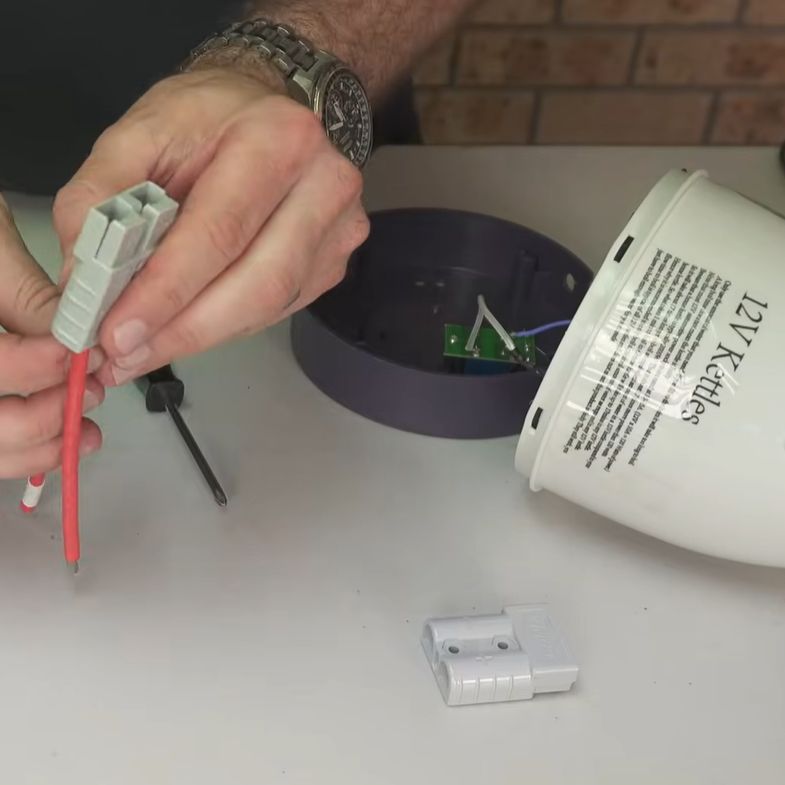
One change that does make a difference is how it’s connected. Replacing the thin gauge wiring and the attached cigarette lighter plug on the 12 VDC kettle with beefier cable and an Anderson plug made things run cooler, resulting in an efficiency bump of about 10%. This cut the time required to get the water boiling by around 6 minutes.

Added to this test were an induction hob and an iso-butane-powered Jetboil, both of which scored rather unimpressively. For the induction option it’s obvious that a lot of energy is wasted by having the pan radiate it away from the water, while burning iso-butane loses energy through the exhaust gases. Ultimately what you pick to boil water with should thus be mostly determined by convenience rather than sheer physics.

Continue reading “Addressing The Divisive Topic That Is Boiling Water”