Hackaday Links Column Banner

Hackaday Links: November 29, 2020

While concerns over COVID-19 probably kept many a guest room empty this Thanksgiving, things were a little different aboard the International Space Station. The four-seat SpaceX Crew Dragon is able to carry one more occupant to the orbiting outpost than the Russian Soyuz, which has lead to a somewhat awkward sleeping arrangement: there are currently seven people aboard a Station that only has six crew cabins. To remedy the situation, Commander Michael Hopkins has decided to sleep inside the Crew Dragon itself, technically giving himself the most spacious personal accommodations on the Station. This might seem a little hokey, but it’s actually not without precedent; when the Shuttle used to dock with the ISS, the Commander would customarily sleep in the cockpit so they would be ready to handle any potential emergency.

Speaking of off-world visitation, the Hayabusa2 spacecraft is nearly home after six years in space. It won’t be staying long though, the deep-space probe is only in the neighborhood to drop off a sample of material collected from the asteroid Ryugu. If all goes according to plan, the small capsule carrying the samples will renter the atmosphere and land in the South Australian desert on December 6th, while Hayabusa2 heads back into the black for an extended mission that would have it chasing down new asteroids into the 2030s.

Moving on to a story that almost certainly didn’t come from space, a crew from the Utah Division of Wildlife Resources recently discovered a strange metal monolith hidden in the desert. While authorities were careful not to disclose the exact coordinates of the object, it didn’t take Internet sleuths long to determine its location, in part thanks to radar data that allowed them to plot the flight path of a government helicopters. Up close inspections that popped up on social media revealed that the object seemed to be hollow, was held together with rivets, and was likely made of aluminum. It’s almost certainly a guerrilla art piece, though there are also theories that it could have been a movie or TV prop (several productions are known to have filmed nearby) or even some kind of military IR/radar target. We may never know for sure though, as the object disappeared soon after.

Even if you’re not a fan of Apple, it’s hard not to be interested in the company’s new M1 chip. Hackers have been clamoring for more ARM laptops and desktops for years, and with such a major player getting in the game, it’s only a matter of time before we start seeing less luxurious brands taking the idea seriously. After the recent discovery that the ARM version of Ubuntu can run on the new M1 Macs with a simple virtualization layer, it looks like we won’t have to wait too long before folks start chipping away at the Walled Garden.

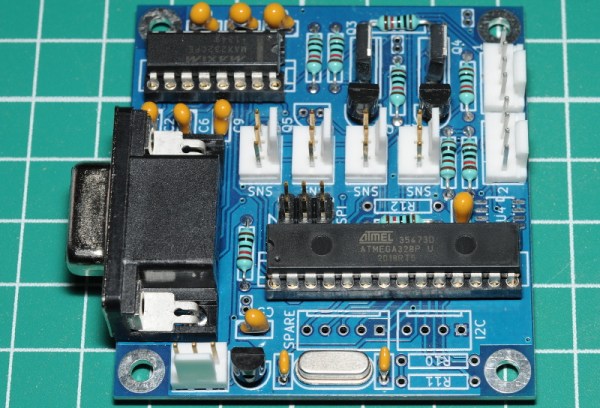
In the market for a three phase servo controller? A reader who’s working on a robotics project worth as much as a nice house recently wrote in to tell us about an imported driver that goes for just $35. Technically it’s designed for driving stepper motors, but it can also (somewhat inefficiently) run servos. Our informant tells us that you’d pay at least $2,000 for a similar servo driver from Allen-Bradley, so the price difference certainly seems to make up for the hit in performance.

Finally, some bittersweet news as we’ve recently learned that Universal Radio is closing. After nearly 40 years, proprietors Fred and Barbara Osterman have decided it’s time to start winding things down. The physical store in Worthington, Ohio will be shuttered on Monday, but the online site will remain up for awhile longer to sell off the remaining stock. The Ostermans have generously supported many radio clubs and organizations over the years, and they’ll certainly be missed. Still, it’s a well-deserved retirement and the community wishes them the best.

MQTT Dashboard Uses SHARP Memory LCD

One of the more interesting display technologies of the moment comes from Sharp, their memory display devices share the low power advantages of an e-ink display with the much faster updates we would expect from an LCD or similar. We’ve not seen much of them in our community due to cost, so it’s good to see one used in an MQTT dashboard project from [Raphael Baron].

The hardware puts the display at the top of a relatively minimalist 3D printed encloseure with the LOLIN32 ESP32 development board behind it, and with a plinth containing a small rotary encoder and three clicky key switches in front. The most interesting part of the project is surprisingly not the display though, because despite being based upon an ESP32 development board he’s written its software with the aim of being as platform- and display-independent as possible. To demonstrate this he’s produced it as a desktop application as well as the standalone hardware. A simple graphical user interface allows the selection of a range of available sources to monitor, with the graphical results on the right.

All code and other assets for the project can be found in a handy GitHub repository, and to put the thing through its paces he’s even provided a video that we’ve placed below the break. User interfaces for MQTT-connected devices can talk as well as listen, for example this MQTT remote control.

Continue reading “MQTT Dashboard Uses SHARP Memory LCD”

Making A “Unpickable” Lock

Every time manufacturers bring a new “unpickable” lock to market, amateur and professional locksmiths descend on the new product to prove them wrong. [Shane] from [Stuff Made Here] decided to try his hand at designing and building an unpickable lock, and found that particular rabbit hole to be a lot deeper than expected. (Video, embedded below.)

Most common pin tumbler locks can be picked thanks to slightly loose fits of the pins and tiny manufacturing defects. By lifting or bumping the pins while putting tension on the cylinder the pins can be made to bind one by one at the shear line. Once all the pins are bound in the correct position, it can be unlocked.

[Shane]’s design aimed to prevent the pins from being set in unlocked position one by one, by locking the all pins in whatever position they are set and preventing further manipulation when the cylinder is turned to test the combination. In theory this should prevent the person doing the picking from knowing if any of the pins were in the correct position, forcing them to take the difficult and time-consuming approach of simply trying different combinations.

[Shane] is no stranger to challenging projects, and this one was no different. Many of the parts had to be remade multiple times, even with his well-equipped home machine shop. The mechanism that holds the pins in the set position when the cylinder is rotated was especially difficult to get working reliably.  He explicitly states that this lock is purely an educational exercise, and not commercially viable due to its mechanical complexity and difficult machining.

A local locksmith was unsuccessful in picking the lock with the standard techniques, but the real test is still to come. The name [LockPickingLawyer] has probably already come to mind for many readers. [Shane] has been in contact with him and will send him a lock to test after a few more refinements, and we look forward to seeing the results! Continue reading “Making A “Unpickable” Lock”

DIY Induction Heater Draws 1.4 KW And Gets Metal Hot

Induction heaters can make conductive objects incredibly hot by generating eddy currents within the metal. They’re used in a wide variety of industrial processes, from furnaces to welders and even heat treatments. [Schematix] whipped up his own design, and put it through its paces on the bench.

The build in question is a fairly compact design, roughly shoebox-sized when fitted with its six-turn coil. Running off anything from 12 V to 48 V, the heater put out at a massive 1.4 kW in testing. At this power level, the high current draw led the power traces to heat up enough to melt solder, and eventually burn out. [Schematix] plans to rebuild the heater with added copper wiring along these traces to support the higher power levels without failure.

The heater is able to quickly heat ferrous metals, though was not able to meaningfully dump power into aluminium under testing. This is unsurprising, as non-ferrous metals primarily undergo only Joule heating from induction, forgoing the hysteresis portion of heat transfer due to being non-magnetic. However, modification to the design could improve performance for those eager to work with non-ferrous materials.

We’ve seen a few induction heaters before, for purposes as varied as soldering and casting. Video after the break.

Continue reading “DIY Induction Heater Draws 1.4 KW And Gets Metal Hot”

Advanced Printer Control Aims To Stop Idle Waste

3D printers are capable of creating complex geometries with a minimum of fuss, but one of the tradeoffs is the long period of time it takes to print a part. Often, printers are left to run for many hours with a minimum of supervision to complete their tasks. This can leave printers idling for long periods of time after their work is finished. Noting this, [TheGrim] put together the Advanced Printer Control.

The aim of the APC is to monitor 3D printers, and shut them off when their work is complete. The aim is to avoid leaving printers running for hours after their prints are finished, which causes needless wear on fans and screens which can have a limited life. This is achieved by putting an ESP8266 in charge of the printer’s AC power supply, via a triac. It measures the current drawn by the printer when idling and in use to set a baseline. Then, whenever the printer drops back to idle levels, a timer begins. When the timer runs out, the printer is switched off. There’s also an option to automatically trigger shutdown with an I/O pin, too.

It’s a project that aims to extend printer life and save power, too. Of course, if you’re really worried about power draw, you could use a solar powered printer instead. If you’ve got your own printer controller hacks, be sure to drop us a line.

A Clap-Activated Machine For All Your Applause Needs

Applause is greatly revered as a symbol of warmth and adoration from a crowd. TV shows that film in front of a live audience often cue their audiences to clap in order to generate the desired auditory atmosphere. Of course, you don’t have to rely on squishy humans to do all the work. [Dillon] built a machine of dubious utility – one which generates mechanical applause when activated by the sound of clapping. (Video, embedded below.)

Somewhat unsurprisingly, the project was built for a Useless Machine contest, but that doesn’t diminish its value as a learning exercise. An Arduino runs the show, using a microphone module to listen out for loud noises such as claps. If two claps are detected in the nominated timeframe, the machine begins to flash its “APPLAUSE” lights and clap its hands. The Arduino achieves this with the help of a relay, which switches on a motor spinning a belt-driven cam which seperates the hands. The hands are then pulled back together to clap via a length of stretchy bungee cord.

With an incredibly noisy drivetrain and somewhat amateur clapping ability, the sound coming from the machine isn’t exactly recognisable as “applause”. However, it’s a start, and it remains the best clapping machine we’ve seen this decade. If you’ve got your own under construction, consider dropping us a line. And if all this has you waxing nostalgic for the vintage Clapper circuit, you can always build one of those, too.

Continue reading “A Clap-Activated Machine For All Your Applause Needs”

Open Hardware GPS Tracker Works On Your Terms

These days, there’s plenty of options if you want to get a GPS tracker for your vehicle. Unfortunately, they come with the sort of baggage that’s becoming increasingly common with consumer tech: subscription fees, third-party snooping, and a sneaking suspicion that you’re more commodity than customer. So [Viktor Takacs] decided to take things into his own hands and create an open GPS tracker designed for privacy minded hackers.

As [Viktor] didn’t want to reinvent the wheel, his design leverages several off-the-shelf modules. The core of the tracker is the ESP32, which gives him plenty of computational power while still keeping energy consumption within reasonable levels. There’s also a NEO-6M GPS receiver which works at the same 3.3 V level as the ESP32, allowing the microcontroller to read the NMEA sentences without a level shifter. He decided to go with the low-cost SIM800L GSM modem, but as it only works on 2G networks, provisions have been made in the board design to swap it out for a more modern module should you desire.

For the code to glue it all together, [Viktor] pulled in nearly a dozen open source libraries to create a feature-complete firmware that uses MQTT to create a database of location data on his personal server. From there the data is plugged into Home Assistant and visualized with Grafana. This is enough to deliver core functionality, but he says that more custom software components as well as a deep-dive into the security implications of the system is coming in the near future.

We’ve seen custom built GPS trackers before, as generally speaking, it doesn’t take a whole lot to spin up your own solution. But we think the polish that [Viktor] has put on this project takes it to the next level, and ranks it up there among some of the most impressive bespoke tracking solutions we’ve seen over the years.