You hold in your hand a circuit board from a product you didn’t make. How does the thing work? What a daunting question, but it’s both solvable and approachable if you know what you’re doing. The good news is that Eric Schlaepfer knows exactly what he’s doing and boiled down the process of reverse engineering printed circuit boards into this excellent workshop. It was presented live during the 2020 Hackaday Remoticon, and the edited video, which you’ll find below, was just published. Slides for the talk have been published on the workshop project page.
Sure, the SpaceX crew made it safely to the ISS, but there’s plenty happening beyond just that particular horizon. The Chinese National Space Administration have launched their Chang’e 5 mission to collect and return lunar rock samples, a collaboration between NASA and ESA to do the same with samples from Mars has passed its review, and a pair of satellites came uncomfortably close to each other in a near-miss that could have had significant orbital debris consequences. It’s time for Spacing Out!
Bringing Alien Rocks to Earth
The Chang’e 5 mission on the launch pad. China News Service, CC BY 3.0.
Ever since the NASA and Soviet lunar launches at the height of the Space Race, there have been no new missions to collect material from the Lunar surface and return it to Earth. That changed last week.
Not to be outdone in the field of ambitious sample return missions, NASA and ESA’s joint plan to collect and return rock core samples from Mars has met with the approval of the independent review board set up to examine it. This will involve multiple craft from both agencies, with NASA’s already launched Perseverance rover collecting and containing the samples before leaving them on the surface for eventual collection by a future ESA rover. This will then pass them to a NASA ascent craft which will take them to Martian orbit and rendezvous with an ESA craft that will return them to Earth. We space-watchers are in for an exciting decade.
That Was a Close One!
Anyone who has seen the film Gravity will be familiar with the Kessler syndrome, in which collisions between spacecraft and or debris could create a chain reaction of further collisions and render entire orbital spheres unusable to future craft because of the collision hazard presented by the resulting cloud of space debris. Because of this, spacecraft operators devote considerable resources towards avoiding such collisions, and it is not uncommon for slight orbital adjustments to be made to avoid proximity with other orbiting man-made objects.
On the 27th of November it seems that these efforts failed, with a terse announcement from Roscosmos of a near-miss between their Kanopus-V craft and the Indian CARTOSAT 2F. The two remote-imaging satellites passed as close as 224 metres from each other, which in space terms given their likely closing speeds would have been significantly too close for comfort. The announcement appears worded to suggest that the Indian craft was at fault, however it’s probably a fairer conclusion that both space agencies should have seen the other’s satellite coming. Fortunately we escaped a catastrophe this time, but it is to be hoped that all operators of such satellites will take note.
RocketLab Joins the Reusable Booster Club
Other recent launches that might excite the interest of readers are the New Zealand-based RocketLab launching their Electron rocket with 30 small satellites on board before for the first time retrieving their booster stage, and the Japanese Mitsubish Electric sending their JDRS-1 satellite to geosynchronous orbit. This last craft is of interest because it carries an optical data link rather than the more usual RF, and could prove the technology for future launches.
The coming weeks should be full of news from China on Chang’e 5’s progress. Getting a craft to the moon and returning it will be a huge achievement, and we hope nothing fails and we’ll see pictures of the first new Moon rocks on Earth since the 1970s. We don’t know how to say “Good luck and a successful mission!” in Chinese, so we’ll say it in English.
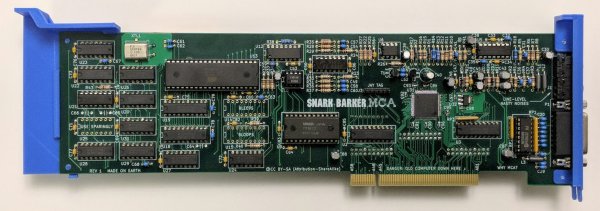
Not many people today probably remember what ‘Micro Channel Architecture’ was about, though its acronym ‘MCA’ might ring a bell. Created by IBM to replace ISA (Industry Standard Architecture) and presumably claw back some of that sweet, sweet licensing money, it didn’t quite pan out as IBM hoped. As history shows us, PCI ended up replacing MCA in all of IBM’s systems. The IBM PS/2 systems that used MCA didn’t miss out on classic 1990s cards, such as the original Sound Blaster, but today MCA versions of the Sound Blaster are admittedly rather… rare, not to mention expensive.
But, no longer: decades after the last PS/2 users have moved on, [Tube Time] proudly presents the Snark Barker MCA. It’s a fully Sound Blaster compatible sound card. It supports AdLib synthesis, digital sound playback and recording, as well as a joystick input and MIDI. Based around a Xilinx XC9572XL CPLD and featuring what looks like a full-length MCA card, it would have made an original Sound Blaster card proud.
The GitHub repository not only contains the schematics, BOM and Verilog-based HDL for the CPLD, but also extensive documentation on the assembly and programming. As a bonus, there’s a troubleshooting section which covers some of the joys that came with the sloppy implementations of MCA across systems. Definitely worth a read.
If anyone decides to build this project and use it in their IBM PS/2 system, we would love to hear about it.
Of course, if all you need is a garden variety PCI Sound Blaster clone, the original Snark Barker is the way to go.
Let’s Encrypt was founded in 2012, going public in 2014, with the aim to improve security on the web. The goal was to be achieved by providing free, automated access to SSL and TLS certificates that would allow websites to make the switch over to HTTPS without having to spend any money.
Hundreds of millions of sites rely on Let’s Encrypt for their HTTPS certificate needs. HTTPS security helps protect sites and users, and makes it harder for malicious actors to steal private information.
When Let’s Encrypt first went public in early 2016, they issued their own root certificate, by the name ISRG Root X1. However, it takes time for companies to include updated root certificates in their software, so until recently, all Let’s Encrypt certificates were cross-signed by an IdenTrust certificate, DST Root X3. This certificate had been around much longer, and was already supported by the vast majority of OSes and browsers in regular use. This allowed Let’s Encrypt to hit the ground running while they waited for the majority of software to support their own root certificate. Continue reading “Let’s Encrypt Will Stop Working For Older Android Devices”→
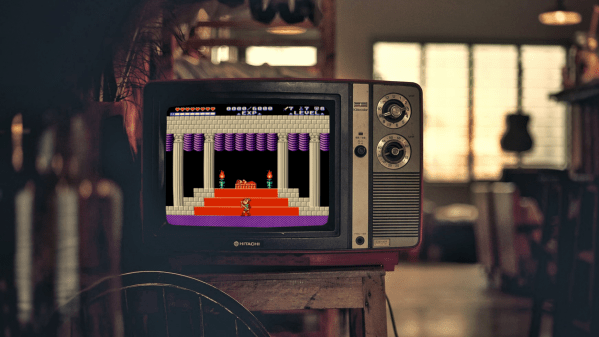
Going back to classic games can be a difficult experience. The forward passage of time leaves technology to stagnate, while the memories attached to those old games can morph in mysterious ways. Therein lies the problem with how you remember a game playing versus the reality of how it actually does. Developer [Jorge] saw that situation arising around Zelda II: The Adventure of Link, and it inspired him to create the Zelda II Redux ROM hack.
Years in the making, Zelda II Redux takes a relatively light-handed approach to revising the original NES game. Graphical enhancements include: a reworked HUD complete with the series’ tradition of hearts, animated enemy icons in the over world, a new title screen, and giving Link the shield from the Famicom Disk System release’s box art. Text speed has been increased and a revised translation of the Japanese script has been incorporated. Under the hood, all sorts of boss battles have been re-balanced while casting magic spells doesn’t require multiple return trips to the pause menu. Though Zelda II Redux’s most important feature may be the inclusion of manual saving via “Up + A” on the pause menu. There are also a whole host of other changes Zelda II Redux incorporates in order to bring Link’s second adventure more inline with the rest of the Legend of Zelda series that can be found on the project’s change log.
To play Zelda II Redux requies an IPS patching program, like LunarIPS, along with a clean dumped image of Zelda II: The Adventure of Link. Dumping NES cartridges is easier than ever these days due to many cartridge dumper devices being plug-and-play over USB. A successfully patched ROM file can be played in an emulator or on actual NES hardware through a flash cart. A video of a tool-assisted speedrun has been included below, so there may be some new strategies to employ. Continue reading “Zelda II Redux ROM Hack Plays How You Remember The Original”→
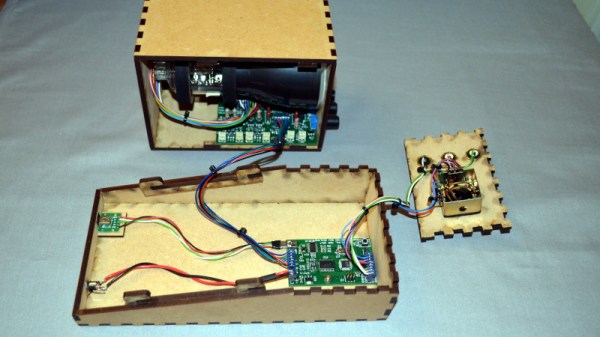
Over the years we’ve seen quite a few projects involving vector graphics, but the spaceship game created by [Mark Aren] especially caught our eye because in it he has tackled building a vector display from scratch rather than simply using a ready-made one such as an oscilloscope. As if the vector game itself wasn’t interesting enough, the process of designing the electronics required to drive a CRT is something that might have been commonplace decades ago but which few electronics enthusiasts in 2020 will have seen.
In his write-up he goes into detail on the path that took him to his component choices, and given the unusual nature of the design for 2020 it;s a fascinating opportunity to see the job done with components that would have been unheard of in the 1950s or 1960s. He eventually settled on a high voltage long-tailed pair of bipolar transistors, driven by a single op-amp to provide the differential signal required by the deflection electrodes. The mix of old and new also required a custom-fabricated socket for the CRT. On the game side meanwhile, an ATmega328 does the heavy lifting, through a DAC. He goes into some detail on DAC selection, having found some chips gave significant distortion.
All in all this is an impressive project from all angles, and we’re bowled over by it. Of course, if you fancy a play with vector graphics, perhaps there’s a simpler way.
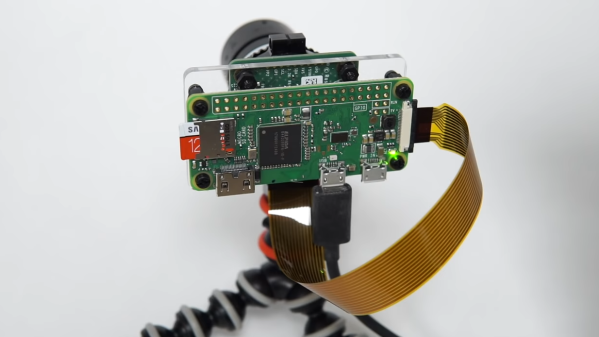
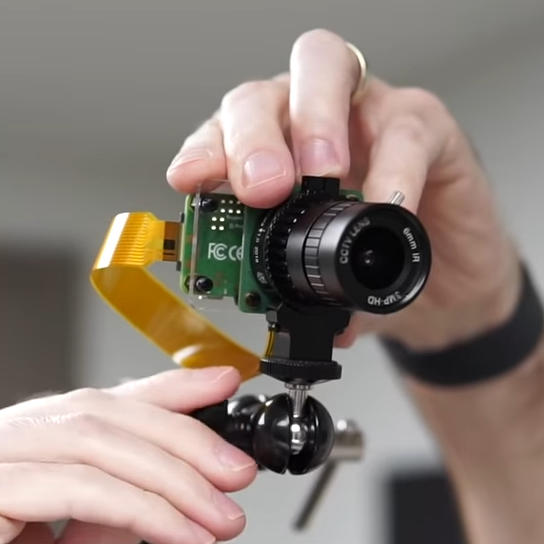
More people working from home has had an impact on the cost and availability of USB webcams, so [Jeff Geerling] got around the issue with a DIY solution that rang in around $100. It consists of a Raspberry Pi and HQ camera module acting as a USB webcam, and there is no messy streaming of ffmpeg over the network masquerading as a camera device or anything. It works just as a USB camera should.
[Jeff] chose a Raspberry Pi Zero and HQ camera module for his unit, making a tidy package that might not be quite as small as commercial webcams, but is certainly perfectly respectable as a USB camera. That being said, there are a few drawbacks, namely the lack of a microphone or autofocus, latency issues at higher resolutions, and the need to shut down the Pi cleanly.
Check out the GitHub repository for everything needed to set up your own, including a complete hardware list and some options for mounting. [Jeff] also tested whether the camera would work with the new keyboard-embedded Raspberry Pi 400, and it absolutely does. Embedded below is a video walkthrough and demonstration of the whole project, so check it out.