Olaf Lets An ESP32 Listen To The Music

The joys of overengineering a simple gift. [Joren] wanted to create a dress for his daughter’s fourth birthday that would react with lights in sequence for a song from Frozen. The dress and an LED strip, along with a digital microphone and a battery were easy to procure. But how to make it all work? An ESP32 did the trick.

While the project’s name–Olaf–sounds like it was from Frozen, according to the GitHub page it actually means Overly Lightweight Acoustic Fingerprinting. Right. However, as the name implies, it can learn to identify any sound you want.

Continue reading “Olaf Lets An ESP32 Listen To The Music”

Read My Lips, Under This No-Sew Mask

Humans continuously communicate with our bodies, and face masks cover one of the most expressive parts. For some, this is a muffler on strangers, but devastating for people who rely on lip-reading. Several masks exist that have a clear window for precisely this purpose, but they’re specialty and high-demand. [Erin St Blaine] over at Adafruit shows how she makes windowed masks with stuff you may already have in your house. Even if your sewing machine is locked up the local maker-space, you are in luck, because you don’t need a single stitch. For the thread-inclined, it is easy to tweak the recipe.

The part of the mask that touches your face is terry cloth, but any breathable cotton towel should work. There is a PDF in the instructions where you can print templates in four sizes. You will also find a cutout for the plastic window salvaged from your cold soft drink cup. A water bottle should work too. Flexible glue holds the fabric together, but to attach the ear-loops, we fall back on our old friend, the red Swingline. If you don’t have that color and brand, any stapler will do in a pinch. Don’t forget to add some defogger and keep smiling.

Wear your homemade mask proudly and fasten it well, but not too fast.

Continue reading “Read My Lips, Under This No-Sew Mask”

RC HalfTrack Is Lasercut Masterpiece

The half-track is a vehicle design that has gradually fallen out of favour in the decades since World War II. Combining the benefits of easy driving and handling of wheeled vehicles with the strong mud and snow performance of a tracked vehicle, they served a niche before largely being phased out with the rise of the armoured personnel carrier. [JackCarter] wished to build his own, so whipped up a lasercut RC version of the SdKfz 251 22.

The work is impressive, with [JackCarter] creating the design in Solidworks from photos and illustrations of the vehicle. The moving parts are lasercut, including the tracks themselves, assembled from many tiny lasercut MDF parts. The benefit of using lasercutting to make the model is that it was easy for [Jack Carter] to create simple jigs to ease the process of putting the tracks together. A NodeMCU with a motor shield controls the gear motors used to drive the tracks, and drives a servo for steering. Control is via a smartphone, thanks to the Blynk framework which makes building apps for custom projects easy.

The finished product really shows off [JackCarter]’s 3D design skills, and looks like great fun to build and drive. We’d love to see it with a lick of paint and some period decals to really complete the look. Hackers love a good tracked vehicle, and we’ve seen some impressive builds before. Video after the break.

Continue reading “RC HalfTrack Is Lasercut Masterpiece”

SDR Transmitting Gets The Power

Most hobby-grade software defined radio setups don’t transmit. Of the few that do, most of them put out anemic levels around one milliwatt or so. If you want to do something outside of the lab, you’ll need an amplifier and that’s what [Tech Minds] shows how to do in a recent video. (Embedded below.)

The video covers LimeSDR, HackRF, and the Pluto SDR, although the amplifiers should work with any transmitter. The SPF5189Z module is quite cheap and covers 50 MHz to 4 GHz, amplifying everything you throw at it. The downside is that it will amplify everything you throw at it, even parts of the signal you don’t want, such as spurs and harmonics.

Continue reading “SDR Transmitting Gets The Power”

A Tiny Jacob’s Ladder You Can Build At Home

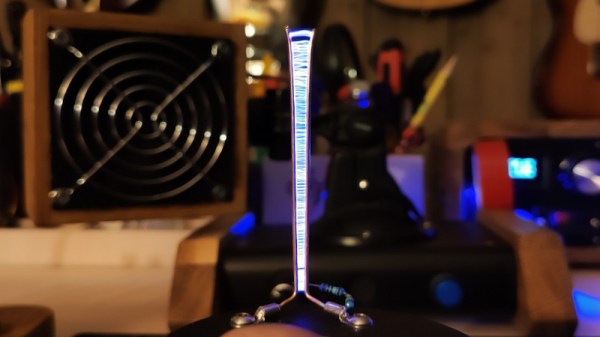
Big fizzing electrical arcs are fun, and handled properly, not too dangerous either. The Jacob’s Ladder is one such piece of arc-generating equipment, one that featured heavily in vintage sci-fi films. It remains a charming demonstration of high-voltage electrical principles, and you can easily build your own mini version at home.

The build starts with a basic high-voltage step-up kit that turns 4V DC into 15 kV at the output. At this voltage level, it’s possible to generate an arc in air. To create the Jacob’s ladder, the kit is wired up to a pair of closely-spaced electrodes that slowly get farther apart as they go up vertically. When an arc jumps from one electrode to the other, it ionises the air, and the voltage sags due to the current flow. The flowing current heats up the air, which begins to rise, taking the current path with it, causing the familiar climbing arc we all know and love. As the distance between the electrodes increases towards the top, the arc can eventually no longer be sustained. With no current flowing, the voltage rises again, and a new arc forms at the bottom of the device, repeating the process.

It’s a fun build that would make an excellent desk toy, albeit best shown under glass to avoid accidental electric shocks. You can even build a larger one out of microwave parts if you’re so inclined. Video after the break.

Continue reading “A Tiny Jacob’s Ladder You Can Build At Home”

UnifiedWater Finds Potable Water And Stops Polluters

Millions of people all over the world don’t have access to clean drinking water, and it’s largely because of pollution by corporations and individuals. Solving this problem requires an affordable, scalable way to quickly judge water quality, package the data, and present it to an authority that can crack down on the polluters before the evidence dissipates. Ideally, the solution would be open source and easy to replicate. The more citizen scientists, the better.

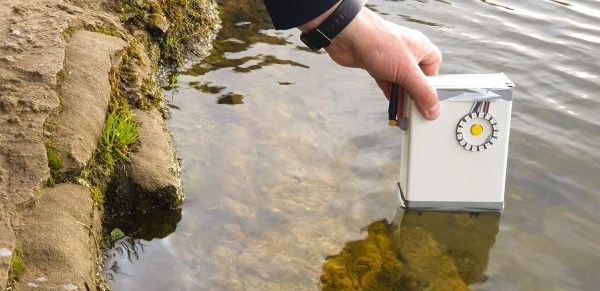
[Andrei Florian]’s UnifiedWater flows directly from this line of thinking. Dip this small handheld device below the surface, and it quickly takes a bunch of water quality and atmospheric readings, averages them, and sends the data to a web dashboard using an Arduino MKR GSM.

UnifiedWater judges quality by testing the pH and the turbidity of the water, which gauges the amount of impurities. Commercial turbidity sensors work by measuring the amount of light scattered by the solids present in a liquid, so [Andrei] made a DIY version with an LED pointed at a photocell. UnifiedWater also reads the air temperature and humidity, and reports its location along with a timestamp.

This device can run in one of two modes, depending on the application. The enterprise mode is designed for a fleet of devices placed strategically about a body of water. In this mode, the devices sample continuously, taking readings every 15 minutes, and can send notifications that trigger on predefined thresholds. There’s also a one-and-done individual mode for hikers and campers who need to find potable water. Once UnifiedWater takes the readings, the NeoPixel ring provides instant color-coded judgment. Check out the demo after the break.

Continue reading “UnifiedWater Finds Potable Water And Stops Polluters”

Easy-To-Use Music Player Relies On RFID

Microwaves used to be simple to use. Set the dial for the desired time, and hit start. Then, everything went digital and the average microwave now takes between four and six button presses in precise order just to start heating. Music players have gone down a similar path, and those that grew up in the era of vinyl records can find modern digital media simply too hard to work with. To solve this problem, [ananords] whipped up Juuke, a music player focused on ease of use.

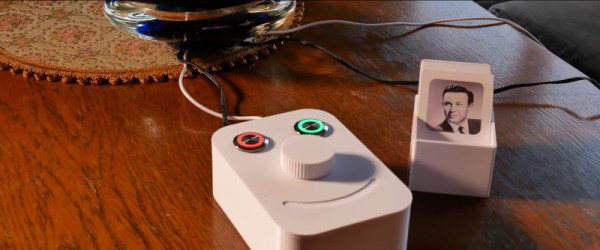
The Juuke has a simplistic interface intended to be as easy to use as possible. Songs are selected using printed cards with embedded RFID tags – placing them on the Juuke triggers playback. Volume is controlled with a simple knob, and the only two buttons are for play/pause and shuffle mode.

Underneath, an Arduino Uno runs the show, hooked up to a RC522 RFID interface board. Music is handled by the DFPlayer mini, which loads tracks off a microSD card. The DFPlayer can be hooked up to a speaker directly, but there’s also a 3.5mm jack output if the device is to be used with an external amplifier.

It’s a tidy project, and one that actually looks pretty fun to use. Obviously, there’s some time investment required to prepare the SD card and produce the RFID cards, but the final product could be fun to use at a party, too. We’ve seen similar builds before, as well. Video after the break.

Continue reading “Easy-To-Use Music Player Relies On RFID”