ISS Ham Radio Repeater

There is a long history of spacecraft carrying ham radio gear, as the Space Shuttle, Mir, and the ISS have all had hams aboard with gear capable of talking to the Earth. However, this month, the ISS started operating an FM repeater that isn’t too dissimilar from a terrestrial repeater. You can see [TechMinds] video on the repeater, below.

The repeater has a 2 meter uplink and a 70 centimeter downlink. While you can use a garden variety dual-band ham transceiver to use the repeater, you’ll probably need a special antenna along with special operating techniques.

Continue reading “ISS Ham Radio Repeater”

Reverse Engineering A Module From A Vacuum Tube Computer

It’s best to admit upfront that vacuum tubes can be baffling to some of the younger generation of engineers. Yes, we get how electron flow from cathode to anode can be controlled with a grid, and how that can be used to amplify and control current. But there are still some things that just don’t always to click when looking at a schematic for a tube circuit. Maybe we just grew up at the wrong time.

Someone who’s clearly not old enough to have ridden the first wave of electronics but still seems to have mastered the concepts of thermionic emission is [Usagi Electric], who has been doing some great work on reverse engineering modules from old vacuum tube computers. The video below focuses on a two-tube pluggable module from an IBM 650, a machine that dates clear back to 1954. The eBay find was nothing more than two tube sockets and a pair of resistors joined to a plug by a hoop of metal. With almost nothing to go on, [Usagi] was still able to figure out what tubes would have gone in the sockets — the nine-pin socket was a big clue — and determine that the module was likely a dual NAND gate. To test his theory, [Usagi] took some liberties with the original voltages used by IBM and built a breakout PCB. It’s an interesting mix of technologies, but he was able to walk through the truth table and confirm that his module is a dual NAND gate.

The video is a bit long but it’s chock full of tidbits that really help clear up how tubes work. Along with some help from this article about how triodes work, this will put you on the path to thermionic enlightenment.

Continue reading “Reverse Engineering A Module From A Vacuum Tube Computer”

Surfboard LED Strips Light Up The Waves

Surfing is an activity predominantly enjoyed during the day, primarily for reasons of warmth and water safety. Of course, if you prefer to carve the waves at night, you might enjoy the latest project from [Moritz Sivers] – a surfboard kitted out with motion-reactive LEDs.

The build consists of a regular surfboard, with a channel cut around the perimeter into which WS2812B LED strips are glued. Powered by a lithium rechargable battery, commands are given by an Arduino Nano hooked up to a MPU6050 3-axis gyroscope. This allows the Arduino to change the light patterns based on the movement of the board. Left and right turns, pumping the board, and surfing down a wave all come with their own animations.

It’s a fun twist on night surfing, and makes it easier to spot a downed surfer, too. It’s a build we expect to see recreated in a high-end 4K surf film before the year is out. Of course, if you just need to know if the conditions are right before you head out, this surf weather station might be just the build for you. Video after the break. Continue reading “Surfboard LED Strips Light Up The Waves”

Eye-Catching And Crumb-Suspending

Printed circuit boards used to be green or tan, and invariably hidden. Now, they can be artful, structural, and like electronic convention badges, they are the entire project. In this vein, we find Open LEV, a horseshoe-shaped desktop bauble bristling with analog circuitry supporting an acoustic levitator. [John Loefler] is a mechanical engineer manager at a college 3D printing lab in Florida, so of course, he needs to have the nerdiest stuff on his workspace. Instead of resorting to a microcontroller, he filled out a parts list with analog components. We have to assume that the rest of his time went into making his PCB show-room ready. Parts of the silkscreen layer are functional too. If you look closely at where the ultrasonic transducers (silver cylinders) connect, there are depth gauges to aid positioning. Now that’s clever.

Continue reading “Eye-Catching And Crumb-Suspending”

Credit: Lewin Day

The O-Bahn Busway – Obscure Transit For The Masses

Around the world, governments and city planners have long struggled with the issue of transport. Getting people where they need to be in a timely fashion is key to making a city a comfortable, attractive place to live. As far as public transport is concerned, this typically consists of buses on the roads, and trams and trains on rails.

Down in the city of Adelaide, Australia, things get a little muddled, however. Nestled in a river valley lies a special  transportation network known as the O-Bahn, where buses ride on concrete rails and the drivers can even take their hands off the wheel. The system remains a rarity worldwide, and was spawned by a perfect storm of conflicting requirements.

A Child of Circumstance

In the 1970s, the South Australian government found itself backed into a corner. Facing a booming population in the north-eastern suburbs, new transport links with greater capacity were needed to get people to the central business district. Original plans from the 1960s had called for more freeways to be built all over the city to solve the problem. In the face of stiff public opposition, legislation was passed in 1970 blocking the construction of any new freeways for a full decade, forcing the government to consider alternatives.

O-Bahn buses passing at speed near Stephens Terrace. Buses formerly reached speeds up to 100 km/h on the network; this was dropped to 85 km/h in 2012, adding 20 seconds to the average run. Credit: Lewin Day

Despite plans being shelved, a corridor of land stretching from the city to the north-east had already been acquired for freeway construction. This was retained, and studies were commissioned to determine the best transportation solution to suit the needs of the area. The “North East Adelaide Public Transport Review” suggested light-rail or a busway would be the best solution.

Initial plans were proposed to link the north-east with a light-rail tramway that would connect with the existing tramline from the city proper to Glenelg in the west. However, the City of Adelaide protested the plan, believing that extending the existing tramline to the east would damage the city’s carefully planned structure.  Plans were made to rectify this by running part of the line underground, massively increasing costs, and the proposal was shelved.

It was at this time, the guided busway in Essen, Germany came to the attention of the state government. Aiming to help reduce congestion by allowing buses to share tram tunnels, it began as a demonstration which later developed into the Spurbus network. The system offered lower cost and higher flexibility than light rail, and avoided the need to carve up the city to hook in to the existing light rail network. Had Adelaide laid out its existing heavy or light rail networks differently, the O-Bahn might not have gotten a look in. However, back in the early 1980s, it was an easy solution in a sea of difficult choices.

Continue reading “The O-Bahn Busway – Obscure Transit For The Masses”

Garbage Can Takes Itself Out

Home automation is a fine goal but typically remains confined to lights, blinds, and other things that are relatively stationary and/or electrical in nature. There is a challenge there to be certain, but to really step up your home automation game you’ll need to think outside the box. This automated garbage can that can take itself out, for example, has all the home automation street cred you’d ever need.

The garbage can moves itself by means of a scooter wheel which has a hub motor inside and is powered by a lithium battery, but the real genius of this project is the electronics controlling everything. A Raspberry Pi Zero W is at the center of the build which controls the motor via a driver board and also receives instructions on when to wheel the garbage can out to the curb from an Nvidia Jetson board. That board is needed because the creator, [Ahad Cove], didn’t want to be bothered to tell his garbage can to take itself out or even schedule it. He instead used machine learning to detect when the garbage truck was headed down the street and instruct the garbage can to roll itself out then.

The only other thing to tie this build together was to get the garage door to open automatically for the garbage can. Luckily, [Ahad]’s garage door opener was already equipped with WiFi and had an available app, unbeknownst to him, which made this a surprisingly easy part of the build. If you have a more rudimentary garage door opener, though, there are plenty of options available to get it on the internets.

Continue reading “Garbage Can Takes Itself Out”

3D-Printed Thermite Brings The Heat, And The Safety

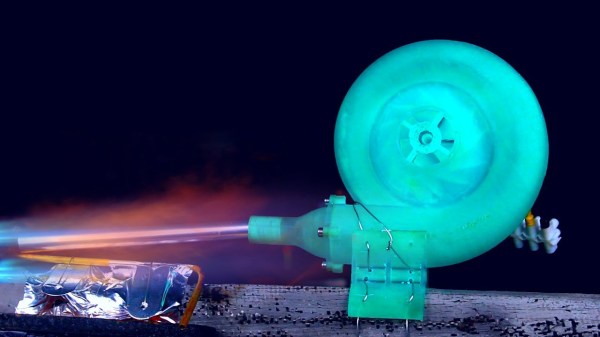
Thermites are a double-edged sword. Packing a tremendous energy density, and eager to produce tremendous heat when ignited, thermite is great for welding train tracks. But sometimes you might be looking for a little more finesse. A new approach to 3D printing thermites might just be able to tame the beast.

Most of us do our soldering while sitting safely indoors in a comfortable climate. The biggest dangers we’re likely to face are burnt fingertips, forgetting the heat shrink, or accidentally releasing the smoke monster. But outside of our homes and workshops, there’s a lot of extreme joining of metals going on. No matter where it’s done, welding and brazing in the field requires a lot of equipment, some of which is unwieldy and even more difficult to move around in harsh conditions.

Welding railroad tracks with thermite. Image via YouTube

The utility of brazing is limited by all the complex scaffolding of hardware required to support it. This limiting factor and the discovery of thermite led to exothermic welding, which uses an energetic material to provide enough heat to melt a filler metal and join the pieces. Energetic materials can store a lot of chemical energy and forcefully release it in a short period of time.

Thermites are made of metal oxide and metal powder, often iron oxide and aluminium. When ignited by a source of high heat, thermite compounds undergo an exothermic reduction-oxidation (redox) reaction as the aluminium reduces the number of electrons in the iron oxide atoms. More heat makes the reaction run faster, generating more heat, and so on. The result is molten iron and aluminium oxide slag.

Continue reading “3D-Printed Thermite Brings The Heat, And The Safety”