A 4-Player Arcade Hidden Inside A Coffee Table

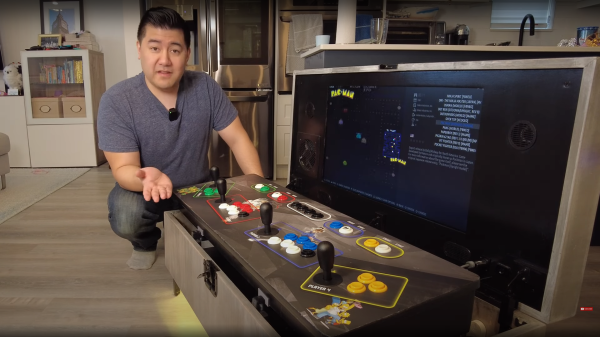
[Ed] from 50% Awesome on YouTube wanted to build a retro gaming system with a decent screen size, but doesn’t have a great deal of space to site it in, so a good compromise was to make a piece of useful furniture and hide all the fun parts inside.
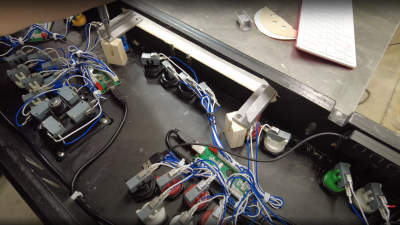
Building an arcade machine usually involves a lot of wiring

This video two-part build log shows a lot of woodwork, with a lot of mistakes (happy accidents, that are totally fine) made along the way, so you do need to repeat them. Essentially it’s a simple maple-veneered plywood box, with a thick lid section hosting the display and some repositioned speakers. This display is taken from a standard LG TV with the control PCB ripped out. The power button/IR PCB was prised out of the bezel, to be relocated, as were the two downwards-facing speakers. The whole collection of parts was attached to a front panel, with copious hot glue, we just hope the heavy TV panel was firmly held in there by other means!

Continue reading “A 4-Player Arcade Hidden Inside A Coffee Table”

My Great-Great-Grandad, The Engineer Who Invented A Coffee Pot

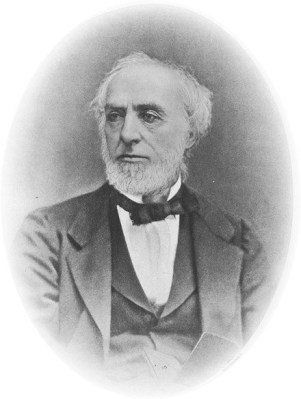
In the study of genealogy it’s common to find people who will go to great lengths involving tenuous cross-links to establish royalty or famous figures such as George Washington or William Shakespeare in their family tree. There’s no royal blood and little in the way of fame to be found in my family tree, but I do have someone I find extremely interesting. One of my great-great-grandfathers was a Scottish engineer called James R Napier, and though his Wikipedia entry hasn’t caught up with this contribution to 1840s technology, he was the inventor of the vacuum coffee pot.

James R NapierHe was born in Glasgow in 1821 and was the son of a successful shipbuilder, Robert Napier, into whose business he followed once he’d received his education. He’s probably most well known today for his work in nautical engineering and for inventing Napier’s Diagram, a method for computing magnetic deviance on compass readings, but he was also a prolific engineer and author whose name crops up in fields as diverse as air engines, weights and measuresdrying timber, and even the analysis of some dodgy wine. The coffee percolator was something of a side project for him, and for us it’s one of those pieces of family lore that’s been passed down the generations. It seems he was pretty proud of it, though he never took the trouble to patent it and and thus it was left to others to profit from that particular invention.
Vacuum Coffee Pots: Impressive, But Slooow

Just what is a vacuum coffee pot, and what makes it special? The answer lies in the temperature at which it infuses the coffee. We take for granted our fancy coffee machinery here in the 21st century, but a century and a half ago the making of coffee was a much simpler and less exact process. Making coffee by simply boiling grounds in water can burn it, imparting bitter flavours, and thus at the time a machine that could make a better cup was seen as of some importance. Continue reading “My Great-Great-Grandad, The Engineer Who Invented A Coffee Pot”

RoboGaggia Makes Espresso Coffee On Its Own

[Nicholas DiPatri] very much loves his Gaggia Pro. It’s an amazing espresso machine, but it’s also kind of fussy and requires a lot of manual attention to brew a cup. As an engineer, he set about fettling the machine to run with a little less oversight. Enter RoboGaggia.

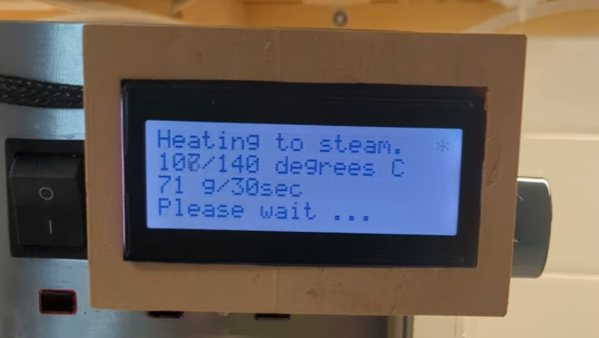
Stock, the Gaggia Pro requires regular water refills. The coffee-thirsty user must also wait for the brew heater to reach temperature before clicking the go button. Knowing the weight of coffee in the machine is key to getting the brew right, too. Steaming must also be done by hand. Overall, it’s a lot of work.

[Nicholas]’s goal was to get the machine to a point where he could load it with fresh ground coffee, hit a button, and walk away. On his return, the machine should be ready for steam. To achieve this, he went ham on outfitting the Gaggia Pro with fancy modern equipment. It scored a scale that sits in the drip tray, PID temperature controllers, a flow rate controller to manage the extraction profile, and an auto-fill water reservoir. The entire brew process is carried out under the command of a microcontroller, with live telemetry also sent to Adafruit.io for logging.

It’s by no means a lightweight project, but [Nicholas] has shared files on Github for the curious. However, if you’re in love with your Italian espresso machine and don’t want to switch, this might just be the kit you need to end your morning headaches. After all, when we’re in need of coffee, we’re at our worst for managing a complicated chemical processing plant. Video after the break.

Continue reading “RoboGaggia Makes Espresso Coffee On Its Own”

Coffee Grinder Gets Bluetooth Weighing

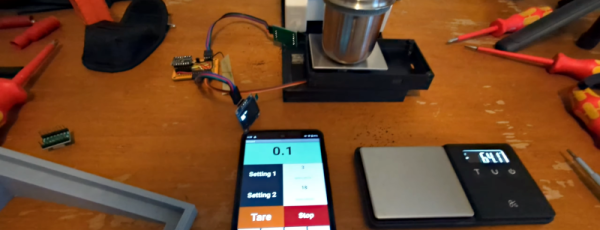
Some people take their coffee grinding seriously. So what do you do when the hot new grinders automatically weigh coffee, and yours doesn’t? Well, if you are like [Tech Dregs] and the rest of us, you hack your existing grinder, of course. The link is to the source code, but for a quick overview, check out the video below.

In true hacker fashion, the first order of business was to pull a load cell out of a cheap scale. Originally, he intended to reuse the processor inside, too, but it was epoxied, so it was a good excuse to use some more modules. A load cell amplifier, an OLED display, and a tiny Xiao processor, which he describes as “ridiculous.” From the context, we think he means ridiculously small in the physical sense and ridiculously powerful for such a tiny board.

With the modules, the wiring wasn’t too hard, but you still need some kind of app. Thanks to App Inventor, an Android app was a matter of gluing some blocks together in a GUI. Of course, the devil is in the details, and it took a lot of “focused cursing” to get everything working correctly.

The coffee grinder has a relay to turn the motor on and off, so that’s the point the scale needs to turn the motor on and off. Conveniently, the grinder’s PCB had an unpopulated pin header for just this purpose.

This is one of those simple projects you can use daily if you drink coffee. We are always impressed that the infrastructure exists today and that you can throw something like this together in very little time without much trouble.

WiFi hacking coffee makers is a popular Java project in these parts. Upgrading a machine can get pretty serious with PID control loops and more.

Continue reading “Coffee Grinder Gets Bluetooth Weighing”

Model Train Delivers Fresh Coffee

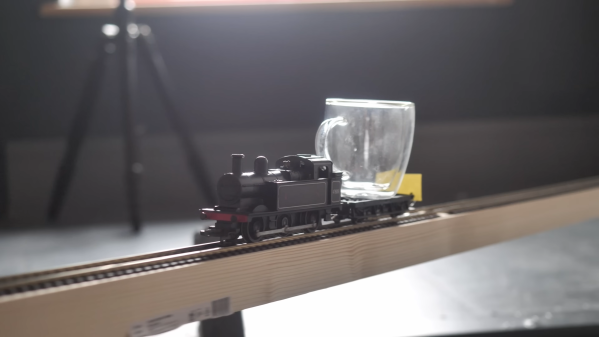
Model trains are good fun, though few of them serve any purpose beyond amusement or authentic railway simulation. [ProjectAir] decided to put his model train to practical use by having it deliver fresh espresso, and faced plenty of difficult challenges along the way.

It sounds simple, but the practicalities of the task proved difficult. After all, even a slight wobble is enough to tip a coffee cup off a small train. Automating everything from the railway itself to the kitchen coffee machine was no mean feat either. Plus, the aim was to deliver coffee from a downstairs kitchen up to an upstairs office. This meant finding a way to get the train to climb a steep staircase and to carry the coffee over a 20-meter journey without losing the caffeinated beverage in the process. That required the construction of a fancy train elevator to do the job — an impressive accomplishment on its own.

The final system is a joy to watch. Having a train roll into the upstairs workshop with a fresh brew certainly beats having to go all the way downstairs for a cup. Just don’t think about the fact that moving the coffee machine upstairs might have been a quicker solution.

Continue reading “Model Train Delivers Fresh Coffee”

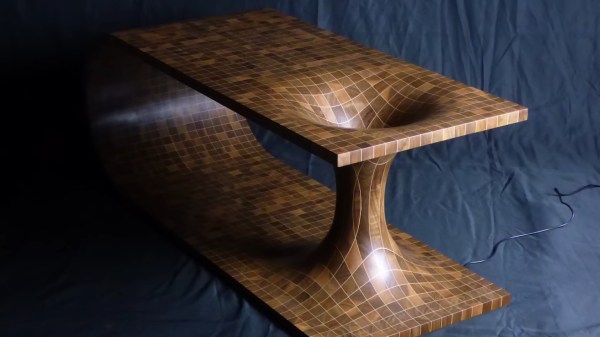
A wooden table with walnut squares and a maple grid. The table has a large barrel-shaped curve on one end and the other is a representation of a wormhole with what look like two stretched cones connected through a narrow cylinder. The wooden grid looks stretch to follow the curvature of spacetime.

Wormhole Coffee Table Takes Woodworking To Another Dimension

While some people are happy with a simple coffee table to hold their snacks while watching Star Trek reruns, others want their furniture to go where no furniture has gone before. [Olivier Gomis] has definitely satisfied this need with his Wormhole Coffee Table. [YouTube]

The complicated shape and curvature of a (3D representation of a) wormhole isn’t easy to create, but [Gomis] managed to carve one without the aid of a CNC or 3D printer. Starting with walnut planks and maple veneer laminated together, he created a grid stackup to replicate the common representation of spacetime as a 2D grid. Using various arrangements of these grids, he built up the central section of the wormhole which looked like a low poly vase before he put it on the lathe for turning.

The lathe work on this build is simultaneously impressive and terrifying. Turning down the central portion of the wormhole required working between two large spinning squares of walnut, which [Gomis] admits was “scary.” Multiple custom jigs were required to keep parts flat and deal with the extreme curvature of the inside of the wormhole’s opening. If that weren’t enough, if you look down the wormhole, he has installed a set of LED lights that show the spacetime grid continuing on to parts unknown.

If you’d like to see another impressive wormhole, check out this Amazing STARGᐰTE With DHD And Infinity Mirror Wormhole.

Continue reading “Wormhole Coffee Table Takes Woodworking To Another Dimension”

Concrete Coffee Table Can Take A Beating

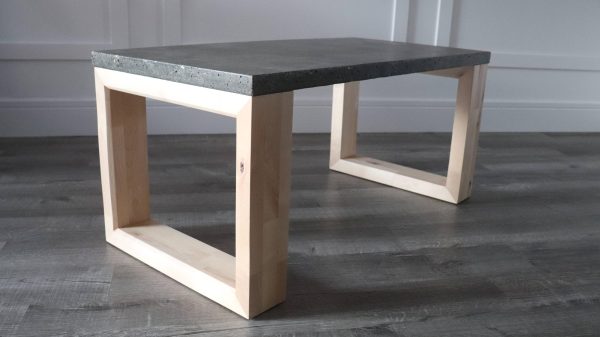
A good coffee table should have a hard-wearing surface and some serious heft to it. This build from [designcoyxe] hits both those criteria with its concrete-based design.

To create the table surface, the first step was to create a form. Melamine was used for the job, thanks to its smooth surface. A rectangular form was readily fabbed up, sealed internally and waxed, and then the concrete was poured. For added strength, the form was only half-filled, and a mesh was added for reinforcement. The rest of the concrete was then poured in to complete the tabletop. The table legs themselves were crafted out of maple, formerly used as a butcher’s block. The light wood makes a great contrast to the dark grey concrete. Plus, the stout, thick, wooden legs are a great combination with the strength of the tabletop itself.

It’s hard to overstate how good concrete is as a coffee table material. It’s difficult to damage and difficult to stain. Plus, if you really need to drive a point home, you can be certain slamming down your mug will get everyone’s attention (just be wary of injury). We’ve seen some other great concrete furniture before, too.

Continue reading “Concrete Coffee Table Can Take A Beating”