Airless Tire For Your Car: Michelin Says 2024, Here’s What They’re Up Against

The average motorist has a lot to keep track of these days. Whether its how much fuel is left in the tank, how much charge is left in the battery, or whether or not the cop behind noticed them checking Twitter, there’s a lot on a driver’s mind. One thing they’re not thinking about is tires, theirs or anyone else’s for that matter. It a testament to the state of tire technology, they just work and for quite a long time before replacements are needed.

There hasn’t been a major shift in the underlying technology for about fifty years. But the times, they are a changing — and new tire technology is claimed to be just around the corner. Several companies are questioning whether the pneumatic tire is the be-all and end all, and futuristic looking prototypes have been spotted at trade shows the world over. Continue reading “Airless Tire For Your Car: Michelin Says 2024, Here’s What They’re Up Against”

3D Printer Meets CNC Router To Make Wood Prints

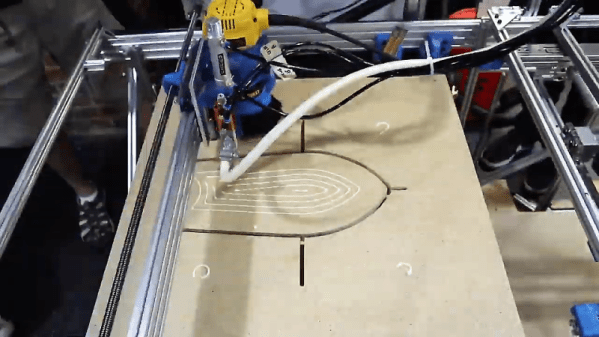
We’ve seen plenty of plywood 3D printers before; after all, many early hobbyist machines were made from laser-cut plywood. But this plywood 3D-printer isn’t made from plywood – it prints plywood. Well, sort of.

Yes, we know – that’s not plywood the printer is using, but rather particleboard, the same material that fills the flatpack warehouse of every IKEA store. And calling it a printer is a bit of a stretch, too. This creation, by [Shane Whigton] and his Formlabs Hackathon team, is more of a hybrid additive-subtractive CNC machine. A gantry-mounted router carves each layer of the print from a fresh square of material – which could just as easily be plywood as particleboard. Once a layer is cut, the gantry applies glue to it, puts a fresh sheet of material on top, and clamps it down tight. The router then carves the next layer, and so on up the stack. The layer height is limited to the thickness of the material – a nominal 3/4″ (19 mm) in this case – and there’s a remarkable amount of waste, but that’s not really the point. Check out the printer in action and the resulting giant Benchy in the video below.

Seeing all that particleboard dust and glue got us thinking: what about a 3D-printer that extrudes a paste of sawdust mixed with glue? We imagine that would be a bit like those giant printers that extrude concrete to build houses.
Continue reading “3D Printer Meets CNC Router To Make Wood Prints”

MQTT Deep Dive

If you read Hackaday, it is a good bet you’ve heard of MQTT — Message Queueing Telemetry Transport. If you’ve not used MQTT before, you should check out Ably’s [Kayla Matthews’] post entitled  MQTT: A Conceptual Deep Dive paper. She does mention their MQTT protocol connector at the end, and has a few notes about Ably’s products, but most of the post is a normal white paper and has a lot of good info.

MQTT’s claim to fame, of course, is that it is very tiny and is made to minimize power consumption compared to heavier-weight protocols. When you are trying to provide or consume data from a device that has to last a year on a coin cell, MQTT is your friend.

Continue reading “MQTT Deep Dive”

XFM: A 32-Voice Polyphonic FM Synthesizer On An FPGA

There’s something about Frequency Modulation (FM) synthesizer chips that appeals to a large audience. That’s one of the reasons behind [René Ceballos]’s XFM project, aiming to duplicate on an FPGA the sound of pure-FM synthesizer chips of the past such as the Yamaha DX series, OPL chip series and TX81Z/802/816. The result is a polyphonic, 32-voice, 6-operator FM synthesizer stereo module.

The project page goes into a lot of detail about the design choices which ultimately led to XFM being implemented on an FPGA, instead of using a dedicated DSP or MCU. Coming from the world of virtual synthesizers running on PCs, [René ]’s first impulse was to implement something on a Raspberry Pi or equivalent. Unfortunately these boards require a lot of power (ruling out battery-powered operation) and can hardly be called real-time, which led [René ] to abandon this attempt.

The design choice against the use of an MCU is simple: though capable of real-time processing, they lack the necessary power to make them a good choice for audio-processing. Working through the calculations to determine what kind of processing power would be needed, it was found that around 650 MIPS would be needed, a figure which most MCUs struggle to achieve a fraction of.

As one of the further requirements for XFM was that it should be as cheap as possible, this ruled out as too expensive the DSP chips which do have the power and hardware features needed. The component chosen was a Xilinx Spartan 6 FPGA, which though somewhat infamous and shunned in FPGA circles turns out to be a very economical option for this project.

Continue reading “XFM: A 32-Voice Polyphonic FM Synthesizer On An FPGA”

Tea Bot Solves Another First World Problem

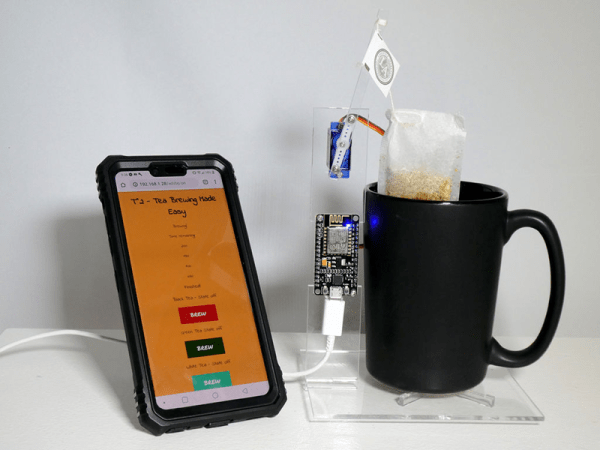
In the movie Wall-E, future humans live in floating chairs and have everything done for them. Today, we grumble if we have to go to physically find a light switch or a remote control. How far away can floating chairs with screens be? T2, the Tea Bot, gets us one step closer to that. Using a laser-cut frame, an ESP8266, and a servo motor, the T2 brews your tea for exactly the right amount of time.

We were kind of hoping the robot would at least dunk the tea bag in and out, but it does provide a web interface that lets you select the brew. Of course, the code is available, so you could make modifications — maybe turn on a hotplate underneath the cup.

Continue reading “Tea Bot Solves Another First World Problem”

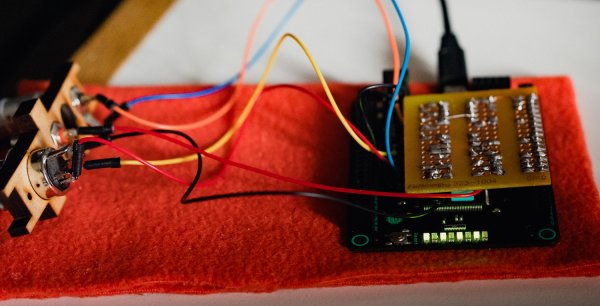
Reaction Trainer Keeps You On Your Toes

In many sports, it’s important for competitors to be light on their feet, and able to react quickly to external stimuli. It all helps with getting balls in goals, and many athletes undergo reaction drills as part of their training regime. To help with this, [mblaz] set out to build a set of reaction trainers.

The training setup consists of a series of discs, each with glowing LEDs and a proximity sensor. The discs randomly light up, requiring a touch or wave to switch them off. At this point, another disc will light randomly, and so on.

The discs are built using an ATmega328 to run the show, with NRF24L01+ radios used to communicate between the modules. High brightness red LEDs are used for indication. An optical proximity sensor is used for its fast reaction time and low cost, while power comes via a small lithium polymer battery integrated into each disc.

We’re sure [mblaz] and his fellow athletes will find the rig to be useful in their training. There’s plenty of scope for electronics to help out with athletic training; this boxing trainer is a great example. If you’ve got a great sports engineering project of your own, don’t hesitate to send it in!

Shower Water Monitor Tracks The Dollars And Cents

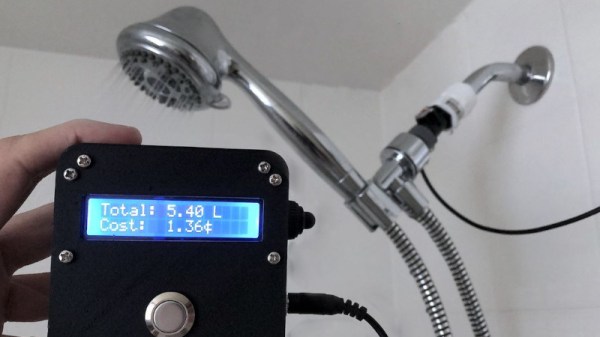
There’s nothing quite as relaxing as a long, hot shower. This has the tendency of making the bather absent minded as to the amount of water being used, which can lead to excessive bills. [LiamOSM] built a device to monitor this instead, and calculate the cost, to boot. 

The device consists of an Arduino hooked up to a cheap flow meter sourced from Banggood. The sensor consists of a paddle wheel that sits in the water flow, fitted with a magnet. A hall effect sensor picks up pulses as the magnet spins, and counting these allows the flow rate to be measured. An HD44780 LCD screen is used to display the readings, controlled over I2C.

To avoid issues in the bathroom environment, the enclosure was designed to be waterproof. The LCD is mounted behind a clear plastic window sourced from vegetable packaging, and the button chosen was specially selected for its sealing grommets. We’d love to see a proper submersion test, but for the most part, it appears to be doing a good job in the bathroom.

If you’re interested in monitoring your water use as a household, you might find it possible to piggy back on the municipal meter.