Flowing Light Art Inspired By Plankton

With today’s technology, art can be taken in directions that have never before been possible. Taking advantage of this, [teamlab] — an art collective from Japan — have unveiled an art installation that integrates the attendee into the spectacle. In the dark room of the piece ‘Moving Creates Vortices and Vortices Create Movement,‘ you are the brush that paints the flowing display.

Inspired by the movement of ocean plankton, this borrows your movement to create tapestries of light with mirrored walls to aggrandize the effect. As attendees walk about the room, their movements are tracked and translated into flowing patterns projected onto the ground. The faster the people move, the greater the resultant flow. Even those who have stopped to take in the scene are themselves still part of it; their idle forms mimic boulders in a river — as eddies would churn about the obstacle, so too does the light flow around the attendee.
Continue reading “Flowing Light Art Inspired By Plankton”

Why Is Donald Duck On The Radio? Math Behind Single Sideband Explained

AM, or amplitude modulation, was the earliest way of sending voice over radio waves. That makes sense because it is easy to modulate a signal and easy to demodulate it, as well. A carbon microphone is sufficient to crudely modulate an AM signal and diode — even a piece of natural crystal — will suffice to demodulate it. Outside of broadcast radio, most AM users migrated to single side band or SSB. On an AM receiver that sounds like Donald Duck, but with a little work, it will sound almost as good as AM, and in many cases better. If you want a better understanding of how SSB carries audio, have a look at [Radio Physics and Electronics] video on the subject.

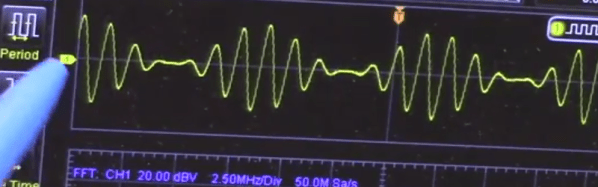
The video covers the math of what you probably already know: AM has a carrier and two identical side bands. SSB suppresses the carrier and one redundant side band. But the math behind it is elegant, although you probably ought to know some trigonometry. Don’t worry though. At the end of the video, there’s a practical demonstration that will help even if you are math challenged.

Continue reading “Why Is Donald Duck On The Radio? Math Behind Single Sideband Explained”

Toy R/C Car Upgrade To Hobby Grade Parts

[HobbyPartz] wanted his toy grade Radio Controlled (R/C) to drive a bit more like the real thing, so he upgraded it to hobby grade electronics.

If you didn’t know, there’s a pecking order in the R/C world. There are the toy grade cars which you can find at your local big box store, and the hobby grade cars, which grace the shelves of the local hobby shop. Toy cars often come with great looking shells – Corvettes, Lamborghinis, Porsches,  or even Ferraris. It often seems like the manufacturer spent all their money licensing and molding the shell though because the mechanics and electronics leave a lot to be desired. You could pull the body off and put it on a hobby grade R/C car, but that could get expensive. It also can be tricky to find a car with exactly the right width and wheelbase.

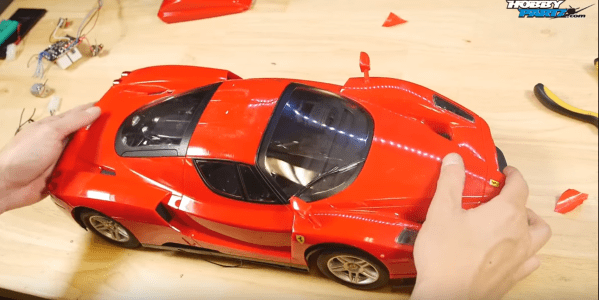
[HobbyPartz] had just this problem with a great looking Ferrari Enzo model that you can see in the video below the break. As expected, the pretty shell hid some really cheap electronics underneath. This is easily fixed by pulling and tossing everything electronic. The steering system was non-proportional — only full left or right turns. He removed the existing steering hardware and hot glued in a standard R/C servo. Once the servo is in position, it’s  easy to connect the linkages to the wheels themselves.

Continue reading “Toy R/C Car Upgrade To Hobby Grade Parts”

An IoT Christmas Tree For Your Hacker-Mas Celebrations

Smart Christmas trees may soon come to mean something more than a fashionably decorated tree. Forging ahead with this new definition, [Ayan Pahwa], with help from [Akshay Kumar], [Anshul Katta], and [Abhishek Maurya] turned their office’s Christmas Tree into an IoT device you can watch live!

As an IoT device, the tree relies on the ever-popular ESP8266 NodeMCU — activated and controlled by Alexa, as well as from a web page. The LEDs for the tree — and the offline-only tree-topper controlled by an Arduino Pro Mini — are the similarly popular Neopixels.

For those viewing online, a Raspberry Pi and camera have been attached to this project to check out the tree’s lighting. To make that possible, [Pahwa] had to enlist the use of ngrok to make the Pi’s –normally — LAN-only camera server accessible over the internet. The aforementioned web page was coded in Javascript/CSS and hosted on a server running an instance of Ubuntu 16.04.

Continue reading “An IoT Christmas Tree For Your Hacker-Mas Celebrations”

Have Your Own 200 Water Street Digital Clock

On the front of a building in New York City, above a branch of the ubiquitous Starbucks coffee chain, there is a clock. It is no ordinary clock, the 200 Water Street clock is an art installation created by the artist [Rudolph de Harak], and consists of 72 lighted numbers which are illuminated in sequence to show hours, minutes, and seconds. It is a landmark of sufficient fame that [Jason Ben Nathan] and [Eldar Slobodyan], Cornell University students of [Bruce Land], decided to make their own tribute to it as their course project.

Water Street clock at night
Water Street clock at night [via NYC ♥ NYC]
It’s a fairly straightforward build, thanks to the use of Adafruit Dotstar multicolour LED strips which are populated with APA102 pixels. Behind the scenes is a PIC32 microcontroller, and the time information comes from an off-the-shelf 60kHz WWVB time signal receiver. There is also a temperature sensor, for a handy second function.

The front panel is a piece of ply with the required numbers nicely laser-cut. All the schematics and code are available, should you fancy your hand at building your own version of the clock.

If you are curious about the real-life clock here’s an image. But you get a much more interesting perspective if you stand in front of it. If you just can’t go there, get an approximation through the wonders of Google Street View.

Making A Classic Chip From Discretes

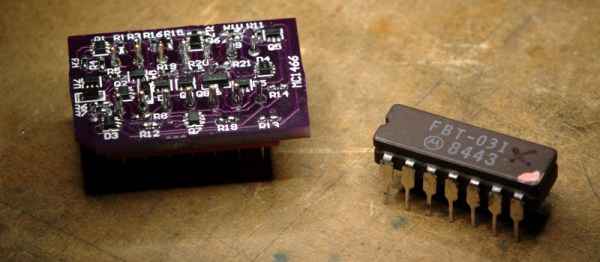
A hackspace discussion of voltage regulators within our earshot touched on the famous μA723, then moved on to its competitors. Kits-of-parts for linear regulators were ten-a-penny in the 1970s, it seems. A rambling tale ensued, involving a Lambda power supply with a blown-up chip, and ended up with a Google search for the unit in question. What it turned up was a hack from 2014 that somehow Hackaday missed at the time, the replication by [Eric Schlaepfer] of an out-of-production regulator chip using surface-mount semiconductors when his Lambda PSU expired.

Lambda were one of those annoying electronics companies with a habit of applying their own part numbers to commonly available chips in an effort to preserve their spares sales. Thus the FBT-031 in this Lambda PSU was in fact a Motorola MC1466, a dirt-cheap common part in the 1970s. Unfortunately though unlike the 723 the MC1466 has long passed out of production, and is rarer than the proverbial hen’s tooth.

Happily, these chips from the early 1970s were often surprisingly simple inside. The MC1466 schematic can be found on its data sheet, and is straightforward enough to replicate with surface-mount discrete components. He thus created a PCB that replicated the original pin layout even though it overlapped the original footprint. A few parts were slightly unusual, dual transistor arrays and a matched triple diode, but the result proved to be a perfect replacement for a real MC1466. Of course a project like this is almost too simple for [Eric], who went on to build the incredible Monster 6502.

If the data sheet lacks a schematic, never fear. You can always try reverse engineering the chip directly.

One String, One Print, One Harp

To exclude musical instruments in the overflowing library of possibility that 3D printing enables would be a disservice to makers and musicians everywhere. For the minds over at [Makefast Workshop], an experimental idea took shape: a single stringed harp.

The TuneFast Harp needed enough notes for a full octave, robust enough to handle the tension of the string, a single tuning mechanism and small enough to print. But how to produce multiple notes on a harp out of only one string? V-grooved bearings to the rescue! The string zig-zags around the bearings acting as endpoints that rotate as its tuned, while the rigid PLA printing filament resists deforming under tension.

After a bit of math and numerous iterations — ranging from complete reconfigurations of part placements to versions using sliding pick mechanisms using magnets! — a melodic result!

Continue reading “One String, One Print, One Harp”