Mosaic Palette: Single Extruder Multi-Color And Multi-Material 3D Printing

Lots of solutions have been proposed and enacted for multi-color and multi-material 3D printing, from color mixing in the nozzle to scripts requiring manual filament change. A solution proposed fairly early on was to manually splice the filament together, making a custom spool. The printer would print as normal, but the filament would change color. This worked pretty well, but it was tedious and it wasn’t entirely possible to control where the color change happened on the model.

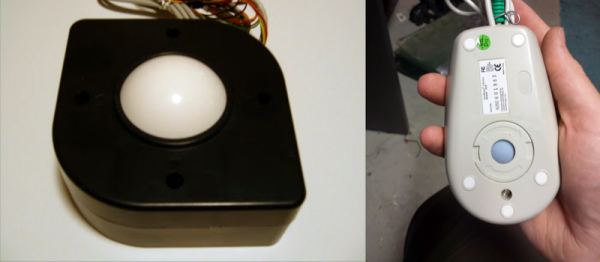
You’ll find some examples of the more successful manual splicing hacks in the pictures below. Scroll down a bit further to find our interview with Mosaic Manufacturing at Bay Area Maker Faire 2016. They have a new product that automates the filament splicing process with precision as the ultimate goal. It unlocks a single extruder printer to behave like a multi-extruder model without stopping and starting.

Mosaic pulled off a very difficult combination of two methods mentioned above. Their flagship product is a machine they’ve dubbed, “Palette”. It’s an automatic filament splicer. Up to four different filaments can feed into Palette, and it will splice them at determined intervals. This would be cool by itself, if only to save the tedium of splicing and winding a custom spool by hand.

The real killer app with Palette, however, is the software that runs alongside it. Palette can take the GCODE output of any properly prepared multi material file from any slicer, and then precisely combine and splice the filament. This can feed into any printer without modifying it, aside from sticking an encoder somewhere in the filament path. The results are indistinguishable from a dual, or quad extruder set-up.

Continue reading “Mosaic Palette: Single Extruder Multi-Color And Multi-Material 3D Printing”

Network Security Theatre

Summer is nearly here, and with that comes the preparations for the largest gathering of security researchers on the planet. In early August, researchers, geeks, nerds, and other extremely cool people will descend upon the high desert of Las Vegas, Nevada to discuss the vulnerabilities of software, the exploits of hardware, and the questionable activities of government entities. This is Black Hat and DEF CON, when taken together it’s the largest security conference on the planet.

These conferences serve a very important purpose. Unlike academia, security professionals don’t make a name for themselves by publishing in journals. The pecking order of the security world is determined at these talks. The best talks, and the best media coverage command higher consultancy fees. It’s an economy, and of course there will always be people ready to game the system.

Like academia, these talks are peer-reviewed. Press releases given before the talks are not, and between the knowledge of security researchers and the tech press is network security theatre. In this network security theatre, you don’t really need an interesting exploit, technique, or device, you just need to convince the right people you have one.

Continue reading “Network Security Theatre”

Become A Peer Reviewer For Citizen Scientist

One of the keys to our scientific community is the concept of Peer Review. When important discoveries are made, the work is reviewed by others accomplished in the same field to test the findings. This can verify the work, but it can also open up new questions and lead to new discoveries.

We’re adding Peer Review to the Hackaday Prize. It’s a new way to apply your skills for the benefit of all. The current challenge is Citizen Scientist; calling for projects that help make scientific research more widely available. A set of independent eyes giving constructive feedback to these entries can be a huge end run to success. After all, you don’t know what you don’t know. Having help recognizing stumbling points, or just receiving a second opinion that you’re on the right track makes a big difference when treading in unknown territory.

Becoming a Peer Reviewer is simple. Pick a project you are interested in, review it thoroughly while making notes in a respectful, positive, and constructive way. When you’re ready, submit your Peer Review using this form. We will privately share your review with the project creator.

Hackaday.io is the most vibrant hardware collaboration platform in the world. Peer Review is yet another interesting way to get more brilliant minds in our community involved in building something that matters.

The HackadayPrize2016 is Sponsored by:

First 360-degree Video From An Amateur Rocket?

Space. The final 360-degree frontier. These are the voyages of the Portland State Aerospace Society (PSAS), whose ongoing mission is to seek out new civilizations and launch rockets at them. For their latest adventure, they stuck a 360-degree video camera into their rocket. The resulting video is spectacular, from the pre-launch drama of an attack by a giant bee to the parachute release. It also works in Google Cardboard or Oculus Rift through the YouTube viewer.

The 360-degree video was made from video captured by five GoPro cameras stuck inside a custom-built module mounted inside the rocket body, then stitched together by PTGUI for the final video. The PSAS has been building modular rockets for some time, and this camera was mounted on their LV2 model. In this flight, the rocket reached an altitude of 4.7km (about 3 miles high), reaching a peak velocity of about 350 meters per second. That’s a pretty impressive height and speed, and you definitely get a good feeling for the dramatic climb of the rocket as it zooms up. This is some impressive stuff from a group of serious rocketeers who are boldly going where nobody has gone before…

Continue reading “First 360-degree Video From An Amateur Rocket?”

How Lasers Actually Work

Lasers are optical amplifiers, optical oscillators, and in a way, the most sophisticated light source ever invented. Not only are lasers extremely useful, but they are also champions of magnitude: While different laser types cover the electromagnetic spectrum from radiation (<10 nm) over the visible spectrum to far infrared light (699 μm), their individual output band can be as narrow as a few µHz. Their high temporal and spatial coherence lets them cover hundreds of meters in a tight beam of lowest divergence as a perfectly sinusoidal, electromagnetic wave. Some lasers reach peak power outputs of several exawatts, while their beams can be focused down to the smallest spot sizes in the hundreds and even tens of nanometers. Laser is the acronym for Light Amplification by Stimulated Emission Of Radiation, which suggests that it makes use of a phenomenon called stimulated emission, but well, how exactly do they do that? It’s time to look the laser in the eye (Disclaimer: don’t!).

Continue reading “How Lasers Actually Work”

An Extremely Useful Shop-Built Belt Grinder

What’s green and black and used all over the shop? It’s [Make It Extreme]’s newest build, a scratch-built belt grinder. And as usual, the build video gets us in the mood to cut metal.

We’ll go out on a limb here and state that the lathe, and not the belt grinder, is the essential metalworking tool. That’s pretty clear from this build – the running gear is machined entirely on a lathe. But as central as the lathe is to machinery making, belt grinders like this one have to rate right up there in terms of shop utility.

You can sharpen with them, quickly remove stock, clean up welds, form chamfers, and remove rust and corrosion. They’re great all-around tools, and with the quick-release idler feature that this one has, fast belt changes for different jobs make it even more flexible. We’d like to see more adjustability in the work table – the ability to angle the table relative to the belt is very handy – but in all this is a great build and a nice tool to have.

On top of it all, watching the [Make It Extreme] builds – like this sandblaster, spot welder, or belt sander – is like high-speed shop class. There’s a lot to learn, although we have to admit that welding in shorts and a T-shirt gives us the willies.

Continue reading “An Extremely Useful Shop-Built Belt Grinder”

Cheap Torque Sensor Goes Back To Basics On Strain Gauges

Sooner or later, we’ve all got to deal with torque measurement. Most of us will never need to go beyond the satisfying click of a micrometer-style torque wrench or the grating buzz of a cordless drill-driver as the clutch releases. But at some point you may actually need to measure torque, in which case this guide to torque sensors might be just the thing.

[Taylor Schweizer]’s four-part series on torque is pretty comprehensive. The link above is to the actual build of his DIY torque transducer, but the preceding three installments are well worth the read too. [Taylor] describes himself as an e-waste connoisseur and tantalizes us with the possibility that his build will be with salvaged parts, but in the end a $20 bag of strain gauges and an LM358 were the quickest way to his proof of concept. The strain gauges were super-glued to a socket extension, hot glue was liberally applied for insulation and strain relief, and the whole thing wired up to a Teensy for data capture. A quick script and dump of the data to Excel and you’ve got a way to visualize torque.

An LCD display for real-time measurements is in the works, as are improvements to the instrumentation amp – for which [Taylor] might want to refer to [Bil Herd]’s or [Brandon Dunson]’s recent posts on the subject.

[via r/arduino]