Hackaday Links: September 7, 2014

Like Adventure Time? Make your own BMO! It’s a little more expressive than the Adafruit version we saw earlier due to the Nokia LCD. It’s got audio playback too so it can talk to football.

A few years ago, [Matt] made a meat smoker with a PID controller and an SSR. Now the same controller is being used as a sous vide. PID controllers: the most useful kitchen gadget ever.

[Josh] keeps his server in a rack, and lacking a proper cable management solution, this means his rack is a mess. He adapted some Dell wire management arms to his system, using a PCI card bracket to attach the arm to the computer.

[Dr. Dampfpunk] has a lot of glowey things on his Youtube channel

Another [Josh] built a 3D tracking display for an IMU. It takes data off an IMU, sends it over Bluetooth, and displays the orientation of the device on a computer screen. This device also has a microphone and changes the visualization in response to noises.

Remember the pile of failure in a bowl of fraud that is the Scribble pen? Their second crowdfunding campaign was shut down. Don’t worry; they’re still seeking private investment, so there’s still a chance of thousands of people getting swindled. We have to give a shout-out to Tilt, Scribble’s second crowdfunding platform. Tilt has been far more forthcoming with information than Kickstarter ever has with any crowdfunding campaign.


Pneumatic leg assistance

AirLegs Augment Your Cardio By 10%

Here’s another very interesting project to come out of the 4 Minute Mile challenge — pneumatically boosted legs.

It’s another project by [Jason Kerestes] in cooperation with DARPA. We saw his jet pack a few days ago, but this one looks like it has a bit more promise. It is again a backpack mounted system, but instead of a few jet turbines, it has a pneumatic cylinders which move your legs for you.

Just watching it it’s hard to believe it makes it easier to run, but apparently after being tested at the Army Research Laboratories last year it demonstrated a whopping 10% reduction in metabolic cost for subjects running at high speeds. It can actually augment the human running gait cycle, and is the only device the US Army has confirmed can do so.

He is already hard at work designing version 2.0 which is lighter and more flexible. There’s a bunch of test videos after the break so stick around to see it in action.

Continue reading “AirLegs Augment Your Cardio By 10%”

CNC3020 Linear Rail and Lead Screw Lubrication

A Little Lubricant Goes A Long Way…. With Your CNC Machine

[Peter] has been having some positional repeatability problems with his CNC3020 Router recently. The problem was mostly in the Z axis and was measured to be up to 0.3mm off position after 10cm of travel. This may not seem like a lot but it was enough to break a few 1mm diameter end mills. The X and Y axes generally seemed OK. Surfing the ‘net reveled that the control board’s power rails did not have any filtering capacitors and that may have been the cause of the problems. Unfortunately, the positioning problem still persisted even after the cap’s were added. Frustrated, [Peter] then started a full-blown investigation to figure out why his Z axis wasn’t cutting the mustard.

In a CNC system there are 2 major components, the electronics and the physical machine. Since it was unknown which portion of the system contained the problem, [Peter] decided to quickly swap the X and Z channels, running the Z axis with the X axis electronics. The problem was still evident on the Z axis which means that there is something wrong in the mechanics of the machine. The Z electronics were put back on the Z axis and the testing continued by lowering the acceleration and the maximum speed. The positioning error was still there. Since it is possible that the Z motor could be the problem, it was decided to swap the X and Z motors but midway through the process the problem became evident. When trying to rotate the Z axis lead screw by hand there was a noticeable lack of smoothness and the axis seemed to jump around a bunch!

Continue reading “A Little Lubricant Goes A Long Way…. With Your CNC Machine”

THP Hacker Bio: Michael R Colton

With many hackers out there realizing how much you can do with a few RF blocks connected to a computer, it’s no surprise software defined radio would make a showing in the semifinalists for The Hackaday Prize. [Michael]’s project is the PortableSDR, a small, self-contained unit that handles just about everything below 30MHz. No, [Michael] isn’t dealing with gigahertz accessible with fancier SDRs, but that’s not the point: PortableSDR is meant to do everything – vector analysis, a neat waterfall display, transmit and receive – in a small, portable package you can take anywhere. It’s also fairly cheap to build, and of course completely open source.

This isn’t [Michael]’s first rodeo; he’s built a number of equally cool projects before. He was kind enough to send in a short bio, available below.

Continue reading “THP Hacker Bio: Michael R Colton”

More WiFi Modules For IoT Madness

The last year has brought us CC3000 WiFi module from TI, and recently the improved CC3200 that includes an integrated microcontroller. The Chinese design houses have gotten the hint, putting out the exceptionally cheap ESP8266, a serial to WiFi bridge that also includes a microcontroller to handle the TCP/IP stack and the software side of an 802.11 connection. Now there’s another dedicated WiFi module. It’s called the MT7681, and it’s exactly what you would expect given the competition: a programmable module with the ability to connect to a WiFi network.

Like TI’s CC3200, and the ESP8266, the MT7681 can be connected to any microcontroller over a serial connection, making it a serial to WiFi bridge. This module also contains a user-programmable microcontroller, meaning you don’t need to connect an Arduino to blink a few pins; UART, SPI, and a few GPIO pins are right on the board. The module also includes an SDK and gnu compiler, so development of custom code running on this module should be easier than some of the other alternatives.

You can pick up one of the MT7681 modules through the usual channels, but there’s an Indiegogo campaign based in China that takes this module and builds a ‘dock’ around it. The dock has a relay, temperature/humidity sensor, a few GPIO pins, and a USB serial connection for use as an Internet of Things base station.

For anyone looking for a little more computational horsepower, there’s also a few mentions and press releases announcing another module, the MT7688, This is a very small (12mm by 12mm) module running Linux with 256 MB of RAM and 802.11n support. This module hasn’t even hit the market yet, but we’ll be on the lookout for when it will be released.

Thanks [uhrheber] for sending this one in.

worlds smallest thermal imaging camera

Building The World’s Smallest Thermal Camera

[Mike Harrison], the mastermind behind electricstuff.co.uk has just finished reverse engineering the Lepton module found in thermal imaging cameras — he then created his own, and perhaps the world’s smallest thermal camera.

He took apart the Flir One iPhone thermal imaging unit and pulled out the magical part that makes it all possible — the Lepton module. It only has a resolution of 80×60 pixels, but in the world of thermal imaging, it’s pretty decent. You can buy it for $250 (for the module) in order quantities of 1000 straight from Flir.

His blog has all the details about figuring out how to interface with the module, and it is really quite impressive. Once he had it all understood he set out to build it into a small thermal camera. The case is machined out of black acrylic, and an iPod nano screen is used as the display, as 80×60 scales up nicely to the 320×240 resolution of the iPod. A home-brew PCB connects to the module, has a voltage regulator and charging circuit for the lithium ion battery — which is then connected to a prototype iPod nano PCB with some of the features removed — he says it was a nightmare connecting it all, and we don’t blame him, that’s some serious hacking skill!

Continue reading “Building The World’s Smallest Thermal Camera”

Tasting Music, With A Side Of Meatballs

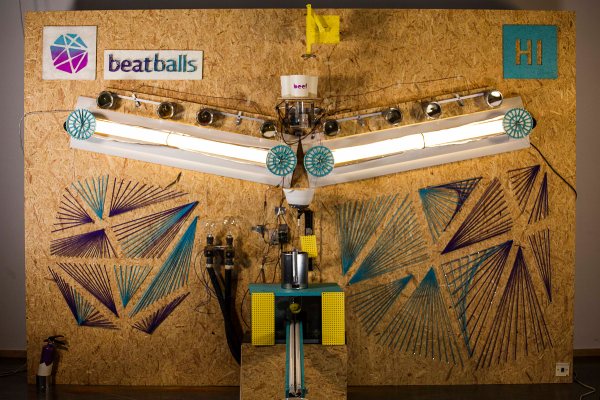
Imagine eating food customized just for you based on your music preferences. This is exactly the premise behind a student-developed application called BeatBalls. This musical cooking platform translates artists and songs into delicious meatball recipes.

BeatBalls uses a computer algorithm that takes into account a variety of factors including key, tempo, cadence, and duration of the song to manifest a unique combination of ingredients. [Maria], who tipped us off about the project, told us in an email that Beatballs used the echonest API to determine elements of each song.

Anyone can go to the BeatBalls’ website and enter their favorite musician, group, or track into the online meatball generator, which outputs unique components to the screen. A few good suggestions are Meat Loaf, Led Zeppelin, Jimi Hendrix, and Bassnectar, which produce some delectable results.

Students involved in the project also created a machine to mix, roll, and cook the meatballs automatically. Team member [Samuel] told us that the system has three Arduino controllers that are hooked up to a remote server with an Ethernet shield and WiFi router. A set of servos and a DC motor controls the mechanisms that pushes the meat through and adds spices to the ingredients.

Continue reading “Tasting Music, With A Side Of Meatballs”