Hackaday Links: June 29, 2014

hackaday-links-chain

Ever see a really cool build on YouTube with no build details at all? Frustrating, right? That’s us with the NES Keytar covering the Game of Thrones theme. He’s using a Raspi with the sound chip in the NES to do live chiptunes. Freakin’ awesome. There’s also the ST:TNG theme as well.

A few years ago the folks at Oculus had an idea – because of cellphones, small, high resolution displays are really cheap, so why not make VR goggles? At Google IO this week someone figured out everyone already has a cellphone, so just wrap it in some cardboard and call it a set of VR goggles. You can get a kit here, but the only difficult to source components are the lenses.

What happens when you put liquid nitrogen under a vacuum? Well, it should evaporate more, get colder, and freeze. Then it breaks up into solid nitrogen snow. No idea what you would do with this, but there ‘ya go. Oh, [NC], we’re going to need a writeup of that LN2 generator.

About a month ago, the House4Hack hackerspace in South Africa told us of their plans to bring a glider down from 20km above the Earth. They finally launched it, The CAA only allowed them to glide back from 6km (20,000 feet), but even from there the foam glider hit 230kph (124 knots). That’s a little impressive for a foam FPV platform, and we’re betting something with a larger wingspan would probably break a spar or something. Shout out to HABEX.

All the electronic dice projects we’ve seen have one thing in common: they’re not cubes. Thus uberdice. It’s six nine-pixel displays on the faces of a cube, powered by a battery, and controlled by an accelerometer. Yes, it is by far the most complicated die ever made, but it does look cool.

Simple Touch Controller Frees Up USB Port

touch screen demonstration using text

[typ.o] was working on a Raspberry Pi project and found himself running short on USB ports. The project required a touch screen interface, which takes up one of the ports. Since he was only using the screen in text mode, he decided to ditch the original USB controller and make his own.

The ever popular Attiny85 is deployed to handle the task, and is interfaced between the resistive touch panel and the Raspberry pi, using only three pins from the GPIO port. The Attiny85 runs off the 3 volt supply from the raspi, so no level shifter is needed, helping to keep his board super simple.

The calibration and calculation of the touched character location is done by a Python script running on the raspi. [typ.o] is a fan of the KISS principle, and it shows. Be sure to check out his site for all source code, schematics and a video demonstrating this simple but effective solution.

Counting Really, Really Fast With An FPGA

fast

During one of [Michael]’s many forum lurking sessions, he came across a discussion about frequency counting on a CPLD. He wondered if he could do the same on an FPGA, and how hard it would be to count high clock rates. As it turns out, it’s pretty hard with a naive solution. Being a bit more clever turns the task into a cakewalk, with a low-end FPGA being able to count clocks over 500 MHz.

The simplest solution for counting a clock would be to count a clock for a second with a huge, 30-bit counter. This is a terrible idea: long counters have a lot of propagation delays. Also, any sampling would have to run at least twice as fast as the input signal – not a great idea if you’re counting really fast clocks.

The solution is to have the input signal drive a very small counter – only five bits – and sample the counter using a slower clock on board the FPGA. [Michael] used a 5-bit Gray code, getting rid of the problem of the ‘11111’ to ‘00000’ rollover of a normal binary counter.

Because [Michael] is using a 5 bit clock with 31 edges sampled at 32 MHz, he can theoretically sample a 992 MHz clock. There isn’t a chance in hell of the Spartan 6 on his Papilio Pro board ever being able to measure that, but he is able to measure a 500 MHz clock, something that would be impossible without his clever bit of code.

A Tiny Robot Family

Back in the late 80s and early 90s, a lot of young electronics hobbyists cut their teeth with BEAM robots – small robots made with logic chips and recycled walkmans that tore a page from papers on neural nets and the AI renaissance of the 80s. Twenty years later, a second AI renaissance never happened because a generation of genius programmers decided the best use of their mental faculties was to sell ads on the Internet. We got the Arduino, though, and the tiny robot family is a more than sufficient spiritual successor to the digital life of the old BEAM bots.

The tiny robot family is [shlonkin]’s growing collection of small autonomous vehicles that perceive the world with sensors and act with different behaviors. They all contain an ATtiny85, a small battery, two motors, and at least one phototransistor and a LED. One robot has left and right eyes pointing down, and can act as a line follower. Another has a group of LEDs around its body, allowing it to signal other bots in all directions. The goal of the project is to create a whole series of these tiny robots capable of interacting with the environment and each other. Video of the line follower below.

Continue reading “A Tiny Robot Family”

2600 And Why Publishing Sucks

26002600: The Hacker Quarterly is the premier (print) infosec publication out there, and depending on who you talk to, the best publication out there that has anything to do with modifying electronics, infiltrating networks, and all the other goodies we post on a daily basis. They’ve also been around for longer than most of our readership, and to lose them would be a terrible loss for anyone who calls themselves a hacker.

Being a print publication, they are completely at the mercy of their distributors. Any sort of media is a very, very dirty business, so when 2600’s distributors recently decided to not pay them for a few previous issues… well, that’s a problem.

2600’s most recent distributor, Source Interlink, was recently dropped as the distributor for Time, throwing the entire company into panic mode. Source Interlink then rebranded itself as TEN: The Enthusiast Network, distributing a disturbing amount of hotrod magazines to bookstores across the country. With this change in names and a little corporatespeak, TEN: The Enthusiast Network has yet to pay 2600 what they’re due.

This isn’t the first time 2600 has faced near oblivion thanks to a distributor. They almost went out of business in 1997 when their distributor declared bankruptcy. 2600 have proven themselves to be resilient folk, though, and all bets are on them making it through this little impasse. Still, they’re still out six months worth of revenue, deep in debt, and they’re putting on a huge conference in a few weeks. It’s really not good timing.

If you’d like to help 2600, buy July’s issue, make them number 1 on Kindle, or buy a ticket for HOPE X. Hackaday is going to have a booth there (awesome!), and we’ll be putting a post up on that when  the already amazing list of speakers is finalized.

Automatic Audio Leveling Circuit Makes Scanning More Fun

alan-scope1

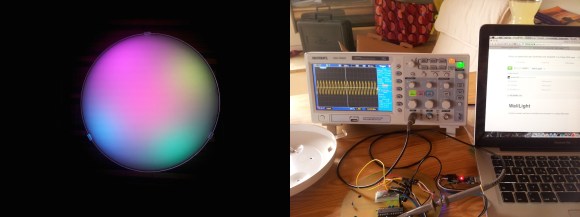
[Alan’s] friend came to him with a problem. He loved listening to his scanner, but hated the volume differences between stations. Some transmitters would be very low volume, others would nearly blow his speakers. To solve the problem, [Alan] built up a quick automatic leveling circuit (YouTube link) from parts he had around the lab.

[Alan’s] calan-scope2ircuit isn’t new, he states right in the video that various audio limiting, compressing, and automatic gain control circuits have been passed around the internet for years. What he’s brought to the table is his usual flair for explaining the circuits’ operation, with plenty of examples using the oscilloscope. (For those that don’t know, when [Alan] isn’t building circuits for fun, he’s an RF applications engineer at Tektronix).

Alan’s circuit is essentially an attenuator. It takes speaker level audio in (exactly what you’d have in a desktop scanner) and outputs a limited signal at about 50mv peak to peak, which is enough to drive an auxiliary amplifier. The attenuator is made up of a resistor and a pair of 1N34A Germanium diodes. The more bias current applied to the diodes, the more they will attenuate the main audio signal. The diode bias current is created by a transistor-based peak detector circuit driven off the main audio signal.
But don’t just take our word for it, watch the video after the break.

Continue reading “Automatic Audio Leveling Circuit Makes Scanning More Fun”

Xkcd’s Virus Aquarium Made Real

A surprising number of projects here are in some way influenced by the webcomic xkcd, but usually not as directly as this. Comic 350, “Network” is the tale of a very odd stickman who keeps multiple VMs running an unprotected, old version of Windows. Between the VMs, they have virtually every virus and are, effectively, a computer virus aquarium.

Now it’s a real thing, and best of all, it’s open to the Internet for normal humans to view, complete with screencaps of all seven nodes updated every 30 seconds, the ability to view all processes on each node, and anyone on the Internet can upload any file to a node. All the files uploaded to the nodes are executed, so you get to see in real-time what the effects of “1TB_of_porn_this_took_a_while_to_upload.exe” are on node 3.

The idea of a virus aquarium is cool, but this actually gets much, much more interesting when the project metas itself. Every 24 hours, a virus scanner runs on each node. As of right now, all the nodes are clean making this not a virus aquarium, but a script kiddie aquarium. On at least one node, TeamViewer is running but your guess is as good as mine as to how anyone will get that working.

Continue reading “Xkcd’s Virus Aquarium Made Real”