Center Pivot Pen Plotter

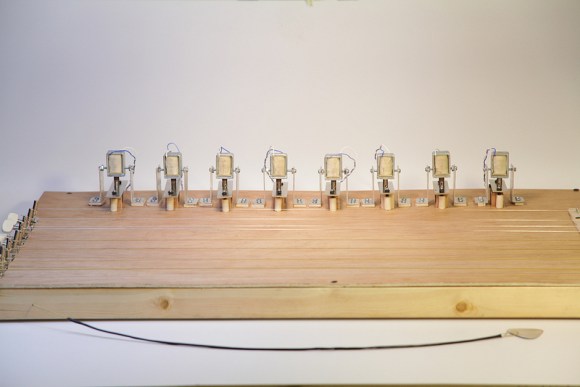
This center pivot pen plotter is an interesting take on the idea, and manages to somewhat simplify the fabrication when compared to a gantry-style built.

Normally we’d see a gantry that travels on two rails, with a print head that moves along its length. Here the gantry is anchored on just one side, with a chain driven system to rotate it along the plotting surface. The print head uses a fine-point felt-tipped marker. It still travels along the arm as you would expect, and can be tilted away from the paper for repositioning.

What was made easier in hardware ends up adding to software complexity. The benefit of a traditional system is that it uses X and Y coordinates to plot a design. The pivot of this mechanism means that as the print head moves further from the center of the machine, the distance between each pixel is magnified. But the clip after the break proves that this issue has been solved.

Continue reading “Center Pivot Pen Plotter”

Giving The IPod Nano A Home On A Honda Dashboard

[Hyeinkali’s] iPod Nano looks right at home on the dashboard of his 2001 Honda Accord. He got rid of the simple LCD clock and the buttons that were used to set it. The hack holds the iPod securely in place, but it remains easy to remove and take with you.

He started by popping out the bezel that holds the clock module and hazard light button in place. The original display was about the same width as the Nano, but he wasn’t interested in mounting the mp3 player under the dash. Since he needed to be able to take it with him to sync his music library he made a space near the bottom of the bezel to accept the connector end of the USB cable while keeping the device accessible. After connecting the other end to power he covered the hole in the bezel with mesh and put everything back together. We’re not sure if audio is piped into the car stereo via a cable or through Bluetooth, but it does feed to the head unit.

[via Reddit]

Retrotectacular: Time Sharing

It’s easy to forget the layer upon layer of technological advances that led to the computers we use today. But this look at the state of the art half a century ago does a good job of reminding us. Here [Fernando J. Corbató] explains the concept of Time-Sharing. He is one of the pioneers of the topic which is now used in every computer system in the world.

Since processors (read: a single core) can only work on one operation at a time, it inherently creates a bottle-neck. This is a huge issue when you consider the cost of the computers used at the time. In the video he mentions $300-$600 an hour. That was in the 1960’s and would roughly equate to about $2300-$4600 in 2012. In other words, there’s big money in using the machine as efficiently as possible.

Early on in the discussion he mentions how programs were loaded and solutions were returned by computers of the day. It started with punch cards, then moved to magnetic tape. At the time this was filmed they had just started using teletype and were hoping to add a graphical interface in the near future. We’ve come a long way but the core principles he’s explaining are still quite important. See both parts of the film after the break.

Continue reading “Retrotectacular: Time Sharing”

Some Technical Improvements On [Alton Brown’s] Hacked Smoker

Bringing that smoky goodness to your cooking is neither hard, nor is it expensive. [Alton Brown], who we consider to be the MacGyver of cooking, always seems to be able to build cooking contraptions from common items. The smoker he built from a flower pot was the inspiration for [Tom’s] own project. But [Tom] added in PID hardware to smoke at just the right temperature.

The enclosure hides a single electric burner at the bottom. A metal tray full of wood chips sits on top of it, smoldering as the burner gets hot. You could just set it and forget it, but it will take a lot of trial and error to figure out which setting achieves the best results. [Tom’s] additional hardware, housed in the grey electrical box, switches the burner with a solid state relay. The PID controller takes measurements from a temperature sensor inserted in the lid of the smoker, ensuring perfectly prepared food every time.

If you’re interested in making your own you could try building a heating element from toaster oven parts.

QR Code Opens Doors To You

[Jeremy Blum] wrote in to share his LibeTech QR Code Door Lock project. He developed it during his Senior year at Cornell University along with three of his classmates. It seeks to move away from magnetic card locks in favor of optical locks that authenticate based on a QR code.

The hardware he’s using here is definitely cost prohibitive, but we’re sure the concept could be greatly simplified. In this case a BeagleBone running embedded Linux monitors a feed from a webcam. When it detects a QR code it compares it with a database of approved keys and will unlock the door for you.

There are problems with this technique, one being that an attacker might be able to get a usable photograph of your key without you knowing. But the majority of hotel locks in use right now are even less secure than that. On the upside, the key to your room can be emailed to you for use on just about any device with a screen, or printed out on a piece of paper.

You can find [Jeremy’s] presentation video embedded after the break.

Continue reading “QR Code Opens Doors To You”

Vending Machine Prototyping

[Vending Mexico] plans to design, build, and sell their of vending machines. You’ve got to start somewhere so they’ve built this prototype. It offers a range of vending features but was built with parts we’re used to seeing in hobby projects.

The one challenge they didn’t take on is the ability to identify coins and make change. You can see they’ve chosen to use a Coinco Guardian 6000 changer. But the custom circuit taps into the device, identifying how much money has been dropped in the slot, and controlling the coin dispenser to make change. Right now there is only one item to choose from; some packs of gum  stored in a cardboard partition with the typical metal corkscrew — driven by a servo motor — to dispense the product. Just below that partition there is a row of IR LEDs which have a complimentary set of IR phototransistors. The machine uses these to detect when product has dropped through. This way if your candy gets stuck you get your money back.

The user interface is shown off in the video after the break. It uses a set of seven segment displays for feedback. An arcade button is used to select the desired product. The video dialog is in Spanish but we had no trouble telling what is being shown off even though we don’t speak the language.

We can’t remember seeing other scratch built vending machine. It seems all of them have been hacks on older commercial vending hardware.

Continue reading “Vending Machine Prototyping”

Incredible Fabrication Process Makes This Word Clock Stand Out

From the look of it his is just another Word Clock, right? From the outside maybe. But if you take a look at the build photos this a good example of extreme fabrication.The design uses a five-layer lamination of glass bezel, vinyl lettering, diffuser, mounting plate, and back panel. The mounting and lettering layers were labor intensive, but are also the reason for the gorgeous finished look.

The bezel consists of black adhesive foil applied to the back of the glass faceplate. The letters were cut out using a vinyl cutter, and the lamination process happened in a pool of water. This technique helps to ensure that no fine particles end up between the glass and the foil.

The wooden mounting bracket was ordered from a local kitchen cabinet fabricator. It’s MDF that is 17.7″ and has been edge wrapped in glossy white PVC. Once it arrived, [Muris] started drilling the 248 holes and their counter sinks. This is on the front side of the layer and when sprayed with silver paint the countsinks act as reflectors. On the back side he milled groves to accept PCB strips to host the LEDs as well as the breakout boards that hold the MAX7219 drivers.

Don’t miss the video clip after the break that shows off the final product.

Continue reading “Incredible Fabrication Process Makes This Word Clock Stand Out”