Sandbox Topographical Play Gets A Big Resolution Boost

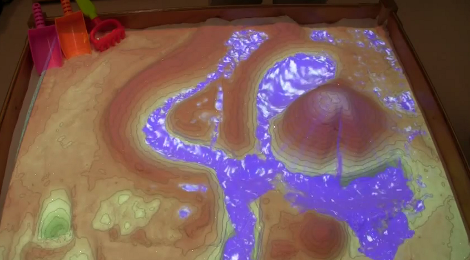
Here’s another virtual sandbox meets real sandbox project. A team at UC Davis is behind this depth-mapped and digitally projected sandbox environment. The physical sandbox uses fine-grained sand which serves nicely as a projection surface as well as a building medium. It includes a Kinect depth camera over head, and an offset digital projector to add the virtual layer. As you dig or build elevation in parts of the box, the depth camera changes the projected view to match in real-time. As you can see after the break, this starts with topographical data, but can also include enhancements like the water feature seen above.

It’s a big step forward in resolution compared to the project from which the team took inspiration. We have already seen this concept used as an interactive game. But we wonder about the potential of using this to quickly generate natural environments for digital gameplay. Just build up your topography in sand, jump into the video game and make sure it’s got the attributes you want, then start adding in trees and structures.

Don’t miss the video demo embedded after the break.

Continue reading “Sandbox Topographical Play Gets A Big Resolution Boost”

16FUSB — It’s Like V-USB For The PIC 16F628

If you have an idea for a fairly simple USB device but don’t want to invest in the more expensive microcontrollers, this library will be of interest to you. It’s a software implementation of the low-speed USB protocol for PIC 16F628. You can pick these up for around $2, and it just takes a few other components to complete the circuit. And hey, you don’t even need a proper PIC programmer to flash the code. This is the same chip for which we just saw an Arduino act as the programmer.

The circuit design looks exactly the same as the V-USB stack, which provides USB functionality to lower-end AVR microcontrollers. In addition to the chip you need a crystal oscillator, a couple of 3.6V zener diodes, and a handful of passive components. There are a couple of LEDs in the design, but we assume these are for feedback and are not crucial to the functionality of the circuit.

There’s no shortage of data included in the project post so you may want to bookmark this one for later reference.

Fancy Telemetry Control Display For A Quadcopter

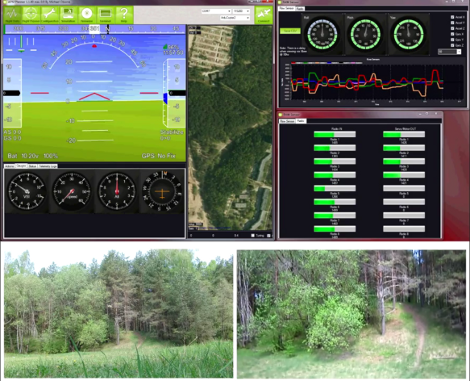
Most of the quadcopter projects that we’ve seen use a joystick-based control system. This lets you fly the thing around like any RC vehicle. But [Saulius] is augmenting his control system by pulling and displaying telemetry data. It doesn’t really change the way the vehicle is controller, but it lets the craft roam much further away because the operator can watch the computer screen and forego the need for the quadcopter to be within sight.

A Carambola board (also used in this weather station project) is used to provide connectivity. This is WiFi based, which helps us understand the range it can travel. The quadcopter carries a camera, which is shown in the lower right box of the image above. There is also an artificial horizon, and feedback dials which display the telemetry data.

It looks like there’s a satellite view in between those two dashboard widgets. We don’t see anything coming up right now, but it’s possible this is meant to overlay a virtual marker for the aircraft’s position based on GPS data. That last part is really just conjecture though. Catch the 80-second test flight after the jump.

Continue reading “Fancy Telemetry Control Display For A Quadcopter”

Building Main Street, USA In A Coffee Table

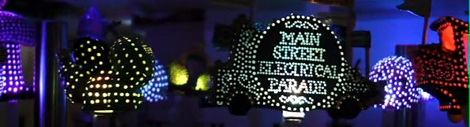
[Alex George] has been collecting miniatures of Main Street, USA in Disney Land hand crafted by artist [Robert Olszewski]. These models are incredibly accurate, but sadly static. [Alex] has some of the floats from the Main Street Electrical Parade that light up with the help of a few LEDs. One day, [Alex] found himself wishing he could watch a miniature parade circling around his diorama and did what any of us would do: make a tiny electrical parade move around his miniature town.

[Alex] began his build by designing a system of chains and sprockets underneath his miniature Main Street. When not on display, the parade floats are hidden underneath the town. At night, though, the parade ascends to the surface to put on a show.

It’s not an electrical parade if there aren’t any lights, so [Alex] grabbed a couple Blinkms to attach to the underside of each float. These are small programmable RGB LEDs that can repeat the same sequence of lights for the entire time the parade is visible. A very excellent job and a masterwork of craftsmanship for both [Alex] and [Robert Olszewski].

[Alex]’s ‘making of’ video and a full demo of the float are available after the break.

via boingboing

Continue reading “Building Main Street, USA In A Coffee Table”

Beautiful Wooden Case For A Portable NES

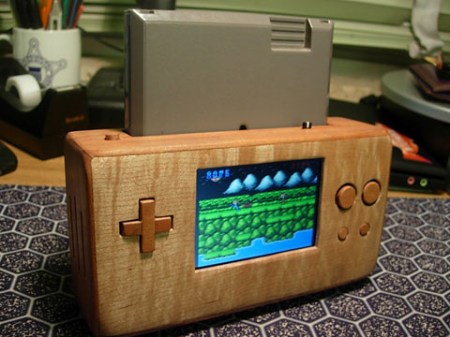
After building a few portable gaming systems, [Parker] wanted to try something a little different than the usual sleek plastic builds. He decided to go with a nice wooden classic NES. He started by gutting a NOAC or Nintendo On A Chip. The NOAC has already done most of the miniaturization for him, so he was mainly focusing on the portability. While this wasn’t the most extreme mod, it wasn’t just a case swap either. He took great pictures of the process of modifying the screen to work and putting everything together. The final product is fantastic looking.

The first comment we thought was, why is the game facing backward? Due to the shape of the NOAC board, he would have had to either add more depth to the case, or extended and flipped the actual cartridge plug to make the game face forward, so we can understand why he left it alone.

Two Saxophone Synthesizer Builds For The Price Of One

[Bruce Land] has been sending in student projects from the electronic design course he taught at Cornell last semester. By a curious coincidence, two groups build saxophone synthesizers with the same key arrangement as a real sax.

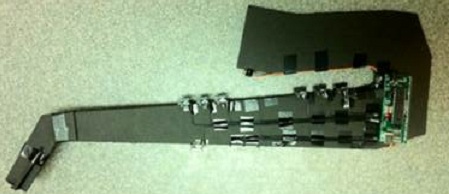
First up is [Brian Wang]’s digital sax. There’s a small microphone in the mouthpiece and a series of buttons down the body of the sax telling the ATMega664 what note to play. The data for the saxophone synthesis was created by looking at a frequency plot of a sax, bassoon, harp, and pipe organ. [Brian] has the synthesis part down pat; there’s definitely a baritone sax in that little microcontroller.

Next up is [Suryansh] and [Chris]’s PVC pipe saxophone. It’s the same general principle as [Brian]’s project – the musician blows into the sax (we really like the kazoo mouthpiece) and a small mic picks up the sound of the wind. If the microphone output is above a certain threshold, the buttons are read and a note come out of the sax. We’re picking up a whiff of alto sax here; shame there wasn’t a duet with the two teams.

After the break you can see both saxophone projects in all their glory.

Continue reading “Two Saxophone Synthesizer Builds For The Price Of One”

Turning Anything Into A Touch Sensor

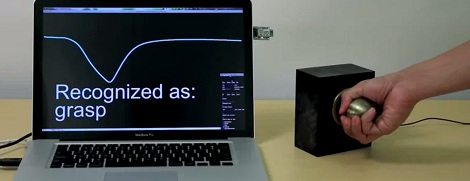
This year at the CHI conference in Austin, [Munehiko Sato], [Ivan Poupyrev], and [Chris Harrison] out of the Disney research lab in Pittsburgh demonstrated their way to make touch sensors out of anything. Not only to they suggest using the surface of your skin to control cell phones and MP3 players, they’re also able to recognize touch gestures, like poking or grasping an object. That sounds a little heady, so check out the video of the Touché tech in action.

Like the capacitive touch sensors in our phones and tablets, Touché measures the rise and fall of a capacitor’s charge over time. Unlike  other touch sensors, Touché scans the capacitor at different rates, allowing for a ‘capacitive profile’ that is used to recognized touch gestures.

The applications for this tech are nearly innumerable; the team demonstrated scolding someone for eating cereal with chopsticks (yeah, we know…), an on-body music player interface, and gestures for an office doorknob that notifies passersby if you’ve stepped out for a minute or are gone for the day.

It’s a very interesting build, and we give it two weeks until someone replicates this build. We’ll be sure to post it then.

Continue reading “Turning Anything Into A Touch Sensor”