Bubble Blowing Bot Blows Big Bouncy Bubbles


[Rob] Was cleaning out his car hole when he stumbled across a servo, a PC cooling fan, an Arduino and apparently a whole lot of bubble mixture. With all of this, some scrap timber and a few trips to the dollar store, he was able to whip up this bubble blowing bot to entertain his children. It looks like a fairly simple mechanism, the servo tips the old pipe bend into the sudds and the fan provides the air to blow the bubble. The size of the bubble is varied by altering the speed that the pipe bend tips.

The video after the break shows the robot blowing some nice big bubbles, and a quick view of the fan and servo mechanism. There is not a lot of information available but we find the motion of the pipe bend and the big bubbles it blows entertaining, you know the saying, “simple things…”

Continue reading “Bubble Blowing Bot Blows Big Bouncy Bubbles”
Improved FPGA Synth

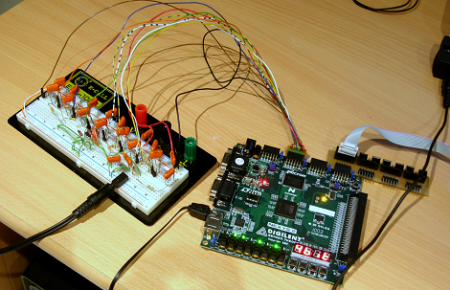
A week or so ago we featured an FPGA MIDI interface. Since then the builder has gone crazy with his FPGA and revised his code to include polyphony and PWM output, and posted a polyphony demo.

In our previous coverage of the build, the synth was monophonic, and the MIDI implementation was pretty shaky. After realizing the hard work was done, [Mich] re-wrote the MIDI interpretation module to keep 8 voices in memory. Now the synth can play 16th note arpeggios at 999bpm.

The original build used 8 pins to output the audio with an R/2R ladder for a digital to analog converter. This didn’t work well with a polyphonic synth (everything was clipped or noisy), so [Mich] moved to PWM output.

Continue reading “Improved FPGA Synth”

Slick 16-segment POV Hard Drive Clock

pov_hdd_clock

Hackaday reader [svofski] sent in a fantastic looking hard drive-based POV clock (Google Translation) created by a maker in the Sichuan province of China. The clock, like the one [svofski] built, relies on LEDs placed behind the spinning platter to create the POV effect.

Quite a few carefully placed cuts have been made to the platter, which make up the segments required to display both numbers and letters of the alphabet. This isn’t a simple 16-segment POV display however. The font uses a lot of sharp edges and odd segment lengths, so we’re guessing that quite a bit of care was taken in the production of this clock.

You can see a demonstration of the clock in the video embedded below, which shows off its ability to display numbers, text, as well as a handful of simple patterns. It looks like there are some details available on the designer’s site, however it is all in Chinese, and Google’s translation is questionable at best. If only we knew someone that could give us a hand with deciphering the inner-workings of this clock…

Continue reading “Slick 16-segment POV Hard Drive Clock”

Repairing A Broken Salad Spinner

Behold [Quinn’s] broken salad spinner, and just when lettuce and other garden produce are hitting their peak. We were surprised to find out that she was able to get the mechanism apart to fix the broken cord. We’re sick and tired of ultrasonically welded plastic enclosures that lock out the most well-intentioned repairman. But in [Quinn’s] case there were a few plastic plugs hiding the screws that keep the two pieces of the case together.

After diagnosing that the cause of the broken cord was a gnarly metal grommet, she removed the offender and sought a replacement cord. The first material she tried was some dental floss but unsurprisingly it only lasted through a few spins. Next on the road to repair was a shoelace which did a bit better but also ended up broken. But the discovery of some parachute cord did the trick in the end and now it’s good as new if not better!

Hardware XOR For Output Pins On AVR Microcontrollers

Did you know that most AVR chips have a type of hardware exclusive OR (XOR) option when it comes to the logic levels of the output pins? If you look in the datasheet (the image above is a screenshot from an ATtiny13 datasheet) you’ll find a section on Toggling the Pin. It turns out that if you set a PORT as an output, writing logic one to the corresponding PIN register will toggle the logic levels of that out. This is really easy to overlook if you’re writing in C, but I’ve been working on learning a bit of assembler language and found this to be very useful. Keep reading after the break and I’ll tell you how I happened upon this info and what it’s good for.

Continue reading “Hardware XOR For Output Pins On AVR Microcontrollers”

Live CD For RFID Hacking On The Go

live_rfid_sniffing_distro

[Milosch] wrote in to tell us that he has recently released a bootable RFID live hacking system – something he has been diligently working on for quite some time. The live distro can be used for breaking and analyzing MIFARE RFID cards, as well as a reasonable selection of other well-known card formats. The release is based off the Fedora 15 live desktop system, and includes a long list of RFID hacking tools, as well as some applications that allow for NFC tag emulation.

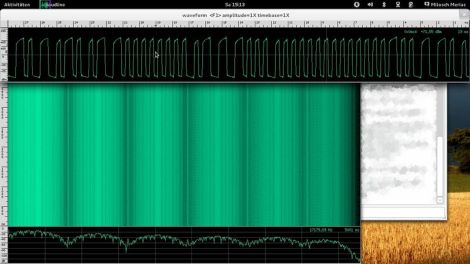
His toolkit also contains a baudline-based LF RFID sniffer package, allowing for a real-time waveform display of low frequency RFID tags. The LF sniffer makes use of a cheap USB sound card, as well as a relatively simple reader constructed from a handful of easy to find components.

We have seen some of [Milosch’s] handiwork before, so we are fairly confident that his toolkit contains just about everything you need to start sniffing and hacking RFID tags. If you’re interested in grabbing a copy of the ISO, just be aware that the live CD is only compatible with 64-bit systems, so older laptops need not apply.

Amazing Hemispherical Omnidirectional Gimbaled Wheel Robot

hemispherical_omnidirectional_gimbaled_wheel_robot

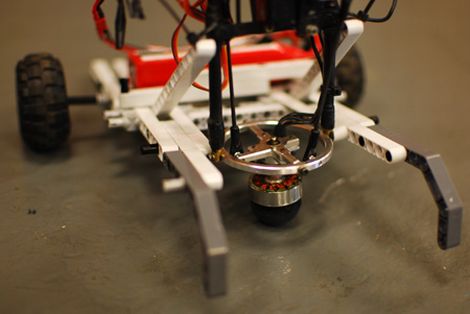
Bradley University grad student [Curtis Boirum] has built a robot which uses quite a unique drive system, one we’re guessing you have never seen before. The robot uses a single motor to drive its hemispherical omnidirectional gimbaled wheel, propelling it across the floor at amazing speeds with uncanny agility.

The robot uses a simple two axis gimbal for movement, which houses a small brushless RC airplane motor. The motor spins a rubber wheel at high speeds, which propels the robot in any direction at the flick of a switch, thanks to a pair of RC servos. When the servos tilt the gimbal, they change which side of the wheel is touching the ground as well as the gear reduction, eliminating the need for a mechanical transmission or traditional steering mechanism.

While he originally thought that he had invented the concept, [Curtis] found that this technology was nearly 100 years old, but that most people had forgotten about it. We’re pretty sure people will remember it this time around. How could you not, after watching the demo video we have embedded below?

We think it’s a great concept, and we can’t wait to see what other robot builders do with this technology.

[via Gizmodo]

Continue reading “Amazing Hemispherical Omnidirectional Gimbaled Wheel Robot”