IPhone To Arduino Communications Sans Jailbreak

iphone_to_arduino

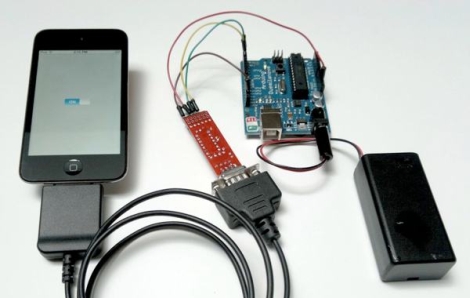
When Google released their ADK allowing Android smart phones to interact with Arduino-based devices, we’re sure there were at least one or two iPhone users who felt left out. Thanks to the folks over at Redpark, those people can now interact with an Arduino without having to jailbreak their phone.

For anyone looking to do any sort of iPhone/Arduino interaction, this is a good thing – except for the price. The 30-pin to serial cable is currently available over at Make for $59, which honestly seems pretty steep to us. When we first saw this announced, our initial thoughts were that we would see an open-source version in no time.

Unfortunately, that idea was short-lived, as we were quickly reminded of Apple’s MFI program. If you are not familiar, MFI (aka Made for iStuff) program limits what can be connected to an iDevice via licensing fees and a boatload of legal agreements. While we won’t be picking up this dongle any time soon, we’re all ears if someone has done any reverse-engineering of those pesky MFI chips.
DIY Book Scanner Processes 600 Pages/hour

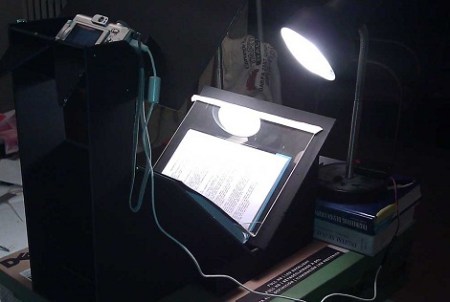
Like any learned individual, [Justin] has a whole mess of books. Not being tied to the dead-tree format of bound paper, and with e-readers popping up everywhere, he decided to build a low-cost book scanner so an entire library can be carried in a his pocket. If that’s not enough, there’s also a complementary book image processor to assemble the individual pictures into a paginated tome.

The build is pretty simple – just a little bit of black craft board for the camera mount and adjustable book cradle. [Justin] ended up using the CHDK software for the Cannon PowerShot camera to hack in a remote trigger. The scanner can manage to photograph 600 pages an hour, although that would massively increase if he ever moves up to a 2-camera setup.

Continue reading “DIY Book Scanner Processes 600 Pages/hour” →

Getting More Information From Your Battery Charger

echo_6_battery_charger_serial_hacking

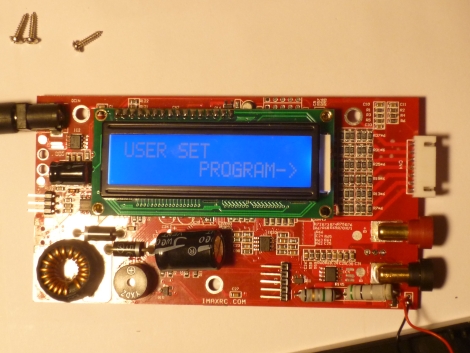
[Dane] bought a reasonably cheap ($17) Hobbyking Echo-6 battery charger and wanted to see what sort of information he could pull from the unit. Since the charger is designed for a variety of battery chemistries and sports an LCD screen, he figured that it contained a fairly decent microcontroller which he could tap into for some useful data.

He disassembled the unit and started looking around for any useful items. He discovered that it used an ATMega32 microcontroller and had quite a few unpopulated areas on the PCB, which led [Dane] to believe that the Echo-6 shared its main board with a more robust charger. He tapped into the ATMega’s UART and began seeing data immediately. Once he figured out what was coming over the serial line, he piped the data into LogView, resulting in some nice graphs showing off the charge/discharge processes in detail.

Tapping into the Echo-6 seems easy enough for any skill level, and we assume that just about anyone would benefit from getting kind of information out of their battery charger.

Robot Band Covers [Marilyn Manson]

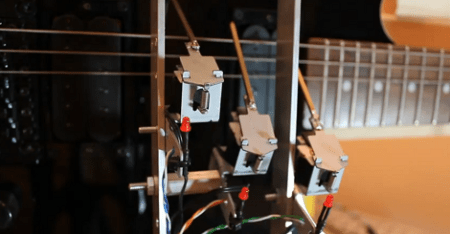
[James] built himself a robotic band from obsolete computer parts. The band needed something to play, and [Marilyn Manson]’s Beautiful People fit the bill. While it’s not the Rock-fire Explosion, having the [James]’ band cover [Marilyn Manson] is nearly as terrifying.

[James]’ original plan was to cover Mad World, but the stepper motors were drowning out the music for that song. While trying fix the cello problem the servos started acting up and reminded him of a certain song. While it’s not faithful to the original, we really like the arrangement on this version.

Continue reading “Robot Band Covers [Marilyn Manson]” →

DIY Robot Remote Control

[Patrick] wanted a remote control to control some of the robots he’s built. He also wanted to get some data back from his robots, so an inexpensive off-the-shelf solution wouldn’t be up to the task. Like all good geeks, [Patrick] decided to build what he needed.

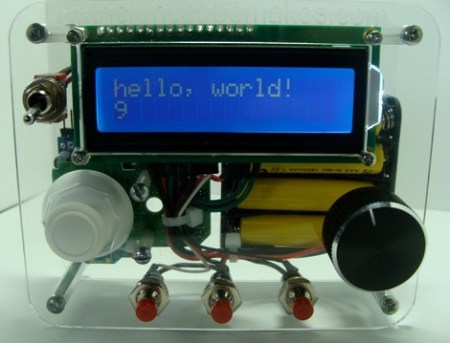
For analog control, [Patrick] decided to use a Wiimote nunchuck. This turned out to be a very good choice – the nunchuck has a 2-axis joystick and 3-axis accelerometer in one small, easy to interface package . The wireless radio is taken care of with an XBee module. For the microcontroller, custom “lcd backpack” was created that provides an I2C port for the nunchuck, inputs for the buttons and the single pot, and 2 serial ports for the FTDI and XBee.

Continue reading “DIY Robot Remote Control” →

Hacking Your NES/Famicom Console For Better Video And Audio

famicom_playchoice_ppu_mod

[Dominic] wrote in to share a pretty neat Famicom console mod that improves both the video and audio output of the system. While some of you may be familiar with the PlayChoice 10, we’re guessing that many of you are not. The PlayChoice 10 was an arcade-style machine that allowed you to play up to 10 different NES games. The system’s hardware was quite similar to the Famicom/NES consoles, but the graphics and sound performance was superior to either console.

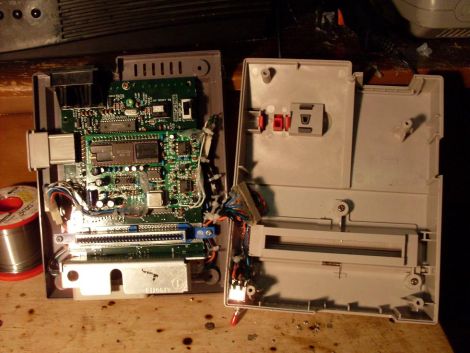
[Dominic] decided to tweak his Famicom system, and ended up replacing its native Picture Processing Unit (PPU) with one from a PlayChoice 10. This allows the console to output RGB video natively, resulting in a crisper picture with brighter coloring. He didn’t stop there however. His Famicom system also sports an upgraded audio circuit that boasts psuedo-stereo sound as well as increased bass response and better overall audio clarity.

The console looks nearly stock, and performs quite well according to [Dominic]. Be sure to check out the video comparison embedded below to see how the modifications improved his system’s performance.

Continue reading “Hacking Your NES/Famicom Console For Better Video And Audio” →

Cheap And Easy PCB Agitator From An Old CD-ROM

cdrom_pcb_agitator

Instructables user [mzsolt] enjoyed making his own PCBs, but he wanted to speed up the etching process just a bit. While some people put together elaborate bubble tanks and agitators, he wanted to keep his simple and more importantly, cheap.

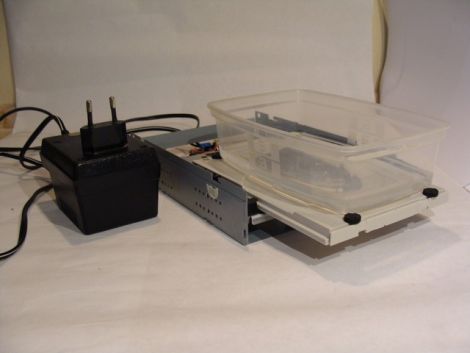
He looked around the house and discovered an ancient CD-ROM drive that was collecting dust, which he figured would make a great agitator for smaller projects. He picked up a decade counter and a handful of other cheap components, then got busy pulling the drive apart. He connected the motor and the drive’s limit switches to the decade counter, which controls the entire setup.

When powered on, the drive ejects, taking his container full of etchant with it. When the drive hits the outer limit switch, the decade counter reverses the motor until it hits the inner switch, reversing the motor once again.

As you can see in the video below, it works reasonably well. He suggests using a variable power supply to regulate the motor’s speed, but a variable pot would probably work just as well. Obviously the agitator is best suited for smaller projects, but since it was so cheap to put together, you won’t hear us complaining.

Continue reading “Cheap And Easy PCB Agitator From An Old CD-ROM” →