ChibiMo – An AVR-based USB Display

chibimo_usb_arduino_external_monitor

[Ko] wanted to add an extra monitor to his computer, but he wasn’t looking for something huge that would sit atop his desk – he desired something smaller, much smaller.

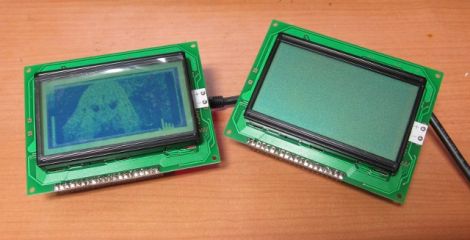
His ChibiMo mini USB monitor is a neat little creation that lets you extend or mirror your Windows desktop onto a tiny 128×64 pixel LCD panel. At first glance you might think that it is too small to be useful, but it is recognized in Windows in the same fashion as any standard monitor. This means that it would be quite easy to load system monitoring software solely on the LCD panel, keeping the clutter off of your main display.

The display is wired to an Arduino like any other standard shield, and is connected to his computer via a USB cable. Once the ChibiMo sketch is uploaded to the Arduino, the display driver needs to be loaded on the PC. This allows you to tweak the ChibiMo’s display settings in Windows’ display manager.

It’s a great concept, one we would love to see explored further. As of right now, the ChibiMo is only supported on x86 versions of Windows XP, and we weren’t able to find source links anywhere on his site. Perhaps there are some talented members of our community who would be interested in taking a whack at it…


On-dash G-meter Project Is Another Way To Distract Drivers

[PJ Allen] built a meter to display gravitation force in an easy to read way. Good thing it’s easy to read, because he’s added it to the dashboard of his car. That way he gets instant feedback when he puts the pedal to the metal. We’re hoping this encourages safe driving practices. But since it appears that not only is he watching the meter while he drives, he’s also holding a camera at the same time, we’d say this makes him a menace on the road.

But we do like the hardware concept. He used five Red/Green LEDs to show what the accelerometer is sensing. A green display reflects acceleration, while a red display shows deceleration. Inside the project box you’ll find a Parallax 2-axis accelerometer and an SX28 micrcontroller. This is an 8-bit Parallax chip family that was discontinued a few years back.

[Phillip Torrone] On Why All Makers Should Learn Chinese

phil_torrone_why_every_maker_should_learn_chinese

A while ago when he was working in China, [Phillip Torrone] started learning Mandarin Chinese in order to help him communicate more efficiently with his peers. Unfortunately, once he returned to the US, he slowly started forgetting most of what he had learned. He recently wrote a piece over at Make: explaining why he’s attempting to learn Mandarin once again, and why you as a maker should consider doing the same.

He starts off citing the economic trends which indicate that China’s global GDP share will likely bypass that of the US in a few short years. While the stats might be a bit boring he says, the rise of a new global superpower is nothing to shrug off.

Economic changes aside, he has found that through his workings at Adafruit and other tech companies, he is frequently being exposed to more and more Chinese on a daily basis. Between emails with suppliers, data sheets, and schematics, he says that learning Chinese is a must for makers.

What do you think? Do any of you full-time makers and hackers see the same trend in your jobs? Let us know in the comments.

Bluescripts Makes Bluetooth Control From Android A Bit Easier

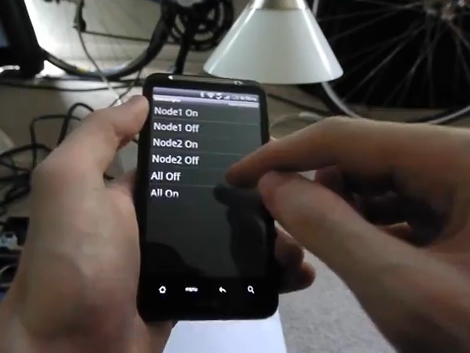
Here’s a way to gain control of your projects using an Android device. Bluescripts is a free app available in the Android market that makes it a bit easier to make interfaces to send customizable messages. If you have a Bluetooth receiver in your project, connecting to it is as easy as putting the MAC address into an XML file on the Android device. Each tag in that file has a name, as well as the address of the target and the message that should be sent. On the receiving end, you just need to make sure your project hardware is ready to receive an ASCII message and act based on what comes through.

Check out the demonstration video after the break. Perhaps it’s not as cool as you could do if you were writing your own Android program, but we can’t think of anything we’ve seen that makes an Android interface this quick and easy.

Continue reading “Bluescripts Makes Bluetooth Control From Android A Bit Easier” →

Mini IR Theremin

[Chris] at PyroElectro sent in a great 8-part write-up of a miniature infrared theremin.

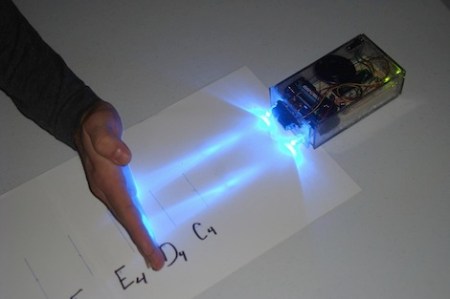
The theremin is based on a PIC microcontroller and an infrared distance sensor.  The build log goes through the theory of operations for the IR sensor and tone generation. [Chris] definitely does a great job showing the math that went into the design.

Although this project isn’t a true theremin because it operates on light like a few other projects we’ve covered in the past, it’s easier to play because of the hard-coded notes. The build does show some promise though – he could likely expand it to use more accurate ultrasonic sensors or use, “two proximity sensors, one for treble and one for bass like an accordion.”

The theremin is usually played with both hands providing a continuous pitch and volume. This project features hard-coded, discrete notes, so we’re wondering about the possibility of implementing MIDI on this IR theremin. The original MIDIbox was based on the same microcontroller as this project, so it’s definitely a possibility.

Check out the video of the theremin in action below.

Continue reading “Mini IR Theremin” →

Reverse Engineering VxWorks (which Replaces Linux On Newer Routers)

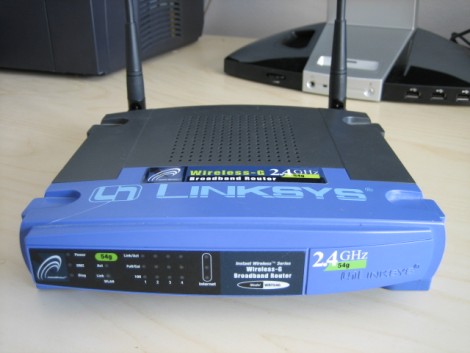
The Linksys router seen about is a WRT54G version 1. It famously runs Linux and was the source of much hacking back in the heyday, leading to popular alternative firmware packages such as DD-WRT and Tomato. But the company went away from a Linux-based firmware starting with version 8 of the hardware. Now they are using a proprietary Real Time Operating System called VxWorks.

[Craig] recently put together a reverse engineering guide for WRT54Gv8 and newer routers. His approach is purely firmware based since he doesn’t actually own a router that runs VxWorks. A bit of poking around in the hex dump lets him identify different parts of the files, leading to an ELF header that really starts to unlock the secrets within. From there he carries out a rather lengthy process of accurately disassembling the code into something that makes sense. The tool of choice used for this is IDA Pro diassembler and debugger. We weren’t previously familiar with it, but having seen what it can do we’re quite impressed.

[Image via Wikimedia Commons]

VU Meter Scarf Lights Up The Night

vu_meter_scarf

[Eli Skipp] wrote in to share a project she has been working on bit by bit, for over a year – an LED VU meter scarf. The project was originally going to be built using a custom PCB, but no matter how long she spent troubleshooting the piece, it just wouldn’t work right. She eventually broke down and purchased a VU meter kit, which worked out quite a bit better than the homebrew version.

The VU meter circuitry is tucked away inside the scarf as she shows in the video below. The LEDs are connected using conductive thread sourced from Lamé Lifesaver, which she says is far more durable than other threads she has tried. After originally testing the VU meter, she was unimpressed by the output of the LEDs, so she swapped them out for brighter ones, which look much better. It looks like it works quite well – we definitely dig the idea of a scarf with a built-in VU meter, even if it was partially built from a kit.

Continue reading to see [Eli] give a quick demonstration and a rundown of the scarf’s construction.

Continue reading “VU Meter Scarf Lights Up The Night” →