Bluetooth-enabled Talking Chicken

bluetooth_chicken

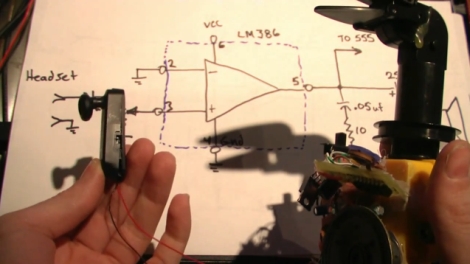
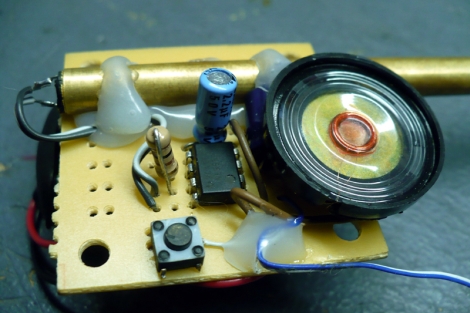
[Jeri Ellsworth] sent us a video walkthrough of a hack she did a few years ago using a toy chicken with a motor operated mouth. She wired up a Bluetooth headset’s audio output to a LM386 audio amplifier, which drives the speaker she added to the chicken. The output of the audio amplifier was also connected to a 555 timer in bistable mode to activate the motorized mouth. The motor simply opens the mouth when activated, allowing the built-in spring to snap it shut when the 555 is reset.

Obviously Jeri didn’t send us an old project just for kicks, she wanted to remind all of our readers that the 555 Design Contest comes to a close tomorrow night, March 1st at 11:59 EST. If you haven’t submitted an entry yet, get something started while there is still time!

Keep reading to see Jeri give a quick video overview of her talking Bluetooth chicken.
Continue reading “Bluetooth-enabled Talking Chicken”

Fun Slide Whistle Synth Toy

slide_synth

[Dino] recently sent us some info on his latest project, a 555 timer-based slider synthesizer. The synth was built to emulate the sound made by playing a slide whistle, and also as an entry into the 555 Design Contest, which is quickly coming to a close. If you’re not familiar with a slide whistle, just spend a few minutes on YouTube looking for clips of Sideshow Bob – it’s ok, we’ll wait.

The circuit is pretty simple, though the implementation is quite clever. While traditional slide whistles require the user to blow in one end, this electronic version operates using a LED and photo cell. When the main switch is closed, the 555 timer is activated, and a tone is produced. The pitch of the tone is controlled by the LED as it slides in and out of the tube. The more light that hits the photo cell, the higher the pitch, and vice versa.

Continue reading to see a quick demonstration of [Dino’s] slide synth, and be sure to check out his other 555 contest entry we featured a short while back.

Continue reading “Fun Slide Whistle Synth Toy”

Web-enabling Your Smoke Breaks

If you’re going to freeze your butt off smoking in the middle of winter you might was well have company while you’re out there. [Zach’s] company wanted to crunch some data about smoking breaks and worker productivity. Instead of just meeting the bland data collection needs he decided to add functionality.

He took time to explain the different parts of the system. Above you can see the web interface that lets you know which of your coworkers are smoking right now. It also lets you click to check in and out from your breaks. After this was up and running he found that often the smokers forgot to ‘clock out’ before a break. As a backup system he build a physical interface on the way out of the office. Each smoker has their own button with a corresponding LED. If the light’s on you’re having a break and when it’s off you’re working. This controller is Arduino based and uses a Perl script to monitor the input and sync both that physical display and the web interface. [Zach] posted a few pictures if you want to take a look at the rest of the system.

Giant Oscilloscope Music Display

oscilloscope_wall

[Andrew] sent us a video of his home made oscilloscope wall, which he uses to visualize different audio tracks he has created. The wall is made up of nine old broadcast monitors he wired together in his studio. At first it appears that the monitors are split into two sets of four, with the center monitor running separately, but upon further inspection it looks as if he can control the display of each monitor independently.

We’re pretty sure he is not using an actual oscilloscope to generate the visuals, but rather visualization software that can approximate the output of an O-scope set in X-Y display mode. Though the screens run independently, it would be great to see all nine screens working in concert to display one large visualization. [Andrew] mentions that an high-def version is in the works, so perhaps we’ll see more features added in that iteration.

Stick around to watch a video of his oscilloscope wall in motion.

Continue reading “Giant Oscilloscope Music Display”

Crank-arm Style Hexapod

The latest robot out of Nolebotic is Al.I.S.E, or Aluminum, Infrared Scanning Entity. Don’t let the name fool you, its a pretty simple take on the classic hexapod walking platform using a crank arm and leavers made into the legs.

The body of the robot is made out of aluminum which is pretty easy to work with at home, lightweight, and sturdy. Bolted to the body are a pair of beefy gear head motors, a 9.6 volt rechargeable battery pack, along with a basic stamp 2 and its own 9 volt supply, and a Solarbotics 1198 CMD driver board.

Obstacles are handled right now with rudimentary infrared detectors and emitters, but it seems to work pretty good avoiding some library books in the demo. Combine that with clean mechanics and a pretty good stride and this thing can get up and move pretty quick.

Quick And Easy DIY Kegerator

diy_kegerator

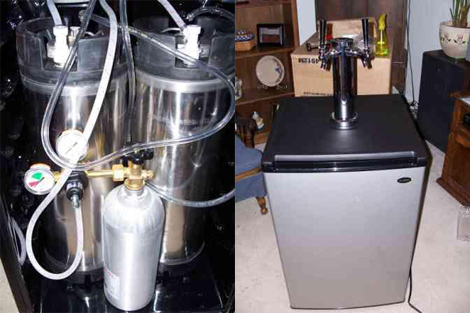
I think we can all agree, there are few things that go better with hacking everything than beer. [Tom] has taken his love for beer and building things, fusing them together in a DIY kegerator. Using an off the shelf mini fridge and some easy to find beer serving components, he walks us through the conversion step by step. When everything is said and done, the kegerator should hold two 5-gallon kegs along with the CO2 tank required to serve the beer.

The process is admittedly pretty easy, but it’s probably the quickest way to go from zero to kegerator. [Tom] has this down to a science, knowing exactly what needs to be altered and removed, so following his tutorial should save you time and headaches, should you attempt this conversion yourself.

It would be great to see this project expanded to include precision temperature controls, a method of determining how much beer remains in the kegs.

Santa-pede Contest Winners

We received several fantastic entries. We laughed, we cried, we stared at our monitors in confusion, it was fantastic. Now we’re here to announce the winners of the Santa-Pede contest.

If you recall, the rules were pretty simple. Aquire a dancing santa (or other holiday dancing annoying toy thingy in the same fashion), tear it apart, build something that walks out of the pieces. We were aware that most of these have a very similar setup with one or two servos and a bit of plastic. That way everyone has a similar starting point.  We were amazed at what was done with so little.

Keep reading to find out who one each of the three categories: Most over-done,  best walker with no extra parts, and best presentation.

Continue reading “Santa-pede Contest Winners”