What Development Board To Use?

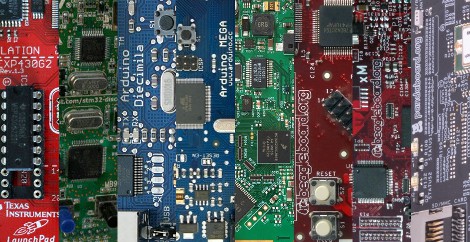
Here at Hackaday, we see microcontroller based projects in all states of completion. Sometimes it makes the most sense to design systems from the ground up, and other times when simplicity or a quick project completion is desired, pre-built system boards are a better choice. We have compiled a list of boards that we commonly see in your submitted projects, split up by price range and with a little detail for reference.

After reading our list, sound off in the comments or on this forum post, and we may include your board in a follow-up guide at a later date. We will also be giving away 10 Hackaday stickers to the most insightful, the most original, and most useful advice given on the forum, so if you haven’t registered yet, now would be a perfect time. Winners of the sticker giveaway will be selected from the forum thread, and the final decision for prizes will be judged by the wit and whim of the Hackaday writing team. More prize details to follow in the thread. Read on for our guide based on past project submissions.
Continue reading “What Development Board To Use?”

Video Game Installations For Kids’ Parties

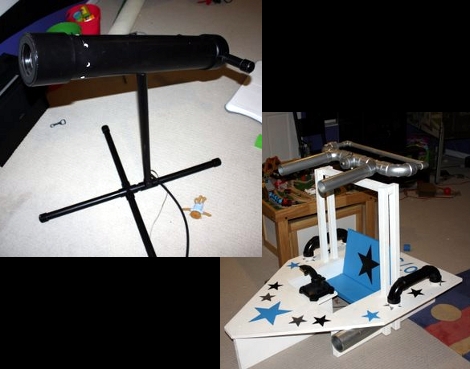
Why won’t someone think of the children?! Actually, some of the best hacks come from entertaining the little ones. Take [Piles of Spam’s] two video game builds. The first is a telescope-based controller that is used to shoot virtual cannon balls at a projection of a pirate ship. The second is a two-player cooperative game where one player drives and the other shoots. Both of them use a projector to display the playing field, an IR laser for targeting, and an NTSC camera to pick up the location of the laser dot. This works really well, thanks to the quality of the physical builds, and great audio and video on the game side of things. See for yourself in the clips after the break.

A couple of posts into the thread [Piles of Spam] talks about laser intensity. He wanted to make sure that there wouldn’t be a room full of half-blind five year olds thanks to the targeting system. Continue reading “Video Game Installations For Kids’ Parties”

555s For Your Mouse And R/C Airplane

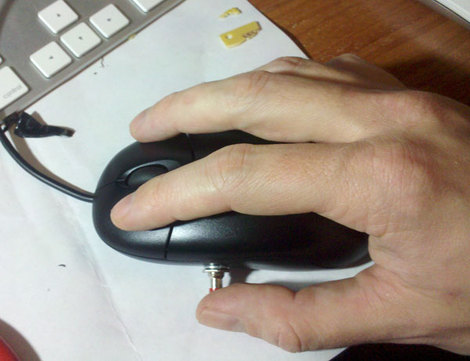
[lenny] decided to build a 555-based auto-firing mouse based on a 555 after seeing a similar PIC-based project we posted earlier. Lenny’s version is self-contained in one mouse without requiring a second mouse to act as the rapid-fire button. It uses only a handful of components, costs less than $5 to build, and doesn’t require any programming.

But then, [wfdudley] shakes things up a bit. He added a 4022 counter IC and some diodes to act as logical “OR” gates in order to create a unique blinking pattern (short-short-long) for the lights on a friend’s RC airplane. While this project involves more components, it’s definitely a trickier problem to solve with a 555 timer IC. We love seeing people choosing simplicity in design over popular off-the-shelf microcontroller frameworks as these two have done.

Don’t forget, the 555 Design Contest is still going strong, and you’ve got the entire month of February to submit your awesome designs. We wanted to highlight two of the more clever 555-based hacks that we’ve had in our backlog for a while, though.

Update: Microtouch The 8-bit Ipod Touch

It looks like [rossum] and [Ladyada] have teamed up and been busy working on the microtouch. Since we covered it last year its had a few minor improvements like an upgrade to the ATmega32u4 microprocessor and some new software. The new and improved microtouch also features an accelerometer as well as some software to go along with it. Plus its now for sale on adafruit for about a quarter the price of an ipod touch (just in case you don’t feel like making your own).

For the unaware the microtouch is a lightweight AVR based ipod touch. It comes with a bootloader which allows you to download your “apps” to the microtouch without the need for an AVR programmer. While it may lack some of the computing power and features of the ipod touch (like music), the microtouch is definitely appealing for its open hardware/software and easy to use touch screen.

Etch-a-Sketch Computer Is A Surprisingly Simple Hack

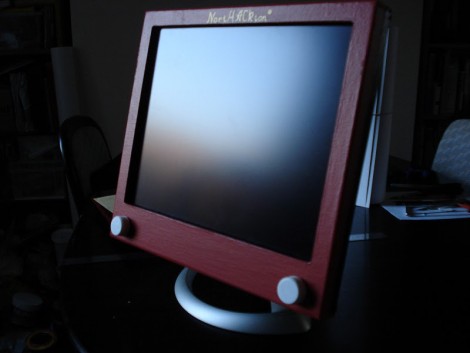
We’re not sure whether to call this an Etch-a-Sketch upgrade or a computer interface downgrade but either way it’s unique. [Martin Raynsford] added a familiar red frame to his computer monitor with classic white knobs that control horizontal and vertical cursor movement. There’s even the click option by pressing the buttons in and, as you can see after the break, the modifications result in a perfectly usable digital Etch-a-Sketch. We’ve seen a lot of computer controlled versions of the toy which use fancy parts and take quite a bit of skill to build. This mimicry of the functionality is easy to build and the idea is genius in its simplicity. [Martin] separated the encoder wheels from a mouse. He placed each on one of the knobs and ran wires for sensors and micro-switches back to the original PCB which is stuck to the back of the monitor. From the computer’s point of view it looks and acts like a normal mouse but this is so much more fun (and less productive). Continue reading “Etch-a-Sketch Computer Is A Surprisingly Simple Hack”

Out Engineering A Sneaky Cat

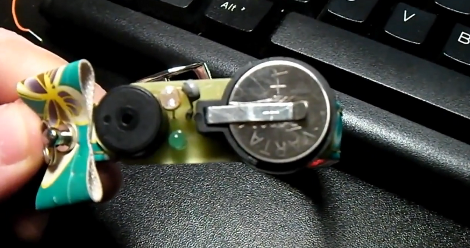
Cats do what they want, which rarely coincides with what their owner wants them to do. In [Dumitru]’s case, his girlfriend’s cat [Pufu] tended to make it outside into the cold more often than desired. Rather than settle with the normal bell which gets obnoxious even when the cat isn’t misbehaving, he decided to put together a custom Cat Finding collar. He used a PIC microcontroller as the brains, and temperature and light sensors to decide whether the cat had snuck into the cold, dark night. Once the cat has been marked as being outside, a buzzer and LED are set to go off at regular intervals until returned into the safety of the indoors.

[Dumitru]’s website along with his YouTube videos are in Romanian, though the schematics and source code provided speak for themselves. He does a wonderful job walking through the entire design process, including time spend in the IDE as well as EAGLE designing the board. YouTube has managed to subtitle the majority of the details, but we imagine this post will be a real treat to any Romanian speaking hobbyists out there. Be sure to catch both videos after the break.

Continue reading “Out Engineering A Sneaky Cat”

Target Hunting UAV Armed With Fireworks

Don’t just build a UAV, use it to blow things up. In this case a tri-copter seeks out colored balloons and pops them using low-grade fireworks. We’ve seen this type of flying armament before, but not in a ‘copter form factor. It looks like the targeting and firing is done by an operator, and is not an automated system despite what the text overlays on the video after the break says. The lack of autonomous firing capability makes this delightful, rather than scary. Don’t miss the build log for the tri-copter itself. How do you think this one stacks up to the last 3-bladed build?

Continue reading “Target Hunting UAV Armed With Fireworks”