N8VEM Computer With A 3Km Wireless Link

pterm

[James] sent in this project in which he built a tiny computer with text based OS and a 3Km wireless link. The details are a bit scarce, but he used an N8VEM, a Propeller Pocket Term, a 4 line LCD and an RF Transceiver to build it. It runs CP/M, the text based operating system and uses less than a half of a watt, without the vga monitor. With a total cost of 145 and 4 serial ports for sensors, this thing could come in handy. Especially since its low power consumption could allow it to be solar powered.  You may recall the N8VEM from an earlier post we did.

Tethering The Kindle 2

kindle

This is not an article on how to use your Kindle’s internet connection with your computer. We’ll let [Jesse] explain why:

This is not a tutorial about how to use the Kindle 2’s Sprint connection from your computer. I don’t know that it’s possible to do so without making changes to the Linux installation on the Kindle. I do know that abusing the Kindle’s Sprint modem like that would upset Amazon a great deal.  Bear in mind also that Amazon know where you live. They know your Kindle’s serial number and thanks to the built in GPS, they know where you are right now.

What this is, however, is a nice tutorial on how to connect your Kindle to your computer so that it can use your computer’s internet connection. The instructions assume you are using a Mac, so you may have to adapt it if you aren’t. Basically you put the Kindle in Debug mode and tell it to use the USB tether for it’s network connection. This should allow not only a faster connection, but possibly a chance to see what exactly they are transferring back and forth.

Smart Card Emulator

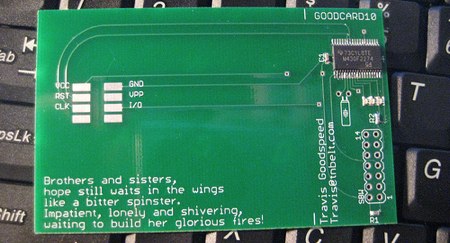
Here’s a quick prototype from [Travis Goodspeed]. It’s a smart card built around an MSP430 microcontroller. We’ve used the MSP430 in the past because of its low power demands. He says this business card currently supports 1.8V to 3.3V, but a future design will have 5V as well. Technologies like Java Card exist for running applets on smart cards, but a familiar microcontroller like the MSP430 could certainly make development much faster. Knowing [Travis], there’s a reader somewhere about to go through some serious fuzzing.

Distributed Computing In JavaScript

mapreduce

We’ve heard about the idea of using browsers as distributed computing nodes for a couple years now. It’s only recently, with the race towards faster JavaScript engines in browsers like Chrome that this idea seems useful. [Antimatter15] did a proof of concept JavaScript implementation for reversing hashes. Plura Processing uses a Java applet to do distributed processing. Today, [Ilya Grigorik] posted an example using MapReduce in JavaScript. Google’s MapReduce is designed to support large dataset processing across computing clusters. It’s well suited for situations where computing nodes could go offline randomly (i.e. a browser navigates away from your site). He included a JavaScript snippet and a job server in Ruby. It will be interesting to see if someone comes up with a good use for this; you still need to convince people to keep your page open in the browser though. We’re just saying: try to act surprised when you realize Hack a Day is inexplicably making your processor spike…

[via Slashdot]

Putting A Digital Picture Frame To Work

picture-frame

[Tobe] shares living accomodations with a few other people, so he built this tool to help them all communicate. using a Samsung SPF-83v wifi enabled picture frame, he’s made a central location for things like shopping lists and messages. He uses PHP for the database accessing and writes it all to an image using gd. Every 15 minutes a cron job runs that pushes the updated image to the picture frame.

Remote Thermometer Using Arduino

temp

[Peter] sent in this writeup on how to build a remotely accessible thermometer. The hardware side is pretty easy on this one, all you need is an Arduino, a resistor and an thermistor. The software is where the main focus is.  You can check the temperature via command line, but also via email. It can also tell you the temperature using the host computers sound hardware. You can see a video of it in action after the break. We have to wonder why he didn’t make it twitter.

Continue reading “Remote Thermometer Using Arduino” →

Hackit: Consumer RFID

Touchatag

RFID seems to have invaded every part of our lives. Sure, the technology has been primarily used in government and industry, but that doesn’t mean that it doesn’t have consumer applications. Recently, we posted about [max’s] RFID dorm room lock, that he built to provide a safe, convenient way to access his room. A while back, we talked about an RFID spatially aware address book that used a combination of rfid tags and post-it notes to control the NFC enabled Nokia 3220 cell phone. Both of these projects highlight unique applications where RFID is used. We bash on RFID from time to time, mostly due to its security (or lack there of). That said, there is an interesting consumer solution out there for people who want to voluntarily use RFID called Touchatag (formerly known as Tikitag). The cool thing about Touchatag is that it uses a combination of RFID and QR (2-D barcode) tags to trigger applications on the Touchatag website. The starter kit, which includes 10 tags and a USB RFID reader, goes for about $40; a decent price considering the hacking potential for the RFID reader. In addition to using the reader, you can also use any NFC enabled phone to read the tags. While NFC enabled phones are currently few and far between, the technology will likely be implemented in many of the new phones released in the coming year.

We’re curious, what do you think is next for consumer RFID? What kind of innovative project ideas do you have?