
High Quality Macro Lens

alligator

[Chris] wanted to do some macro photography, but found the price tag off putting. He was looking at roughly $800 for a decent macro lens. Instead, he decided to build his own. He wanted to build a lens that could be removed and used just like his normal lenses. He picked up a standard Canon AF lens for $10 to start with. He has posted detailed steps on how he modded it to work, and you can see the results are quite stunning. Great job [Chris]. If you want to try your hand at macro photography but don’t think you can pull of a job like this, you might want to check out the pringles can macro lens.
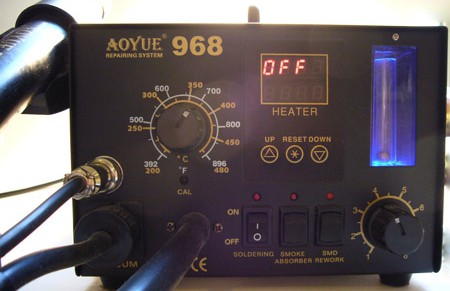
Tools: Aoyue 968 3-in-1 Soldering And Rework Station

The $10 “fire-starter” is the most common beginner soldering iron. These are simple irons with a hot end, a handle, and little else. There’s no temperature control or indication. Despite their simplicity, they’ll do just about anything. You can solder any legged chip type with this type of iron. We used fire-starters in the lab for years.

Eventually, we wanted a hot air rework tool to salvage SMD parts and solder QFN chips. Aoyue is a relatively unknown Chinese brand that makes soldering stations very similar in appearance and function to Hakko. Aoyue stations are recommended and used by Sparkfun Electronics, something that factored heavily in our decision to buy an Aoyue. Read more about our experiences with this tool after the break.

Continue reading “Tools: Aoyue 968 3-in-1 Soldering And Rework Station” →

Non-von1 Supercomputer

nonvon_box_small_comp

[Chris] sent us this project, where he built a tiny supercomputer called the Non-von1. Wanting a supercomputer, but lacking space and funds, he opted to go after the supercomputers of the 80s. His system was patterned after the “Von Neumann” systems developed at Columbia university. His system has 31 8 bit processors to crunch numbers for him. The whole unit communicates with the computer using a19.2 kbps serial link.  He does talk about its limited capabilities, stating that he could use it as a way to store roughly half of his cell phone’s phonebook. This reminds us of the Basic stamp supercomputer we covered back in November.

Experiments In Polaroid

polaroidpage

[Peter] found that Polaroid film was an easy medium to play with, as the ability to develop it is built in. He has done several fun experiments, from electrocuting it to making giant mozaics. The Polaroid film may not be easy to get your hands on though. They stopped producing it in the summer of 2008. Some former employees are trying hard to get it back into production, but that may never happen. Polaroid has recently received permission to sell itself at auction. We’ll just have to wait and see.

Flatpack Walker

flatpack

If you’re into robotics, you’re probably already familiar with the 2 motor walker. This design, usually used in B.E.A.M. robotics is a pretty easy way to make a 4 legged walking robot. [Edwindertien] has made the design a little bit easier to build with these flatpack walker plans. He used 4mm thick birch, cut by laser to get his walker into shape, but the design would work with almost any material. His walker is Arduino powered, so it could be programmed for all kinds of behavior, especially if you add some sensors. You can see his bot in action after the break.

Continue reading “Flatpack Walker” →

Stantum’s High Precision Multitouch

touch

We love keeping track of new interaction technologies and this new touchscreen by Stantum looks especially promising. Engadget shot a hands-on video with it at the Mobile World Conference. It’s a resistive screen, so it can be used with both fingers and styluses (unlike capacitive screens). It’s sensitive enough that you could use a brush too. The screen supports any number of multitouch points and does pressure sensing based on the size of the detected fingertip. The touch detection is actually more accurate than the screen can display. Stantum is hoping mobile manufactures will pick up their input framework for inclusion in new devices. The resistive touchscreen was built to Stantum’s specifications (it won’t work with current phones), but they say it wouldn’t be hard to go into mass production.

Segway And Input Filtering

seg

[Kerry] is building a segway type vehicle for a senior project. Though it doesn’t appear to be done yet, there is some good work finished. As with any balancing bot, it relies heavily on input from a gyroscope, and at least in this case, an accelerometer. That data can be very messy. The sensitivity of the sensor means that people often end up with vibrating or drifting in their projects. [Kerry] has put some work into finding a method of smoothing that results in fast, accurate, but smooth reaction. You can see a video of some comparisons between methods after the break.

Continue reading “Segway And Input Filtering” →









