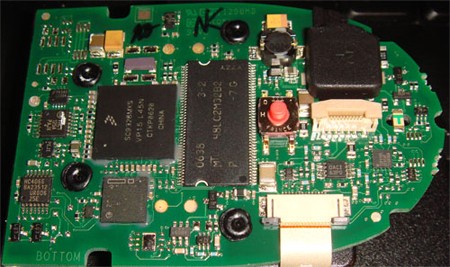
Guessing games are fun, especially when unnamed hardware and prizes are involved. [bunnie] holds a Name that Ware contest on his blog once a month; he posts an image of hardware components like the PCB above (which is May’s mystery ware) and asks visitors to try to guess the machine it came from or at least its function. Aside from the prizes he gives out, winners get the most coveted of all rewards: bragging rights. He’s been running the monthly contest for quite some time and it’s not always PCBs; past wares have included this micron thickness guage (internal) and an xray of a crystal oscillator.
Drawing Images On A Character Display

[Dean Hall] doesn’t seem to know his Simpsons characters very well, but that didn’t stop him from coming up with this method for displaying a bitmap on an LCD character display with a Hitachi HD44780 chip.
[Hall] used an LCD with two 16 character rows and 8×5 pixels in each character. He displayed the image over 2×3 characters, which gave him 17×18 pixels (including the spaces between the characters) to work with. The first step after acquiring an image is to rasterize the image by hand onto graph paper. This won’t be scanned, it’s just a diagram to determine which pixels to light up.
Once the 6 characters were determined, [Hall] used this handy web-based tool to convert his graphed diagram to bitmap data. The data is loaded onto the microcontroller and the image shows up on the LCD. This is a pretty straightforward project, just be sure you properly identify your monkeys.
[via YourITronics]
Covert IPhone Moleskine Case
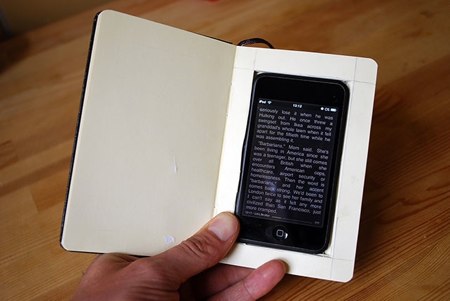
Crafting isn’t really our thing, but just last week we were planning on doing this project. Thanks to the how-to singularity: the longer we wait, the more likely someone else will do our dirty work. The instructions are this:
- Cut a hole in a book.
- Stick your phone in that book.
- Let her open the book.
Wired’s write up has about 600 more words if you need clarification. The ebook on the screen is Cory Doctorow’s Little Brother, so expect to see this on BoingBoing… and again when it’s fan translated into Polish. [bre] made a similar hidden compartment book last Fall for Make’s PDFcast.
In all seriousness, we do enjoy the idea of carrying an innocuous little book around that could be doing some covert WiFi scanning, acting as a mobile accesspoint, or live streaming our location to friends. Unfortunately, since it’s an iPhone, most of this isn’t possible yet; you can’t even voice dial from your headset, while leaving the notebook in your pocket. This case also blurs what is considered rude. Most people would be annoyed if you started txting mid conversation, but people taking notes in Moleskines don’t get the same treatment.
The Best Of 2600
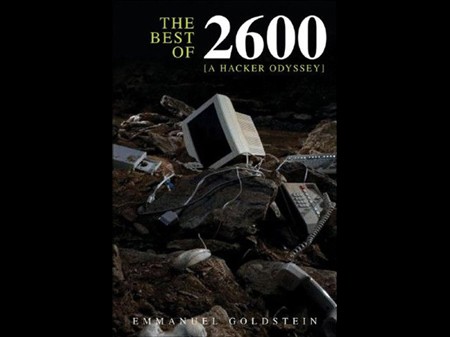
2600 editor [Emmanuel Goldstein], has decided to publish The Best of 2600. It features some of the best essays on lockpicking, phone phreaking, social engineering, and other topics that the hacker quarterly had to offer.
Founded in 1984, 2600 was one of the major catalysts that got the modern hacker scene going. They published controversial articles on topics like red boxing and spawned monthly meetings. This firsthand account of the development of hacker culture will be released in July at The Last HOPE in New York.
Malware Alters DNS Data On Routers
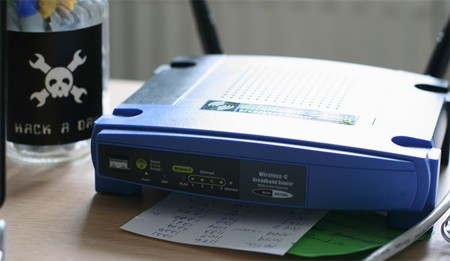
The Zlob trojan, also known as DNSChanger, has been around for a few years, but recent Zlob variants to appear in the wild attempt to log into routers using a list of default admin/password combos. If they succeed, they alter the DNS records on the router to reroute traffic through the attacker’s server.
Our friend [Dan Kaminisky] recently did a presentation warning against vulnerabilities in internet browser plugins that allow attackers to mount DNS rebinding attacks against routers with default passwords.. Though it achieves the same end, Zlob is different because it infects by the tried-and-true method of fooling users into downloading it inside a fake video codec. Once it is running on a client machine, it is free to attempt to use the default admin id and password of the router to log in and alter DNS settings. It even supports the DD-WRT firmware.
Even if a system is wiped clean of Zlob trojans, the router could still be compromised. The good news is that it is easy to fix and even easier to prevent. Fixing it takes no more than wiping all network clients clean, then resetting the router and restoring custom settings. Prevention is a simple matter of changing the router’s password.
[photo: fbz]
Stabilized Video Collages
This is some beautiful work. The clip features multiple video streams stabilized and then assembled into a whole. First, [ibftp] used the “Stabilize” feature in Motion 3 (part of Apple’s Final Cut Studio 2) to remove the camera shake from the clips. Then he was able to blend the videos with “fusion” set to “multiplication”. If you’ve got access to the tools, this shouldn’t be too hard to do yourself. We’re certain someone in SIGGRAPH is already attempting to do the same thing live. If you want to see image stabilization really making a difference, have a look at the stabilized version of the Zapruder film embedded below.
LED Lightbar Controller
[youtube=http://www.youtube.com/watch?v=6ihIaNN9UBY&hl=en]
[Adam Grieg] recently posted this video of his LED lightbar controller at work making a strip of LEDs flash to the beat of his music. The controller does it by picking up the music via an electret microphone, then amplifying it with an LM386 Amp. The ATtiny13 microcontroller keeps track of the noise level and makes the LED array flash whenever it senses a peak.
In addition to the parts listed, [Grieg] used a small SparkFun box as the enclosure for the controller. If you’re considering trying your hand at this project, check out [Grieg]’s schematics and code. It’s relatively cheap to make, so it wouldn’t be that hard to rig up several of these set to flash at different frequencies.
[via SparkFun]