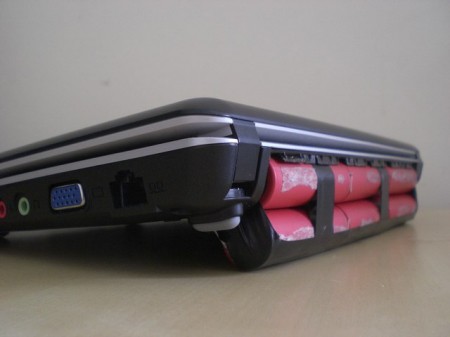
MSI Wind Extended Battery


[The Tech Guy] shows us how he added cells to an MSI Wind’s battery. This hack is extremely simple but it may be difficult to get the battery back into your laptop. Also, we’re not too sure how stable it is, and you can definitely forget about taking this thing through an airport. It would be really nice to start seeing people fabricate custom enclosures. Until then, this hack is best reserved for people completely desperate for extended battery life.

[via hypatiadotca]

Tablo, Fabric Gesture Controller


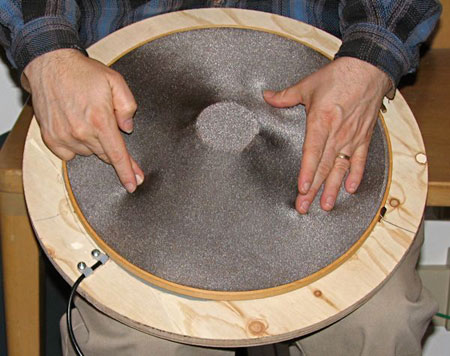
[Adrian Freed] posted this interesting fabric gesture controller called Tablo. It uses a stretchy conductive fabric, laid over a framework to create a curve known as the Witch of Agnesi. Holding the center of the fabric up is an inverted bowl covered with sections of conductive material. The whole thing is wired to a microcontroller that measures the resistance fluctuations when you press on the fabric. It is capable of measuring displacement and pressure as well as being multitouch.

They mention that the simple interface allows it to be used as a foot input as well as a hand input. We’d love to see a video of it in action.

Essential Bluetooth Hacking Tools

Security-Hacks has a great roundup of essential Bluetooth hacking tools. As they point out, Bluetooth technology is very useful for communication with mobile devices. However, it is also vulnerable to privacy and security invasions. Learning the ins and outs of these tools will allow you to familiarize yourself with Bluetooth vulnerabilities and strengths, and enable you to protect yourself from attackers. The list is separated into two parts – tools to detect Bluetooth devices, and tools to hack into Bluetooth devices. Check out BlueScanner, which will detect Bluetooth-enabled devices, and will extract as much information as possible from those devices. Other great tools to explore include BTCrawler, which scans for Windows Mobile devices, or Bluediving, which is a Bluetooth penetration suite, and offers some unique features like the ability to spoof Bluetooth addresses, and an L2CAP packet generator. Most of the tools are available for use with Linux platforms, but there are a few you can also use with Windows.

[via Digg]

Electric Screwdriver Robot Hand


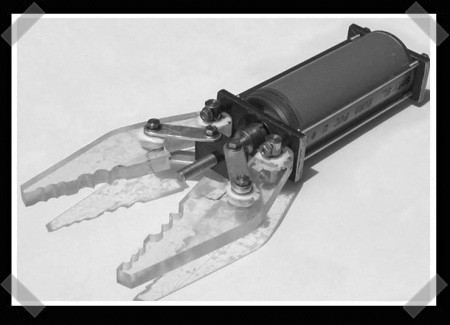
Here’s an interesting grabber hand built for use on an ROV. This grabber is a novel use of a very common and extremely cheap electric screwdriver, that is probably found in everyone’s toolbox. It is also a great way to reuse that small electric screwdriver you have kicking around that uses proprietary batteries that are not worth replacing. Many of the ROV’s covered previously could benefit from such a powerful device built from very common materials off his parts list. Because the screwdriver was extremely cheap the designer chose not to completely seal the housing.

It seems like this simple design that could be used in many robotic projects and by simply changing the jaws could yield other creative uses. The first thing that comes to mind is to upsize this hack into something bigger and stronger. Either way, you might not want to get your fingers in there.

Breakthrough In Water Based Energy Storage


[Daniel Nocera], working with the MIT Energy Initiative, has come up with a method to easily and cheaply store energy generated from solar electricity with water. The method uses two catalysts of non-toxic and abundant metals to separate the water into both oxygen and hydrogen. These gases are then stored, and later recombined in a fuel cell to generate power. The process was inspired by photosynthesis, and helps to make sources such as solar power viable around the clock. Current storage technologies are both expensive and inefficient, so technologies like solar are only useful when the source is available. This will allow homes to cheaply and easily store power generated through solar and other technologies. While this is only part of the solution towards the current energy problem, it could go a long way towards decreasing our use of non-renewable sources. When combined with other new breakthroughs in the field, you can easily imagine more homes coming off the grid. Check out the short video after the break.

Continue reading “Breakthrough In Water Based Energy Storage” →

Securing DNS On OSX


It’s been a few weeks since [Dan Kaminsky] announced the nature of the DNS vulnerability and allowed 30 days of non-disclosure for patches to be applied before details of the exploit went public. Unfortunately, the details were leaked early and it didn’t take long for a functional exploit to be released into the wild. Since then, many ISPs have taken steps to prevent their users from falling victim to the attack, and BIND, the widely-used DNS protocol implementation, was updated to minimize the threat. Even then, there were reports of a version of the attack being actively used on AT&T’s DNS servers.

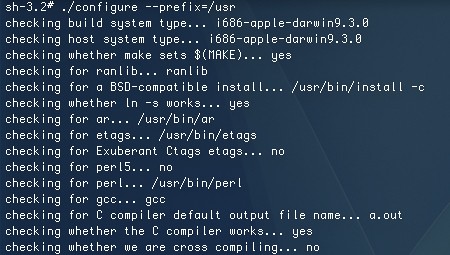
Mac OSX uses a BIND implementation but as of yet, Apple has not released a patch updating the system (Microsoft, on the other hand, patched this up on July 8). As a result, machines running OSX are at risk of being exploited. Individual users are less likely to be targeted, since the attacks are directed towards servers, but it’s not a smart idea to leave this vulnerability open. [Glenn Fleishman] has published a way to update BIND on OSX manually, rather than waiting on Apple to patch it themselves. It requires Xcode and a bit of terminal work, but it’s a relatively painless update. When we tried it, the “make test” step skipped a few tests and told us to run “bin/tests/system/ifconfig.sh up”. That allowed us to re-run the tests and continue the update without further interruption. [Fleischman] warns that people who manually update BIND may break the official update, but he will update his instructions when it happens with any possible workarounds. Unfortunately, this fix only works for 10.5 but alternative, yet less effective methods may work for 10.4 and earlier.

If you’d like to know if your preferred DNS servers are vulnerable or not, you can use the DNS checker tool from Doxpara. As an alternative to your ISP’s DNS servers, you can use OpenDNS, which many prefer for its security features and configuration options.

UnMouse Cheap Multitouch Prototype


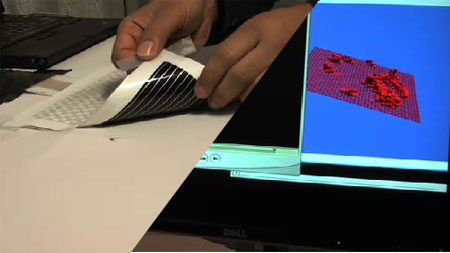
A Microsoft research team has delivered a prototype called the UnMouse that could really be a big hit. This unit is a mouse pad sized sensor that is multitouch and pressure sensitive. It is flexible and thin enough to roll up. The article mentions that the construction of the device is “dirt cheap”. This is very exciting; is this the next mouse?

The idea of having low cost multitouch input is very enticing. While there are many ways to do multitouch right now, most are limited by their large size due to projector/camera setups or high cost such as the iPhone. A portable (fits in your laptop bag) pressure sensitive multitouch input device is something that a lot of people have been craving for a while.

Just imagine the uses. Audio engineers could create new interfaces on the fly. You could draw a key map on piece of paper and just lay it on top. Graphic designers could use different sized and shaped brushes. Gamers could make their own ergonomically comfortable gaming layouts. How about covering one in Velcro and attaching buttons to it?