FDM Filament Troubles: Keeping Hygroscopic Materials From Degrading

Despite the reputation of polymers used with FDM 3D printing like nylon, ABS, and PLA as being generally indestructible, they do come with a whole range of moisture-related issues that can affect both the printing process as well as the final result. While the concept of ‘baking’ such 3D printing filaments prior to printing to remove absorbed moisture is well-established and with many commercial solutions available, the exact extent to which these different polymers are affected, and what these changes look like on a molecular level are generally less well-known.

Another question with such hygroscopic materials is whether the same issues of embrittlement, swelling, and long-term damage inflicted by moisture exposure that affects filaments prior to printing affects these materials post-printing, and how this affects the lifespan of FDM-printed items. In a 2022 paper by Adedotun D. Banjo and colleagues much of what we know today is summarized in addition to an examination of the molecular effects of moisture exposure on polylactic acid (PLA) and nylon 6.

The scientific literature on FDM filaments makes clear that beyond the glossy marketing there is a wonderful world of materials science to explore, one which can teach us a lot about how to get good FDM prints and how durable they will be long-term.

Continue reading “FDM Filament Troubles: Keeping Hygroscopic Materials From Degrading”

Sharing 3D Printing With Kids

If you have a hobby, it is natural to want to share it with kids. If you are interested in 3D printing, you may even have kids who want to try their hand at printing without prompting. There are a number of “kid printers” aimed specifically at that market. Are they worthwhile? How old is old enough? [Everson Siqueirar] tries out a Kidoodle with this 6-year-old daughter, and the results are good, as you can see in the video below.

Impressively, his daughter [Sophie] was able to set up the printer with a little help. The build plate is very small and not heated. Apparently, a glue stick is necessary for bed adhesion. The printer has WiFi but also has a collection of models you can print without any internet connection.

Continue reading “Sharing 3D Printing With Kids”

Axial 3D Printer Aces Test Aboard Virgin Spaceplane

Here on Earth, being able to 3D print replacement parts is handy, but rarely necessary. If you’ve got a broken o-ring, printing one out is just saving you a trip to the hardware store. But on the Moon, Mars, or in deep space, that broken component could be the difference between life and death. In such an environment, the ability to print replacement parts on demand promises to be a game changer.

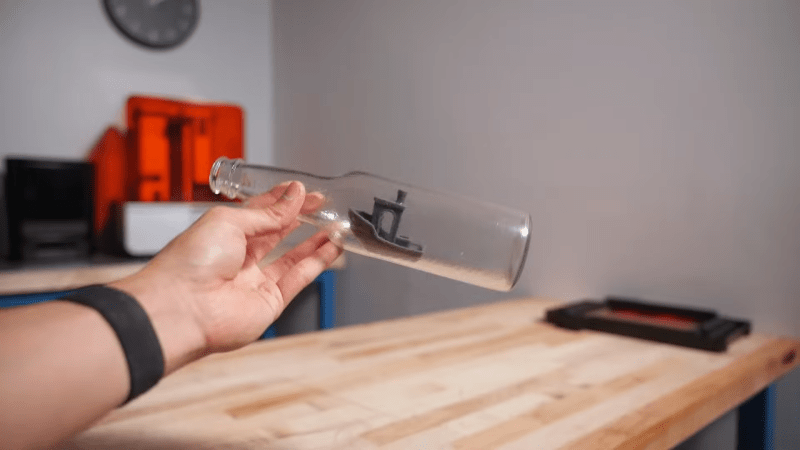
Which is why the recent successful test of a next-generation 3D printer developed by a group of Berkeley researchers is so exciting. During a sub-orbital flight aboard Virgin Galactic’s Unity spaceplane, the SpaceCAL printer was able to rapidly produce four test prints using a unique printing technology known as computed axial lithography (CAL).

Continue reading “Axial 3D Printer Aces Test Aboard Virgin Spaceplane”

A Teeny 3D-Printed Printing Press, Thanks Gutenberg

The printing press was first invented in 1440 AD by Johannes Gutenberg. It’s not so relevant to our day to day lives today, but it’s a technology that forever changed the path of human history. Now you can whip one up yourself using this teeny design from the [3DPrintingEnthusiast]!

Don’t expect to be making broadsheets with this thing—it’s a strictly table-top sized unit made on a 3D printer. Still, it does the job! The bed, frame, paper holder, and clamps are all 3D-printed. However, you will need some minor additional supplies to complete the carriage and inkballs.

As for your printing plates, you could go out and source some ancient lead type—or you could just 3D print some instead. The latter is probably easier if you’re living in 2024 like yours truly. Who knows, though. 2028 could be a banner year where printing presses roar back to prominence. Try not to think about the global scale disasters that would make that a reality.

In any case, there’s got to be some kind of irony about 3D-printing a printing press on a 3D printer? Perhaps, perhaps not. Debate it below!

DIY Spacer Increases FDM Flow Rate For Faster, Better Printing

The host of problems to deal with when you’re feeling the need for FDM speed are many and varied, but high on the list is figuring out how to melt filament fast enough to accommodate high flow rates. Plus, the filament must be melted completely; a melty outside and a crunchy inside might be good for snacks, but not for 3D printing. Luckily, budget-minded hobbyists can build a drop-in booster to increase volumetric flow using only basic tools and materials.

[aamott]’s booster, which started life as a copper screw, is designed to replace the standard spacer in an extruder, with a bore that narrows as the filament gets closer to the nozzle to ensure that the core of the filament melts completely. Rather than a lathe, [aamott]’s main tool is a drill press, which he used to drill a 0.7 mm bore through the screw using a PCB drill bit. The hole was reamed out with a 10° CNC engraving bit, generating the required taper. After cutting off the head of the screw and cleaning up the faces, he cut radial slots into the body of the booster by threading the blade of a jeweler’s saw into the bore. The result was a bore wide enough to accept the filament on one end, narrowing to a (roughly) cross-shaped profile at the other.

Stacked up with a couple of knock-off Bondtech CHT nozzles, the effect of the booster was impressive — a 50% increase in flow rate. It’s not bad for a prototype made with simple tools, and it looks a little easier to build than [Stefan]’s take on the same idea.

Continue reading “DIY Spacer Increases FDM Flow Rate For Faster, Better Printing”

If You Want An Expensive Chair Just Print Your Own

The Magis Spun chair is a weird piece. It’s basically a kind of seat with a round conical base that stops it from sitting still in one place. Instead, it rolls and pivots around when you sit on it, which is apparently quite fun. They’re expensive though, which gave [Morley Kert] a neat idea. Why not 3D print one instead?

Obviously 3D printing a sofa wouldn’t be straightforward, but the Magis Spun is pretty much just a hunk of plastic anyway. The real thing is made with rotational molding. [Morley] suspected he could make one for less than the retail price with 3D printing.

With no leads on a big printer, he decided to go with a segmented design. He whipped up his basic 3D model through screenshots from the manufacturer’s website and measurements of a display model in a store. After print farming the production, the assembly task was the next big challenge. If you’re interested in doing big prints with small printers, this video is a great way to explore the perils of this idea.

Ultimately, if you want to print one of these yourself, it’s a big undertaking. It took 30-50 print days, or around 5 days spread across 15 printers at Slant 3D’s print farm. It used around $300-400 of material at retail prices, plus some extra for the epoxy and foam used to assemble it.

The finished product was killer, though, even if it looks a little rough around the edges. It rolls and pivots just like the real thing.

We don’t feature a lot of chair hacks on Hackaday, but we do feature some! Video after the break.

Continue reading “If You Want An Expensive Chair Just Print Your Own”

Instant Filament Drying Satisfies An Immediate Need

Most 3D printer filament soaks up water from the air, and when it does, the water passing through the extruder nozzle can expand, bubble, and pop, causing all kinds of mayhem and unwanted effects in the print. This is why reels come vacuum sealed. Some people 3D print so much that they consume a full roll before it can soak up water and start to display these effects. Others live in dry climates and don’t have to worry about humidity. But the rest of us require a solution. To date, that solution has been filament dryers, which are heated elements in a small reel-sized box, or for the adventurous an oven put at a very specific temperature until the reel melts and coats the inside of the oven. The downside to this method is that it’s a broad stroke that takes many hours to accomplish, and it’s inefficient because one may not use the whole roll before it gets soaked again.

In much the same way that instant water heaters exist to eliminate the need for a water heater, [3DPI67] has a solution to this problem, and it involves passing the filament through a small chamber with a heating element and fan circulating air. The length of the chamber is important, as is the printing speed, since the filament needs to have enough time in the improvised sauna to sweat out all its water weight. The temperature of the chamber can’t get above the glass transition temperature of the filament, either, which is another limiting factor for the dryer. [3DPI67] wrote up a small article on his improvised instant filament heater in addition to the video.

So far, only TPU has been tested with this method, but it looks promising. Some have suggested a larger chamber with loops of filament so that more can be exposed for longer. There’s lots of room for innovation, and it seems some math might be in order to determine the limits and optimizations of this method, but we’re excited to see the results.