Friday Hack Chat: Graphical Programming Languages With Boian Mitov

There is a long history of Visual or Graphical Programming Languages, and most of them make more sense than the name of Microsoft’s Visual Basic, C#, and Visual Studio IDE. Some people don’t like to code, and for them, graphical programming languages replace semicolons and brackets with easy-to-understand boxes and wires.

This Friday, we’re going to be talking about graphical programming languages with [Boian Mitov]. He’s a software developer, founder of Mitov Software, and the creator of Visuino, a graphical programming language for the embedded domain. Everything from the Arduino to Teensy, ESP8266, ESP32, the chipKIT, and Maple Mini are supported with this IDE. It’s a simple drag-and-drop way of programming microcontrollers that Scratches an itch (see what I did there?) for an easy way to introduce non-programmers to the embedded world and also provides a faster way to build custom applications.

When it comes to graphical programming languages, we can’t find a better Hack Chat guest than [Boian]. He’s the author of the OpenWire dataflow processing technology — another graphical programming language –, the IGDI+ library, VideoLab, SignalLab, AudioLab, PlotLab, InstrumentLab, and author of VCL for Visual C++. He’s a regular contributor to Blaise Pascal Magazine, too.

During this Hack Chat, we’ll be discussing what makes Visual Programming worth it, how and why it works, when it doesn’t and how to develop a graphical programming language. Visuino will be of special interest, And I’m sure someone will work in a, ‘what’s happening with Max/MSP under Ableton’ question. If you have a question for [Boian], here’s a question sheet to guide the discussion.

Here’s How To Take Part:

join-hack-chatOur Hack Chats are live community events on the Hackaday.io Hack Chat group messaging. This Hack Chat will take place at noon Pacific time on Friday, August 11th. Here’s a time and date converter!

Log into Hackaday.io, visit that page, and look for the ‘Join this Project’ Button. Once you’re part of the project, the button will change to ‘Team Messaging’, which takes you directly to the Hack Chat.

You don’t have to wait until Friday; join whenever you want and you can see what the community is talking about.

Superconference Talk Deadline Extended One Week

Our Call for Proposals for the Hackaday Superconference was scheduled to close yesterday. We are extending that deadline by one week so get your proposal for a talk or a workshop in now.

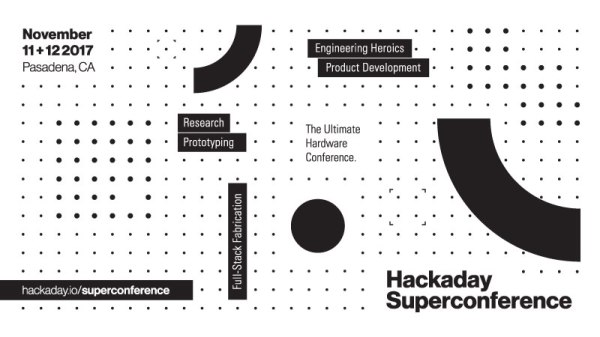
We want to leave no stone unturned and are intimately familiar with the procrastination habits of busy hackers like you. Now there is no excuse. Put together your pitch now and send it our way. This is the ultimate hardware conference and we’re topics covering Engineering Heroics (how you managed to pull it together to get across the finish line), Prototyping, Research (building custom rigs for University/private industry/giggles), Product Development, Full-Stack Fabrication, and anything else you think fits the vibe of Hackaday.

Accepted talks receive free admission and access to speaker events. There are travel stipends available for exemplary proposals. We also record talks for publication after the Superconference so this is a chance to be famous on Hackaday.

It’s likely that you have an interesting story to tell. Time to get up there and tell it!


The Hackaday SuperConference is November 11-12, 2017 in Pasadena California. There are still tickets available but what remains will sell out quickly when the slate of speakers in announced. Don’t miss out, grab your ticket now.

Get Your Eclipse Glasses Emblazoned With Hackaday

We’re getting ready to stare at the Sun for a few hours when a total solar eclipse is visible across the United States on August 21st. You could protect your eyes with some welding goggles, but why not wear a pair of Hackaday eclipse glasses instead?

UPDATE: And They’re Gone. We had a huge response to this with over 200 event pages made in just a few hours (and more coming since then; thank you, you’re awesome!). We had 500 glasses to give away and are sending them out in envelopes of 4. We would still love it if you made an event page but unfortunately we’ve run out of glasses to send out.

Let us know where you’ll be watching the eclipse and we’ll mail you some custom-printed Hackaday eclipse glasses (sorry, they’re all gone).  Head over to the Eclipse Meetups page, click the “Host a Meetup” button and tell us where you’ll be. We’ll add you to the map and contact you for the shipping address and the number of glasses you’ll need.

Whether you want others to join you or not is your choice, but we want to see a map full of pins where the Hackaday community is taking part in this momentous event.

As you can see, there are already a number of meetups watch the partial eclipse and that’s fine with us. No matter where you are, if you can see the eclipse we’re ready to send you some glasses. Hurry up though, they need to arrive before Monday!

Hackaday Links Column Banner

Hackaday Links: August 13, 2017

We found the most boring man on the Internet! HTTP Status Code 418 — “I’m a teapot” — was introduced as an April Fools Joke in 1998. Everyone had a good laugh, and some frameworks even implemented it. Now, the most boring man on the Internet and chairman of the IETF HTTP working group is trying to get 418 removed from Node and Go. There is an argument to removing code 418 from pieces of software — it gums up the works, and given only 100 code points for a client error, with 30 of them already used, we don’t really have space for a joke. There’s a solution, though: someone has submitted a request to register 418 as ‘I’m a teapot’.

The Travelling Hacker box is a migratory box of random electronic junk. The box has traveled across the United States several times, and earlier this year it started across Canada — from Vancouver to St. Johns — to begin an International journey. The box is now missing, and I’m out. I’m turning this one over to the community. There are now several rogue boxes traveling the world, the first of which was sent from [Sophi] to [jlbrian7] and is now in Latvia with [Arsenijs]. The idea of the Travelling Hacker Box is now up to you — organize your own, and share random electronic crap.

Bluetooth 5 is here, or at least the spec is. It has longer range, more bandwidth, and advertising extensions.

Guess what’s on the review desk? The Monoprice Mini Delta! If you have any questions you’d like answered about this tiny, very inexpensive printer, put them in the comments. I only have some first impressions, but so far, it looks like extending the rails (to make a taller printer) is more difficult than it’s worth. That’s not to say it’s impossible, but with the effort required, I could just print another printer.

Interested in PCB art? [Drew] found someone doing halftone art with PCBs. This is a step up from nickels.

Indiana University is getting rid of some very, very cool stuff in a government auction. This device is listed as a ‘gantry’, but that’s certainly not what it is. There have been suggestions that these devices are a flight sim, but that doesn’t sit quite right either. It’s several thousand pounds of metal, with the minimum bid of $2.00 at the time of this writing. Any guesses on what this actually is?

Testing Distance Sensors

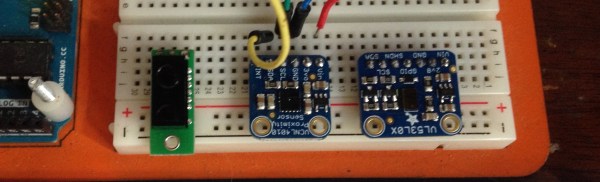
I’m working on a project involving the need to precisely move a tool based on the measured distance to an object. Okay, yeah, it’s a CNC mill. Anyway, I’d heard of time of fight sensors and decided to get one to test out, but also to be thorough I wanted to include other distance sensors as well: a Sharp digital distance sensor as well as a more sophisticated proximity/light sensor. I plugged them all into a breadboard and ran them through their paces, using a frame built from aluminum beams as a way of holding the target materials at a specific height.

Continue reading “Testing Distance Sensors”

Books You Should Read: IGNITION!

Isaac Asimov described the business of rocket fuel research as “playing footsie with liquids from Hell.” If that piques your interest even a little, even if you do nothing else today, read the first few pages of IGNITION! which is available online for free. I bet you won’t want to stop reading.

IGNITION! An Informal History of Liquid Rocket Propellants is about how modern liquid rocket fuel came to be. Written by John D. Clark and published in 1972, the title might at first glance make the book sound terribly dry — it’s not. Liquid rocket fuel made modern rocketry possible. But most of us have no involvement with it at all besides an awareness that it exists, and that makes it easy to take for granted.

Most of us lack any understanding of the fact that its development was the result of a whole lot of hard scientific work, and that work required brilliance (and bravery) and had many frustrating dead ends. It was also an amazingly dangerous business to be in. Isaac Asimov put it this way in the introduction:

“[A]nyone working with rocket fuels is outstandingly mad. I don’t mean garden-variety crazy or a merely raving lunatic. I mean a record-shattering exponent of far-out insanity.

There are, after all, some chemicals that explode shatteringly, some that flame ravenously, some that corrode hellishly, some that poison sneakily, and some that stink stenchily. As far as I know, though, only liquid rocket fuels have all these delightful properties combined into one delectable whole.”

At the time that the book was written and published, most of the work on liquid rocket fuels had been done in the 40’s, 50’s, and first half of the 60’s. There was plenty written about rocketry, but very little about the propellants themselves, and nothing at all written about why these specific substances and not something else were being used. John Clark — having run a laboratory doing propellant research for seventeen years — had a unique perspective of the whole business and took the time to write IGNITION! An Informal History of Liquid Rocket Propellants.

Liquid rocket propellant was in two parts: a fuel and an oxidizer. The combination is hypergolic; that is, the two spontaneously ignite and burn upon contact with each other. As an example of the kinds of details that mattered (i.e. all of them), the combustion process had to be rapid and complete. If the two liquids flow into the combustion chamber and ignite immediately, that’s good. If they form a small puddle and then ignite, that’s bad. There are myriad other considerations as well; the fuel must burn at a manageable temperature (so as not to destroy the motor), the energy density of the fuel must be high enough to be a practical fuel in the first place, and so on.

The actual process of discovering exactly what materials to use and how precisely to make them work in a rocket motor was the very essence of the phrase “the devil is in the details.” For every potential solution, there was a mountain of dead-end possibilities that tantalizingly, infuriatingly, almost worked.

The first reliable, workable propellant combination was Aniline and Red Fuming Nitric Acid (RFNA). “It had the one – but magnificent – virtue that it worked,” writes Clark. “Otherwise it was an abomination.” Aniline was difficult to procure, ferociously poisonous and rapidly absorbed through skin, and froze at an inconvenient -6.2 Celsius which limited it to warm weather only. RFNA was fantastically corrosive, and this alone went on to cause no end of problems. It couldn’t be left sitting in a rocket tank waiting to be used for too long, because after a while you wouldn’t have a tank left. It needed to be periodically vented while in storage. Pouring it gave off dense clouds of remarkably toxic gas. This propellant would go on to cause incredibly costly and dangerous problems, but it worked. Still, no one wanted to put up with any of it one moment longer than they absolutely had to. As a result, that combination was not much more than a first step in the whole process; there was plenty of work left to do.

By the mid-sixties, liquid rocket propellant was a solved problem and the propellant community had pretty much worked themselves out of a job. Happily, a result of that work was this book; it captures history and detail that otherwise would simply have disappeared.

Clark has a gift for writing, and the book is easy to read and full of amusing (and eye-widening) anecdotes. Clark doesn’t skimp on the scientific background, but always in an accessible way. It’s interesting, it’s relevant, it’s relatable, and there is plenty to learn about how hard scientific and engineering development actually gets done. Download the PDF onto your favorite device. You’ll find it well worth the handful of evenings it takes to read through it.


Getting Started With Blinking Lights On Old Iron

If you ever go to a computer history museum, you’ll be struck by how bland most modern computers look. Prior to 1980 computers had lights and switches, and sometimes dials and meters. Some had switchboard-like wiring panels and some even had oscilloscope-like displays. There’s something about a machine with all those switches and lights and displays that gets your hacker juices flowing. Have you ever wanted to get started in retrocomputing? Is it difficult? Do you need a lot of money? That depends on what your goals are.

There are at least three ways you can go about participating in retrocomputing: You can pony up the money to buy actual antique computers, you can build or buy old computers recreated with anywhere from zero to one hundred percent of period-authentic components, or you can experiment with emulators that run on a modern computer. As a hybrid of the second and third option there are also emulations in FPGAs.

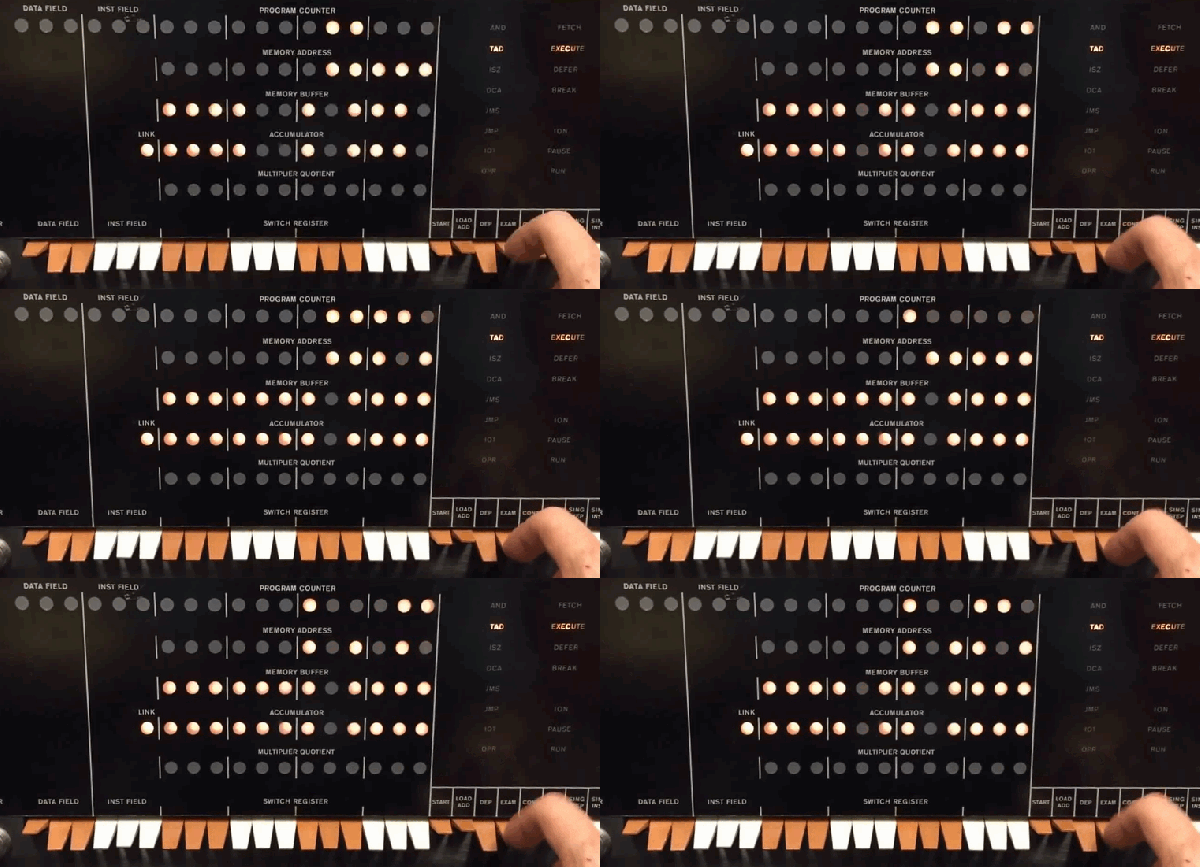
You can see that the first option can be very expensive and you will probably have to develop a lot of repair and restoration skills. Watching [Mattis Lind] twiddle the bits on an actual PDP-8 in the clip above is great, but you’ll need to work up to it. The two techniques which get you going without the original hardware don’t have to break the bank or even cost anything presuming you already have a PC.

Although some sneer at emulation, for some machines it is almost the only way to go. You couldn’t buy the original EDSAC, for example. It is also a good way to get started without a lot of expense or risk. But regardless of how you do it, there’s one thing in common: you have to know how to operate the thing.

Continue reading “Getting Started With Blinking Lights On Old Iron”