The Benefits Of Restoring A C64 With A Modern FPGA Board

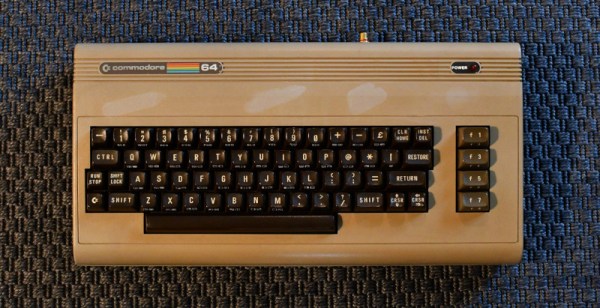
The Commodore 64 was the highest selling computer of all time, and will likely forever remain that way due to the fragmentation of models in the market ever since. Due to this, it’s hardly surprising that it still has a strong following many years after its heyday. This means that the avid restorer has a wide range of parts and support available at the click of a button. [DusteD] is just one such person who had a busted-up C64 laying around, and decided to make it a project.

[DusteD] wanted to reuse the original case, and decided it should remain a Commodore 64 after an initial attempt at a mini-ITX swap went awry. Desiring a reliable machine, an Ultimate64 FPGA board was selected to replace the original faulty motherboard. This has the benefit of being hardware compatible with the classic C64, while allowing [DusteD] to tinker and program to his heart’s content, without having to worry about blowing up valuable original parts. It also provides several interesting modern features, like HDMI output, USB, and even Ethernet connectivity. This allows one to experiment with the platform without the hassles of all the inherent limitations of 1980s technology.

As a fan of the classic SID sound chip, [DusteD] was also highly interested in the audio output of the Ultimate64. Recordings were made of the emulated output from the FPGA, as well as the sound output from a real SID installed in the board, both through the mixed output and directly from the chip via a SIDTAP. Those interested can download the 800MB of recordings and compare the output; there’s a summary of the differences noted listed on the site as well.

[DusteD] makes a great argument for the benefits of building up a C64 rig in this way. It’s a great way to get started for those eager to explore the world of Commodore’s 8-bit hardware without the hassles and expenses of buying all the real gear. As it stands, the C64 aftermarket is so advanced now, that you can build an entirely new machine from scratch if you so desire. Go forth and enjoy!
VR On The 6502

The MOS Technology 6502 was one of the more popular processors of the 1980s. It ran the Commodore 64, the NES in a modified form, and a whole bunch of other hardware, too. By modern standards, it’s barely fit to run a calculator, but no matter – [Nick Bild] built a VR game that runs on the retro CPU anyway!

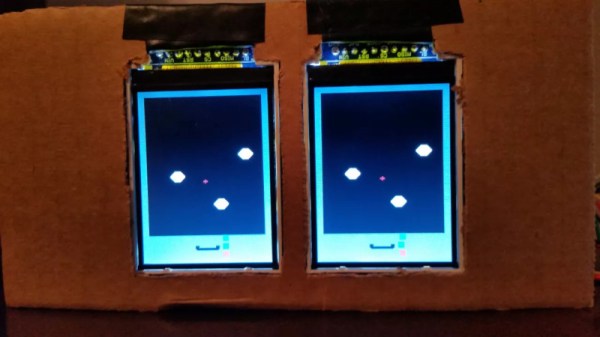
[Nick]’s project is built on his 6502 computer, the Vectron 64. Being a breadboard build, it’s easy to modify things and add additional hardware, and that’s precisely what he did. The VR system uses two 320 x 240 LCD screens, one for each eye. These are controlled over SPI, but the humble 6502 simply doesn’t have the speed to clock out enough bits fast enough for a video game. Instead, additional hardware is added to generate pulses to run the screens. There’s a bunch of other neat hacks as well that help make the game playable, like overclocking the CPU to 1.75 MHz and drawing common elements to both screens at the same time.

To test out the VR system, [Nick] coded a basic Asteroids VR game. It’s not really practical to demonstrate the game without the hardware, but we’d love to try it out. There’s something compelling about a low-resolution VR game with 8-bit graphics, and we hope to see the concept further developed in future.

More grunt would make this project even more capable, and for that, a 6502 running at 20MHz could come in handy. Video after the break.

[Thanks to Fred Gimble for the tip!]

Continue reading “VR On The 6502”

A TTL CPU, Minimising Its Chip Count

By now we should all be used to the astonishing variety of CPUs that have come our way created from discrete logic chips. We’ve seen everything from the familiar Von Neumann architectures to RISC and ever transport-triggered architecture done in 74 TTL derivatives, and fresh designs remain a popular project for many people with an interest in the inner workings of a computer.

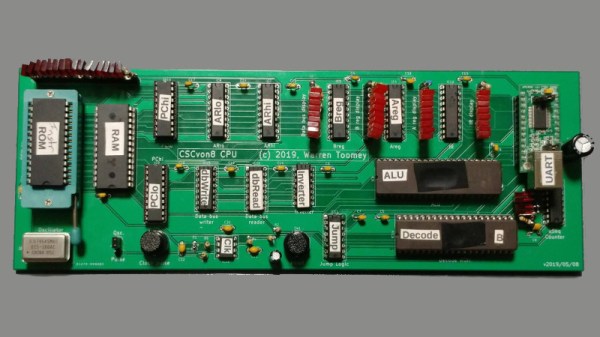
[Warren Toomey]’s CSCvon8 is an interesting machine that implements an 8-bit computer with a 64-bit address space using only 17 chips, and without resorting to any tricks involving microcontrollers. It implements a fairly conventional Von Neumann architecture using TTL with a couple of tricks that use modern chips but could have been done in the same way in decades past. Instruction microcode is stored in an EEPROM, and the ALU is implemented in a very large EPROM that would probably once have been eye-wateringly expensive. This in particular removes many discrete TTL chips from the total count, in the absence of the classic 74181 single-chip part. To make it useful there is 32k each of RAM and EEPROM, and also a UART for serial access. The whole is brought together on a neat PCB, and there is a pile of demo code to get started with. Everything can be found in the project’s GitHub repository.

At the start of this article we mentioned a couple of unconventional TTL CPUs. The transport triggered one we featured in 2017, and the RISC one is the Gigatron which has appeared here more than once.

The OS/2 Operating System Didn’t Die… It Went Underground

One problem with building things using state-of-the-art techniques is that sometimes those that look like they will be “the next big thing” turn out to be dead ends. Next thing you know, that hot new part or piece of software is hard to get or unmaintained. This is especially true if you are building something with a long life span. A case in point is the New York City subway system. Back in the 1990s the transit authority decided to adopt IBM’s new OS/2 operating system. Why not? It was robust and we used to always say “no one ever got fired for buying IBM.”

There was one problem. OS/2 was completely eclipsed by other operating systems, notably Windows and — mostly — has sunk from the public view. [Andrew Egan’s] post covers just how the conversion to a card-based system pushed OS/2 underground all over the Big Apple, and it is an interesting read.

Continue reading “The OS/2 Operating System Didn’t Die… It Went Underground”

Reverse Engineering The Sound Blaster

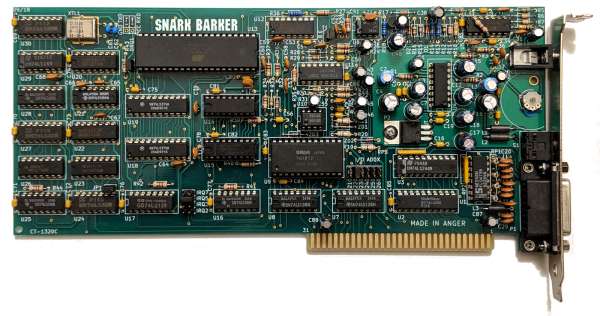
The first sound card to output PCM audio — the kind you need for audio samples — wasn’t the Sound Blaster. The AdLib Music Synthesizer Card could output PCM audio over software. The AdLib card also cost $200 at the time of its release. This was too much for some, and in time the Creative Labs Sound Blaster was released for the rock-bottom price of $125. This was a more capable card, and in the years since prices on the used market have gone through the roof. In 1990, you could buy a Sound Blaster for a Benjamin and a half, in 2019, prices on eBay are reaching and exceeding $400.

With the prices of used cards so high, we start to get into the territory where it starts to make sense to reverse engineer and re-manufacture the entire card. This hasn’t been done before, but that’s no matter for [Eric Schlaepfer], or [@TubeTimeUS]; he’s done crazier projects before, and this one is no different.

In reverse-engineering the Sound Blaster, there are a few necessary components. The Sound Blaster had an OPL2 chip for sound synthesis, which you can get through various vendors. The trick, though, is the microcontroller. This is really just an 8051 with a custom mask ROM.

The goal of this project is actually just to dump the ROM on the Intel 8051-alike microcontroller. This is something that’s relatively commonly done in high-tech labs, and luckily the Bay Area has [John McMaster], the guy who will take you into his lab and strip a die from its epoxy. Looking at the chip under the microscope, it was discovered the mask ROM on this chip was an implant ROM, with the ones and zeros represented by invisible ions in the substrate itself. There was no hope of reverse-engineering this chip from a purely visual inspection, but there was a sense amplifier on one of the data lines. By probing this sense amplifier while running through the address space, [Eric] was able to dump all the bytes of the ROM one bit at a time.

However, and there’s always a however, there are clone Sound Blasters out there, usually from China, and you can dump these chips if you’re lucky enough to get your hands on one. [Eric] reached out to the community and found these clone microcontrollers didn’t have the code protect bit set; dumping these was easy. This ROM was compared to the work [Eric] did with the sense amplifier, and after figuring out the order of the bits, it was found the code matched. The code was successfully cloned, and now new Sound Blasters can be made. Don’t tell eBay that, because someone is trying to sell one of [Eric]’s clone cards for $180.

All the code, files, materials, and everything needed to clone a Sound Blaster can be found in [Eric]’s GitHub, although there are a few open questions as to what’s going on in the Sound Blaster’s microcontroller. There’s a ‘secret’ 512-byte ROM on the die, and no one outside of an Intel NDA knows what it does. This could be used for a manufacturing test, but who knows. Other than that, there are a few features in the code that weren’t used, like previously unknown DSP commands, an ADPCM lookup table, and a routine that plays from SRAM without using DMA. It’s a deep dive into the inner workings of the most popular sound card of all time, and it’s quite simply amazing.

A Faithful Replica Of An Early Computer Trainer

Turn the clock back six decades or so and imagine you’re in the nascent computer business. You know your product has immense value, but only to a limited customer base with the means to afford such devices and the ability to understand them and put them to use. You know that the market will eventually saturate unless you can create a self-sustaining computer culture. But how does one accomplish such a thing in 1961?

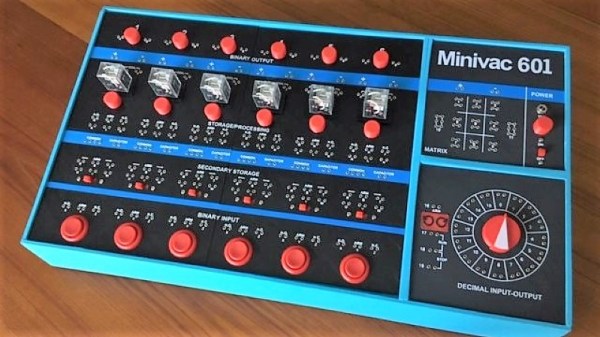
Enter the Minivac 601. The brainchild of no less a computer luminary than Claude Shannon, the father of information theory, the Minivac 601 was ostensibly a toy in the vein of the “100-in-1” electronics kits that would appear later. It used electromechanical circuits to teach basic logic, and now [Mike Gardi] has created a replica of the original Minivac 601.

Both the original and the replica use relays as logic switches, which can be wired in various configurations through jumpers. [Mike]’s version is as faithful to the original as possible with modern parts, and gets an extra authenticity boost through the use of 3D-printed panels and a laser-cut wood frame to recreate the look of the original. Sadly, the unique motorized rotary switch, used for both input and output on the original, has yet to be fully implemented on the replica. But everything else is spot on, and the vintage look is great. Extra points to [Mike] for laboriously recreating the original programming terminals with solder lugs and brass eyelets.

We love seeing this retro replica, and appreciate the chance to reflect on the genius of its inventor. Our profile of Claude Shannon is a great place to start learning about his other contributions to computer science. We’ve also got a deeper dive into information theory for the curious.

Thanks to [Granz] for the tip.

Back To Where (For Most Of Us) It Started, The Intel 8080

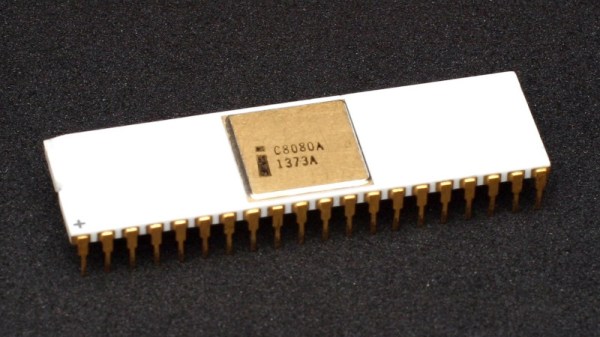
The early history of microprocessors is a surprisingly complex one, with more than one claimant for the prize of being the first, and multiple competing families. That the first commercially available part was the Intel 4004 is a matter of record, but it’s fair to say that few of us will have ever encountered one. Even its 8-bit sibling the 8008 would not have featured heavily in a 1974 version of Hackaday, such was its exotic nature. If there’s a microprocessor that can be claimed to have started it all for us then, it’s the Intel 8080. It established the 8-bit microporcessor with an 8-bit bus and a 16-bit address space, it had an order of maginitude more performance than its predecessors, and crucially it would become affordable enough for experimenters. It provided the guts of the MITS Altair 8800 microcomputer, and thus kickstarted the progression of home computers which led to the devices you use every day.

The 8080 is in our sights today, thanks to [DeviceGuru], who was sent down memory lane by thoughts of the 6502-based KIM-1 from his master’s thesis project. This led to memories of the 8080 Abie computer that he built for himself in 1979, for which he provides us some details and hand-drawn schematics. By then the 8080’s need for several support chips made it somewhat outdated, but from his perspective the chip could be had from Radio Shack without too much outlay. His tale of hand-assembling 8080 code and sending it to a friend for blowing onto a PROM might be familiar to some readers of a certain age.

Though the 8080 ceased volume production a quarter century ago (surprisingly there are still places you can get a new one though) it hasn’t entirely disappeared from our community’s consciousness. [DeviceGuru] tells us about the 8080 Microprocessor kit from [Wichit Sirichote] in Thailand which is a single board computer in the 1970s vein, hex keypad and all.

As you might expect, the 8080 hasn’t appeared in many projects here due to its rarity. Those that have seem more likely to feature its Eastern Bloc clones, such as this Polish model or this Russian one. It’s worth the reminder that if you fancy exploring some 8080 code of your own that you don’t even need an 8080 to run it on some silicon. The hugely popular Zilog Z80 as found in retrocomputers such as the RC2014 is fully mostly 8080 code compatible, indeed some of us learned about microprocessors that way because 8080 books were discounted in 1983 and Z80 ones weren’t.

Header image: Konstantin Lanzet [CC BY-SA 3.0].