Vintage Speech Synthesizer Croons The Oldies

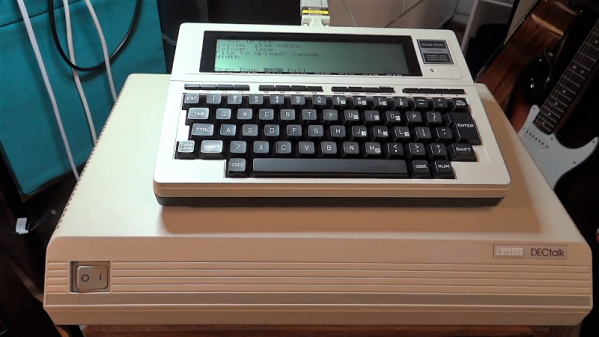
If you listened to the National Weather Service Weather Radio in the US about 25 years ago, you’ll no doubt remember [Perfect Paul], one of the synthesized voices used to read current conditions and weather forecasts. The voice came from a DECtalk DTC01, a not inexpensive voice synthesizer first made in 1984 that also gave voice to [Stephen Hawking] for many years.

Long obsolete, the DECtalk boxes have a devoted following with hobbyists who like to stretch what the device can do. Some even like to make it sing, after a fashion, and [Michael] decided that making a DECtalk sing “Xanadu”, the theme song from the 1980 [Olivia Newton-John] musical extravaganza, was a good idea. Whether it actually was is debatable, and we’ll take exception with having that particular ditty stuck in our head as a result, but we don’t judge except on the merits of the hack.

It’s actually easy if you have a DECtalk; the song is a straight ASCII file with remarkably concise instructions on which phonemes the box needs to generate. Along with inflection, tone, and timing instructions, the text file looks almost completely unlike English while still somehow being readable. The DECtalk accepts the file over RS-232, which would be easy enough to do with a modern computer, but [Michael] upped his game a bit by using a TRS-80 Model 100 computer as a serial terminal. The synthesized song is in the video below, with the original included for reference by those who didn’t experience endure the late disco-era glory days.

DECtalks seem pretty rare in the wild, so we appreciate this glimpse at what they can do. There are other retro speech synthesizer hacks, though: the simulated walnut goodness of the Votrax and the MicroVox come to mind, as does the venerable TI Speak and Spell.

Continue reading “Vintage Speech Synthesizer Croons The Oldies”
Homebrew Laptop Makes A Statement With A Steampunk Theme

Some may argue, but your choice of computing hardware says exactly zero about you, at least when you buy off the shelf. Your laptop or PC is only one of millions, and the chances of seeing someone with the exact same machine are pretty good. If you want to be different, you really need to build something yourself.

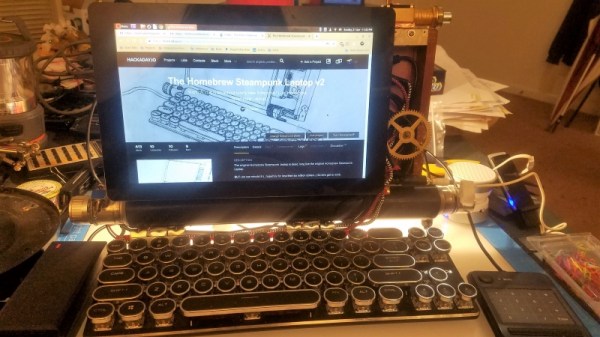
This homebrew steampunk laptop does a great job at standing out from the crowd. [Starhawk]’s build is an homage to the Steampunk genre, in a wooden case with brass bits and bobs adorning. The guts are based on an Intel motherboard, a bit dated but serviceable enough for the job. There’s a touch-capable LCD in the lid, and we absolutely love the look of the keyboard with its retro-style chrome and phenolic keycaps. Exposed USB cables run to and fro, and the braided jackets contribute to the old-timey look. The copier roller as a lid hinge is a nice touch too.

[Starhawk]’s build log is long and detailed, and covers the entire build. We’ve seen interesting builds from him before, like this junk-bin PC build for a friend in need. Looks like this one is for personal use, though, and we can’t blame him.

1980s Plotter Plays Flappy Bird

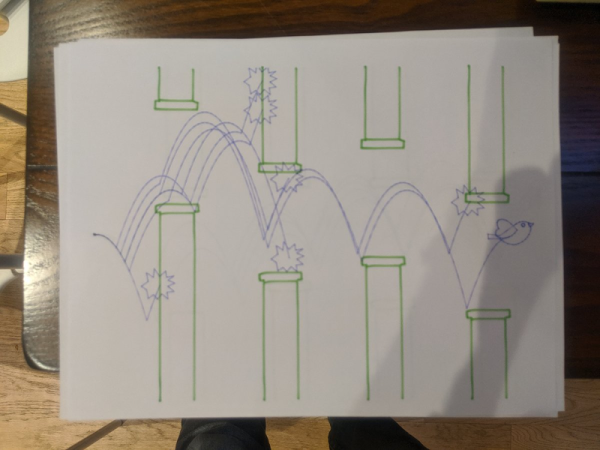
Should you happen to have an HP7440A or similar plotter hanging around, you could have a quick game of Flappy Bird — or Plotty Bird as [WesleyAC] calls it. Just be sure you have some blank paper. The whole thing fits in about 200 lines of Rust code and — according to the author — gets to about 20 frames per second.

Watching the thing go, it appears that it draws a random set of pipes and then traces your flight path on the same page in real time.

Continue reading “1980s Plotter Plays Flappy Bird”

Recovering Data From Floppies With Errors

Those of us of advancing years will remember the era of the floppy disc. Maybe not that of the 8-inch drive, but probably its 5.25-inch and certainly its 3.5-inch cousins. Some will remember the floppy disc fondly, while for others there will be recollections of slow and unreliable media with inadequate capacity, whose ability to hold data for any length of time was severely questionable. Add three decades to the time a disc has spent in storage, and those data errors become frequent. The life of a retrocomputing enthusiast hoping to preserve aged software is made extremely difficult by them, and [] has a few tips to help with recovery.

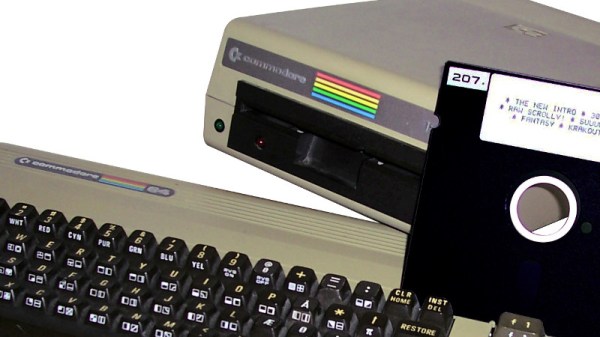
It’s written with specific reference to Commodore 5.25-inch floppies, but aside from some of the specific software, the techniques could be applied to any discs. Most interesting is his explanation of the mechanisms that lead to bad discs or bad sectors, before he looks at some of the mitigations that might be employed. Cleaning the disc or the drive head with alcohol is explored, then taking a dump of the raw data for detailed inspection and disassembly in search of checksum errors. If in your youth a floppy disc was just something you put in a drive and you never investigated further, perhaps this piece will fill in some of the gaps.

If the thought of a stack of Commodore 64 floppies fills you with dread, how about using an emulator?

Header image: PrixeH [CC BY-SA 3.0].

This Commodore 16 Is An NTSC One… No, Wait, It’s A PAL One!

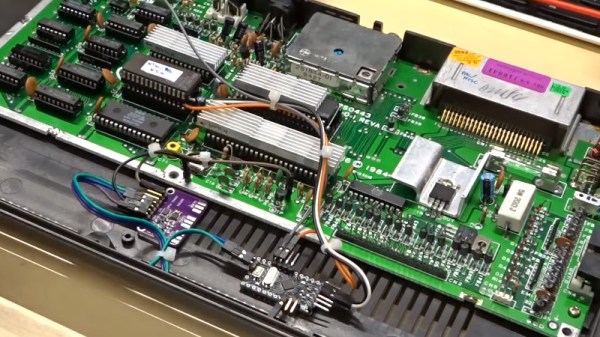
We’re used to our computers being powerful enough in both peripheral and processing terms to be almost infinitely configurable under the control of software, but there was a time when that was not the case. The 8-bit generation of home computers were working towards the limits of their capability just to place an image on a TV screen, and every component would have been set up to do just the job it was intended for. Thus when different countries had different TV standards such as the mostly-European PAL and the mostly-American NTSC, there would have been different models of the same machine for each market. The Commodore 16 was just such a machine, and [Adrian Black] has modified his NTSC model with a custom ROM, an Arduino and an Si5351 clock generator to be switchable between the two.

The differences between a PAL and NTSC C16 are two-fold. The clock for the video chip is of a different frequency, and the ROM contents differ too. [Adrian]’s machine therefore has a larger ROM containing both versions which are switchable via one of the upper address lines. A couple of tracks cut in the crystal oscillator circuit allow him to inject a new clock from the Si5351 module, and and Arduino controls everything. The appropriate ROM and clock are selected via a very simple interface, the reset button is captured and while a short press still resets the computer a long one switches the mode.

Despite having its principal engineer, [Bil Herd] as a colleague here at Hackaday, it’s sad that we don’t see as many Commodore 16s as we should. A recent feature showed a 64k C16, but didn’t make it into a C64.

Continue reading “This Commodore 16 Is An NTSC One… No, Wait, It’s A PAL One!”

AI-Enabled Teletype Live Streams Nearly Coherent Conversations

If you’ve got a working Model 33 Teletype, every project starts to look like an excuse to use it. While the hammering, whirring symphony of a teleprinter going full tilt brings to mind a simpler time of room-sized computers and 300 baud connections, it turns out that a Teletype makes a decent AI conversationalist, within the limits of AI, of course.

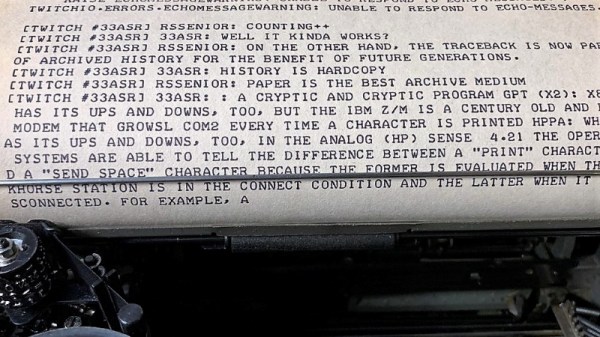
The Teletype machine that [Hugh Pyle] used for this interesting project, a Model 33 ASR with the paper tape reader, is a nostalgia piece that figures prominently in many of his projects. As such, [Hugh] has access to tons of Teletype documentation, so when OpenAI released their GPT-2 text generation language model, he decided to use the docs as a training set for the model, and then use the Teletype to print out text generated by the model. Initial results were about as weird as you’d expect for something trained on technical docs from the 1960s. The next step was obvious: make a chat-bot out of it and stream the results live. The teletype can be seen clattering away in the recorded stream below, using the chat history as a prompt for generating text responses, sometimes coherent, sometimes disturbing, and sometimes just plain weird.

Alas, the chat-bot and stream are only active a couple of times a week, so you’ll have to wait a bit to try it out. But it looks like a fun project, and we appreciate the mash-up of retro tech and AI. We’ve seen teleprinters revived for modern use before, both for texting and Tweeting, but this one almost has a mind of its own.

Continue reading “AI-Enabled Teletype Live Streams Nearly Coherent Conversations”

Zork And The Z-Machine: Bringing The Mainframe To 8-bit Home Computers

Computer games have been around about as long as computers have. And though it may be hard to believe, Zork, a text-based adventure game, was the Fortnite of its time. But Zork is more than that. For portability and size reasons, Zork itself is written in Zork Implementation Language (ZIL), makes heavy use of the brand-new concept of object-oriented programming, and runs on a virtual machine. All this back in 1979. They used every trick in the book to pack as much of the Underground Empire into computers that had only 32 kB of RAM. But more even more than a technological tour de force, Zork is an unmissable milestone in the history of computer gaming. But it didn’t spring up out of nowhere.

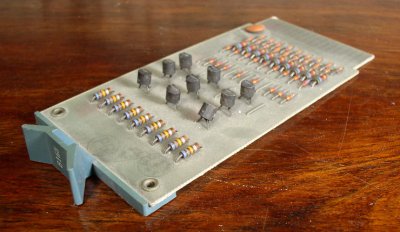
DEC PDP-10 Flip Chip module

The computer revolution had just taken a fierce hold during the second World War, and showed no sign of subsiding during the 1950s and 1960s. More affordable computer systems were becoming available for purchase by businesses as well as universities. MIT’s Laboratory for Computer Science (LCS) was fortunate to have ties to ARPA, which gave MIT’s LCS and AI labs (formerly part of Project MAC) access to considerable computing resources, mostly in the form of DEC PDP systems.

The result: students at the MIT Dynamic Modeling Group (part of LCS) having access to a PDP-10 KA10 mainframe — heavy iron at the time. Though this PDP-10 was the original 1968 model with discrete transistor Flip Chip modules and wire-wrapping, it had been heavily modified, adding virtual memory and paging support to expand the original 1,152 kB of core memory. Running the MIT-developed Incompatible Timesharing System (ITS) OS, it was a highly capable multi-user system.

Naturally, it got mostly used for playing games.
Continue reading “Zork And The Z-Machine: Bringing The Mainframe To 8-bit Home Computers”