Autopsy Of A Freshly Cooked 10Gbit SFP+ Network Adapter

With the advent of affordable 2.5 Gbit, 5 Gbit, and 10 Gbit consumer networking gear, more and more people are taking advantage of these higher networking speeds, with [This Does Not Compute] having used 10 Gbit SFP+ modules over regular Cat-5e copper to connect to a NAS in the next room. Only problem was that after a while these SFP+ modules began to start dropping frames. On taking a closer look at these modules, he found that they were running pretty hot: 40°C while idle. A teardown of one of these modules showed severe discoloration due to heat.

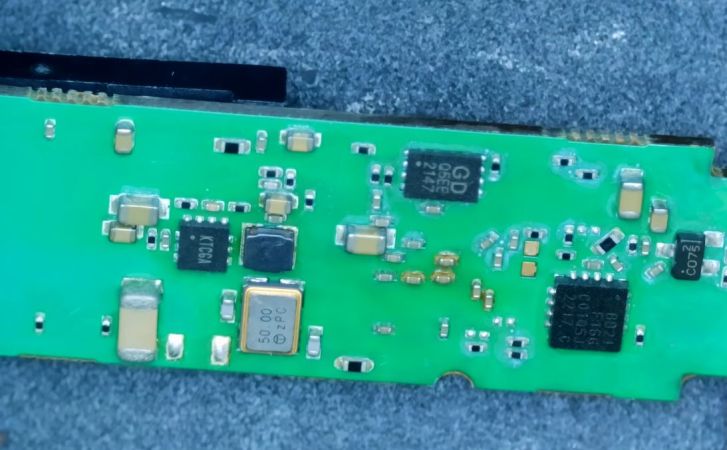
Side view of the SFP+ module's PCB. (Credit: This Does Not Compute, YouTube)
Side view of the SFP+ module’s PCB. (Credit: This Does Not Compute, YouTube)

Inside these 10Gbit modules is the Marvell-branded Alaska X 88X3310/40P PHY, which despite the ‘low-power’ claims have a metal heatsink glued onto the actual IC and thermally coupled to the module’s metal enclosure. The other side of the PCB was quite discolored, further indicating how hot these modules run in operation. Some digging revealed that this can go up to around 2.5 watts.

Perhaps the most fascinating part of this teardown is the discovery of an 8051-based MCU that’s responsible for telling the switch the module is put into that it is a 30-meter multi-mode fiber module, presumably for compatibility purposes. It’s definitely an interesting feature of these FS-branded SFP+ modules.

These old modules were replaced with Wiitek-branded modules that are supposed to use only up to around 1.5 watts in operation courtesy of a newer chipset, in the hope that these wouldn’t fry themselves. At idle these do however still run at 30 °C. As noted in the comments, it might be a good idea to have active airflow over high-speed networking gear like this, as they generally can get pretty hot and sometimes crispy.

The final solution for the video’s networking problem was to just run single-mode fiber to the room and use appropriate SFP+ modules for that, also because these run noticeably cooler. If you still have room in your cable ducts, that would seem to be the optimal solution.

Continue reading “Autopsy Of A Freshly Cooked 10Gbit SFP+ Network Adapter”
The Repair Nightmare That Are Smart Rings

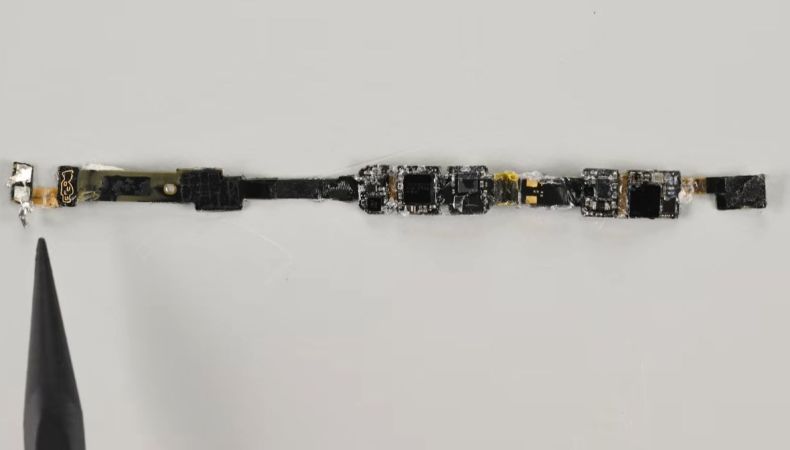
In the quest to make every wearable device ‘smart’, a lot of electronics along have to be crammed in very small spaces, along with ways to make them resistant to environments that our bodies do not mind, like getting hit by a rainstorm or simply washing our hands. These two factors combined make especially devices like smart rings an interesting case study for repairability, with [iFixit] recently taking apart a modern Oura smart ring to assess its e-waste factor after the built-in battery dies.

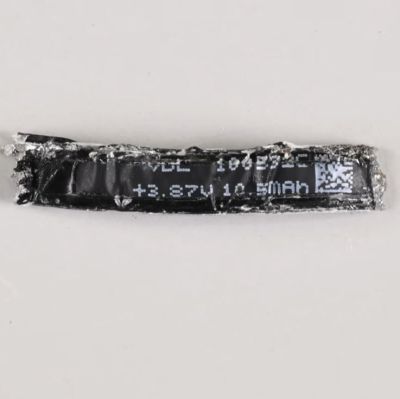
The tiny 10.5 mAh Lipo cell in the Oura Ring 5. (Credit: iFixit)

The subject of the teardown video is the Oura Ring 5, a $400 smart ring that’s designed to track your vitals much like a wrist-worn fitness tracker — just in a much smaller package. This metal-and-epoxy sandwich can definitely survive a good rain shower and washing of hands, but to get to the internals rather forceful methods were needed, unlike previous Oura and Samsung smart rings where some applied heat was enough.

In the Ring 5’s case even more heat was needed to make the inner ring start to slide out, but by that point the Li-ion battery inside had already popped from the heat. The inner ring then got stuck and more violence was required to continue the disassembly and get to the super-tiny, 10.5 mAh battery. Of course, at this point the smart ring really won’t be getting back together, never mind still work or be waterproof, which is a central issue with these smart rings.

With the EU’s February 2027 deadline for user-replaceable batteries looming on the horizon, it’ll be interesting to see whether devices like this can squeeze into an exception category, or whether manufacturers will have to massively redesign or stop selling these devices to this rather large market. So far this particular regulation has already forced Nintendo to make a special Switch 2 console for the EU.

Continue reading “The Repair Nightmare That Are Smart Rings”

Learning About Ground Loop Isolators Thanks To A Scam Product

When [Denki Otaku] bought a ¥1,200 (roughly €6.5) XLR ground loop isolator off Japanese Amazon, he initially didn’t suspect that anything was off. Since they’re fairly simple devices, with basically a 1:1 transformer per channel in some kind of enclosure, the price wasn’t unreasonable.

That’s before a teardown showed that this ‘ground loop isolator’ actually contains direct wiring between the XLR sockets, but that doesn’t mean that you cannot still make an educational video about the real devices.

First the basic theory is explained, before the fake ground loop isolator is subjected to an analysis, showing why you’d want to use the real deal. Of course, detecting a fake one is pretty easy, as a simple continuity test with a multimeter  or similar will show that DC passes right through the fake isolator.

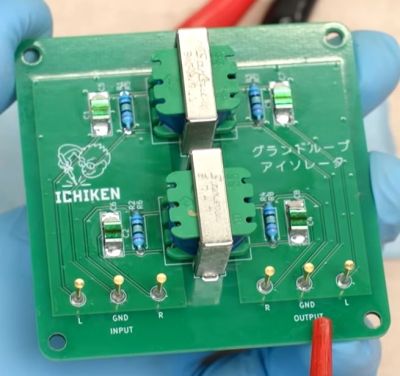
Next a real ground loop isolator was designed with a custom PCB and a high-pass filter added to the feature list. Here rather than a very basic filter with cheapo parts there was definitely some gold-plating going on, but it does show what you can do in addition to just adding a few simple transformers for ground isolation purposes.

The finished ground loop isolator device is pretty large, and would definitely require a larger enclosure than the homeopathic device, but it makes for an easy test bed with convenient access during the subsequent analysis.

Here each of the two channels has its own transformer and filter, with an initial test just by ear making the injected 2 kHz noise signal appear to go completely away.

Next, an oscilloscope is used to visualize the functionality, with the non-isolated 440 Hz test signal first shown with and without the injected noise, showing the clear impact of the noise and subsequently the isolator.

Of course, high-frequency noises will still pass through the transformer via parasitic capacitance leakage between the windings, so it’s not a silver bullet. Here the analysis at the end of the video shows the noise-rejection characteristics of these isolators, and why adding a high-pass filter makes a lot of sense. Finally, the scam device’s XLR connectors were reused in an enclosure for this custom board, giving it some purpose after all.

Continue reading “Learning About Ground Loop Isolators Thanks To A Scam Product”

The Air Position Indicator For The B-29

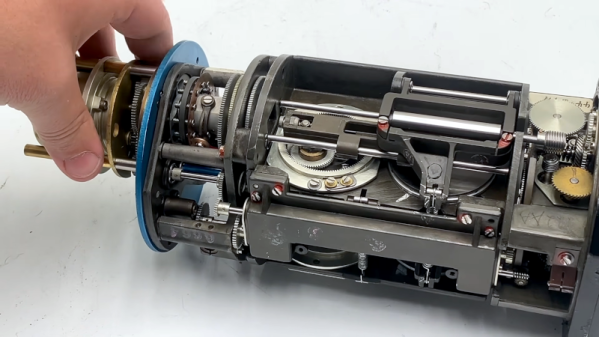
When you think of a computer, you probably don’t think of a tube full of motors and mechanics. However, as [Our Own Devices] shows, the Bendix AN5841 API Computer, an air position indicator computer, is exactly that. Using mechanical integrators and data from other analog systems on an airplane to provide key flight data to a pilot. You can see the video below.

These devices were made for military aircraft, including the B-29. It is odd that speed data can be derived from a pump that balances pressures using a fan. The video does a good job of explaining exactly how that works.

Continue reading “The Air Position Indicator For The B-29”

As It Turns Out, There’s More Than One Cassette Mechanism Being Made After All

It’s become an accepted truth amongst tapeheads that there’s no point looking at new hardware, because there’s only one tape mechanism being made anywhere in the world anymore, and that it sucks. [VWestlife] may enjoy German automobiles, based on the name, but he’s also a tapehead– and he took the time to demonstrate on YouTube that the accepted truth just ain’t so.

The supposed One Mechanism to Rule Them All in Lo-Fi is designed or made by Chinese company Tanishin. Certainly Tanishin does make a tape mechanism, but as [VWestlife] demonstrates with a few teardowns, there’s absolutely more than one on the market. That doesn’t mean any of the new offerings will out-compete your vintage Sony Walkman, but it does mean there are differences worth considering if you were to buy new.

Note that it is handhelds like the Walkman being talked about– it must be, since there are both slot-loading and flip-loading decks still being made, and even if you’re not a tapehead you should be able to tell that those won’t share the same part on the BOM.

With a few teardowns, he finds three separate mechanisms, followed by a deep-dive into the Tanishin. If you’re looking to buy a new walkman– or perhaps use its guts to build a mass storage device-– you might want to watch the whole thing to help you pick. On the other hand, the mechanism doesn’t matter that much, as he points out. It brings the tape over the head, but that’s not difficult. Everything else– from the motor that needs to draw the tape out evenly, to the pickup and the preamps and amplifiers–is where noise and poor quality sound tends to creep in, especially when something’s built to a budget.

Overall, [VWestlife] takes pains to point out that these ‘crappy’ new players aren’t any worse than the original Sony Walkman– we’ve just been spoiled by decades of better media than the humble compact cassette. That’s no slight against the cassette– people are still pushing its limits to this day, like this insanely fast vacuum-driven mechanism we featured.

Thanks to [Stephen Walters] for the tip!

Continue reading “As It Turns Out, There’s More Than One Cassette Mechanism Being Made After All”

Inside Dyson’s Over-Engineered ₤1000 Hand Dryer

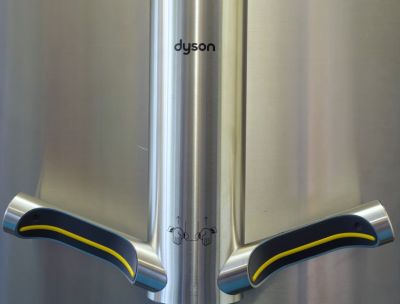
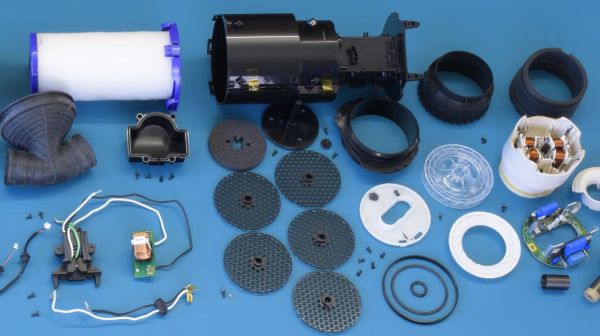
It seems fair to say that Dyson sits at the intersection of impressive engineering and borderline ridiculous products. The Dyson Airblade 9KJ hand dryer that [ElectrArc240] recently took to bits would definitely seem to fall under the latter, combining an incredible amount of engineering all for the simple task of drying wet hands.

These hand dryers are rated for a cool 900 Watts, with an 0.5 W standby power consumption, though you can also switch it to a 650 W ‘eco mode’ when installing it. The air that gets sucked into the dryer first passes through a HEPA filter before it hits the heating element and then gets blown out of the handles onto one’s hands.

Both of these handles come with a presence sensor in the form of an ST VL53L3CX time-of-flight sensor, along with a path for the heated air towards the thin slits. Returning to the section just past the HEPA filter is the compressor, with a rather fancy airflow path that involves various stacked meshes. As can be seen in the video, where you’d expect basically a simple blower motor or so, there is a truly astounding amount of parts as the teardown progresses.

The motor disassembly is the first part where some desoldering and breaking of glue bonds is really necessary, but it gives full access to the driver board. The circuit used here is your typical IGBT-based driver, though with a mystery PIC MCU to do things. Following this the tear-down turns fully destructive, giving access to the motor internals.

Following an analysis of these internals we marvel at the carbon-fiber rotor that keeps the single magnet in one piece. This is another engineering choice that serves to justify the 1,000 quid price tag. All so that rest room visitors do not have to suffer the humility of using paper towels.

Continue reading “Inside Dyson’s Over-Engineered ₤1000 Hand Dryer”

Spacelab’s Mitra 125 MS

[Ken Shirriff] does some of the most interesting teardowns. This time, he’s looking at a French-built minicomputer called the Mitra 125 MS from around 1980. In particular, it was the computer inside Spacelab, a European lab that could fit in the back of the Space Shuttle.

As you might expect, the computer doesn’t contain a microprocessor. Instead, it is a series of cards and, in this post, [Ken’s] looking at the ALU that allows the computer to perform math operations.

Continue reading “Spacelab’s Mitra 125 MS”