3D-Printed Moiré Illusion May Just Drive You Crazy

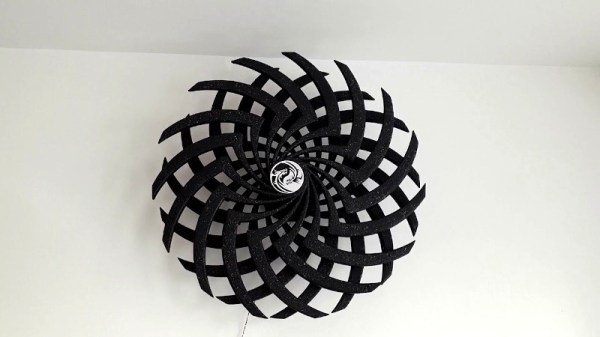
Moiré illusions can be visually captivating, particularly when a little rotational motion is thrown in the mix. [Dushyant Ahuja] was a fan of these moving Moiré sculptures he’d seen around the place, and decided to create his own.

The build is based around spinning two spoked discs in opposite directions, such that the spokes create moving Moiré patterns as they turn. To achieve this, the discs were 3D printed, along with a central housing containing two 12 volt gear motors. 3D printed gears are used to allow both discs to rotate about the same axis. Nominally, the motors spin relatively slowly, generating a pleasing, hypnotic effect when turning the discs.

The drivetrain is under the control of an ESP8266, though [Dushyant] notes that to get the basic effect, one need only connect the motors to a 12 volt power supply and let them run. However, future plans involve adding some LEDs for bling, and varying the motor speed to create yet more complex effects. With the microcontroller already installed, upgrades should be a cinch.

Moiré effects are good for everything from guiding ships to taking precision measurements. If you’ve found a new application for these confounding line patterns, be sure to let us know! Video after the break.

Continue reading “3D-Printed Moiré Illusion May Just Drive You Crazy”

A Programming Language That Lets You Code With Pixels

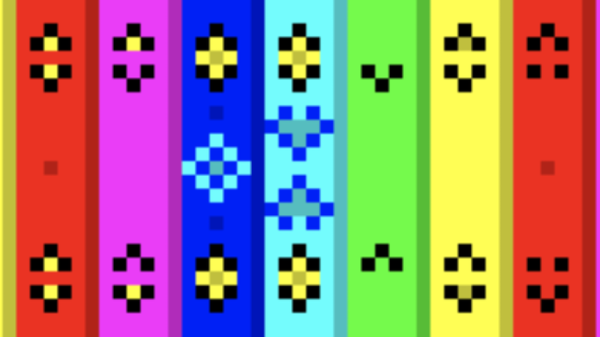
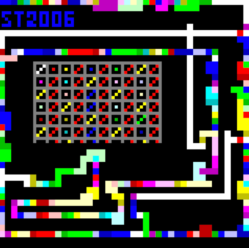
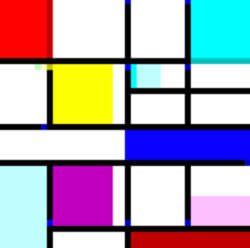
This programming language gives you programs that resemble modern art. It’s fortunately a feature of the language, dubbed Piet after the famed abstract painter Piet Mondrian.

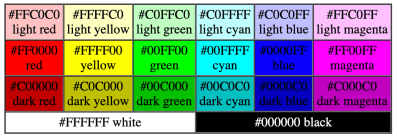
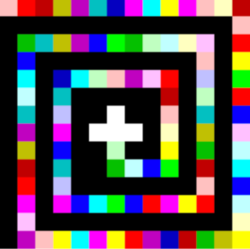
The language uses 20 distinct colors, with the colors cycling from red to yellow to green to cyan to blue to magenta and the lightness cycling from light to normal to dark. The code is formed from graphics made of the recognized colors, with individual pixels holding much of the information. Stacks are used for storing data values, that can exist as integers or as Unicode characters with the proper commands applied.

Numbers in the program are represented by colors, while black blocks indicates edges and white blocks indicate free zones. The interpreter physically slides through blocks in the direction of the Direction Pointer (DP), with hue changes indicating different commands based on the steps of the change.

To execute a program, the Piet language interpreter begins in the upper left codel (or individual code block) of the program, maintaining a DP initially pointed to the right and a Codel Chooser (CC) initially pointed to the left. The DP and CC turn right, left, down, or up depending on the execution.

There is currently a small community of coders developing sample programs, interpreters, IDEs, and compilers for the language. You can check out some of the sample programs here.

Bend It Like Bhoite: Circuit Sculptures Shatter The Bounds Of Flatland

As electronics hobbyists, we live in a somewhat two-dimensional world. Our craft is so centered around the printed circuit board that our design tools are specifically geared to spit out files tailored to the board house, who can then ship us a study in fiberglass and copper. We daub on flux and solder, add components, apply heat, and like magic, our circuits come to life, all within a few millimeters above and below the PCB.

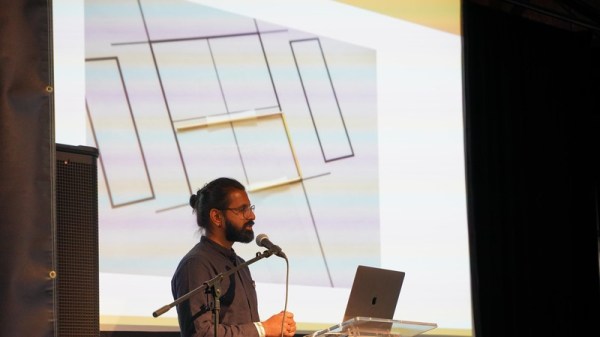
Breaking out of this self-imposed Flatland can be therapeutic. At least that’s how Mohit Bhoite sees his free-form circuit sculptures, which he spoke about at length at the Hackaday Superconference this year. By way of disclosure, I have to admit to being a longtime fan of Mohit’s work, both at his day job as a designer at Particle, and with his spare time hobby of creating sculptures from electronic components and brass wire which can be followed on his Twitter feed. He ended up joining us for a circuit sculpture Hack Chat just before heading to Supercon, too, so not only was I looking forward to meeting him, I was sure his talk would reveal the secrets of his art and give me the inspiration to start doing some of my own. I wasn’t disappointed on either score.

Continue reading “Bend It Like Bhoite: Circuit Sculptures Shatter The Bounds Of Flatland”

Kelly Heaton’s Artwork Blurs The Line Between Traditional And Electronic

Digital electronics are all well and good, but it’s hard to ignore the organic, living qualities of the analog realm. It’s these circuits that Kelly Heaton spends her time with, building artistic creations that meld the fine arts with classic analog hardware to speak to the relationship between electronics and nature. During her talk at the 2019 Hackaday Superconference, Kelly shared the story of her journey toward what she calls Electronic Naturalism, and what the future might bring.

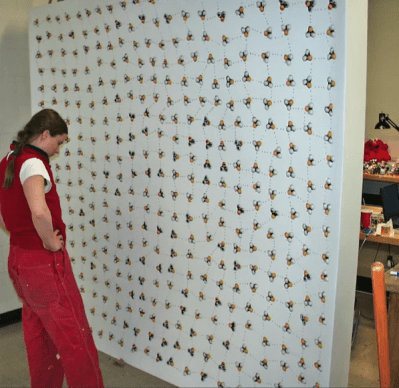
The Pool of Reflection Loop was one of Kelly’s early electronic installation pieces.

Kelly got her start like many in the maker scene. Hers was a journey that began by taking things apart, with the original Furby being a particular inspiration. After understanding the makeup of the device, she began to experiment, leading to the creation of the Reflection Loop sculpture in 2001, with the engineering assistance of Steven Grey. Featuring 400 reprogrammed Furbys, the device was just the beginning of Kelly’s artistic experimentation. With an interest in electronics that mimicked life, Kelly then moved on to the Tickle Me Elmo. Live Pelt (2003) put 64 of the shaking Muppets into a wearable coat, that no doubt became unnerving to wear for extended periods.

Analog electronics parallel living organisms while programmable logic merely simulates life.

Forrest Mims

Wanting to create art with a strong relationship to organic processes, Kelly focused on working with discrete components and analog circuitry. Basic building blocks such as the astable multivibrator became key tools that were used in different combinations to produce the desired effects. Through chaining several oscillators together, along with analog sequencers, circuits could be created that mimicked the sound of crickets in a backyard, or a Carolina wren singing in a tree.

Continue reading “Kelly Heaton’s Artwork Blurs The Line Between Traditional And Electronic”

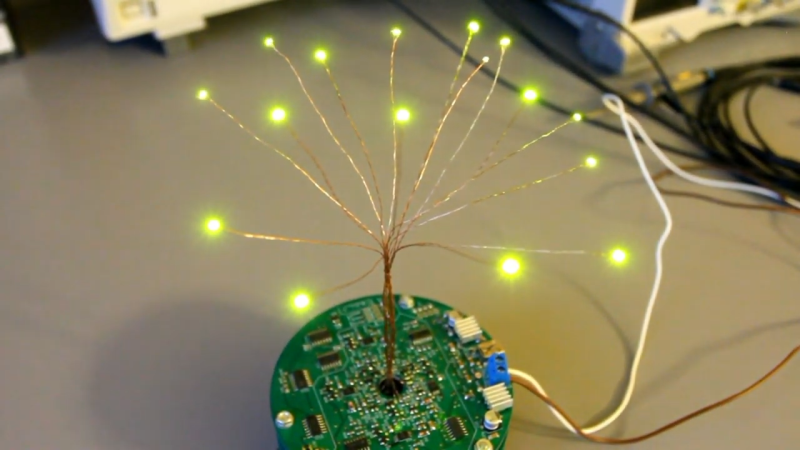
A Tree Of LEDs That Blows Out Like A Candle

The beautiful workmanship in [Andrew]’s LED tree is gorgeous all on its own, but of course there’s more going on than meets the eye. This  LED tree can be blown out like a candle and it even playfully challenges a user to blow out all the lights at once in a single breath.

Some of you may remember the fascinating example of an LED you can blow out like a candle which had the trick of using the LED itself as a sensor. Like any diode, the voltage drop across the LED changes very slightly based on temperature. By minimizing thermal mass with surface-mount LEDs and whisker-thin wires, it was possible to detect when the LED was being blown on.

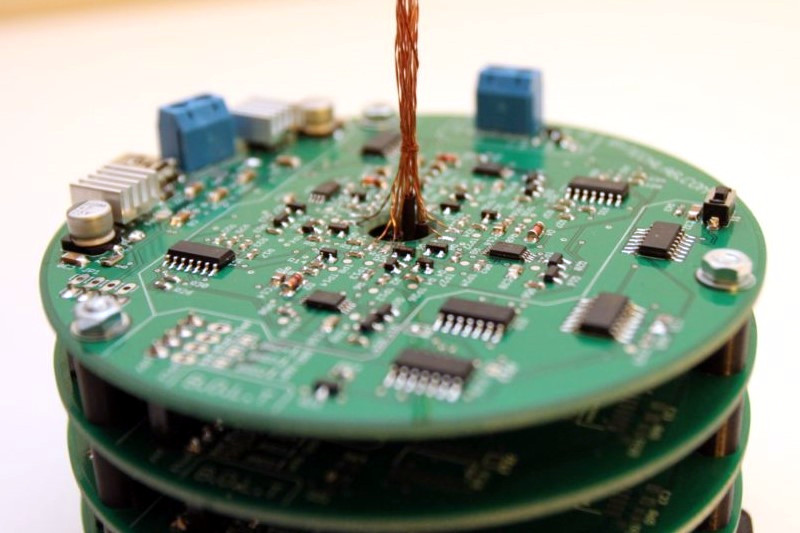
The LED tree shown here uses the same basic principle, but with a few important changes. The electronics have been redesigned and improved, and the Arduino used in the original proof of concept is ditched for stacked custom PCBs. Each board has a diameter under 100 mm in order to take advantage of the fab house’s lower cost for small boards. [Andrew] says that while the boards required a lot of time-consuming hand soldering and assembly, the payoff was that five boards rang in at barely five dollars (plus shipping) and that’s hard to beat.

Watch the tree in action in the brief video embedded below.

Continue reading “A Tree Of LEDs That Blows Out Like A Candle”

Using Glow-in-the-Dark Fish Gut Bacteria To Make Art

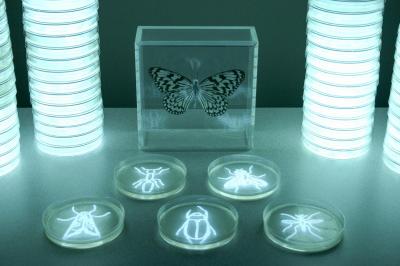
In New Orleans, a Loyola University professor has been creating original art out of glow-in-the-dark fish gut bacteria, enough to fill 1000 Petri dishes. Her first major foray into art was biomorphic abstractions, inspired by Impressionist painters, with her current work reflecting much of the abstraction of the earlier style.

The bacteria comes from the Pacific Rock Fish and glows a vibrant electric-blue. It is typically kept in a freezer and has a texture and color similar to water when it’s being used. The luminescence only lasts for 24 hours, presenting timing challenges when preparing artwork for a photoshoot, as artist [Hunter Cole] often does. With a Q-tip, [Cole] paints roses, lilies, and insects onto the Petri dishes and arranges them for surreal photography shoots. In addition to painting shapes in agar, she uses a light painting technique by filling clear water bottles with the bacteria for long-exposure shots.

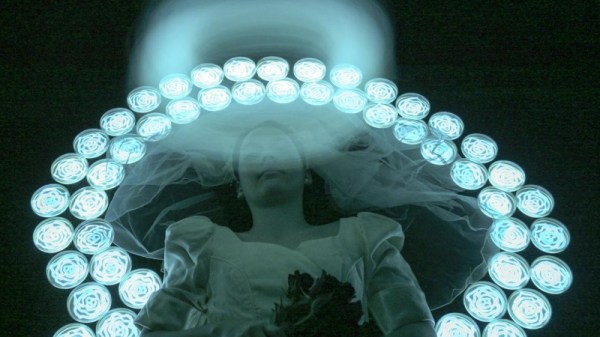
[Cole] is planning on presenting her work at an art exhibit in New Orleans, along with showcasing a performance piece featuring models clad in chandelier-like costumes glowing with bioluminescent bacteria in petri dishes.

Add LEDs To Your Stained Glass

Stained glass is an art form that goes back many centuries, with the churches and cathedrals of Europe boasting many stunning examples from the mediaeval masters of the craft. You do not however have to go to York or Chartres cathedrals to experience stained glass, for it remains a vibrant and creative discipline with many contemporary practitioners. One thing the stained glass of today has in common with that of yesteryear though is that it remains static, being composed of pieces of glass held together by metal strips. This is something that [Frank Zhao] has addressed as he has evolved a technique that allows him to incorporate LEDs into static stained glass, making for a particularly eye-catching effect.

It’s likely that we join many readers in not knowing the intricacies of making a piece of stained glass, so his is a fascinating write-up for its step-by-step run-through. His stained glass cat has pieces of glass edged with copper tape, which he then solders together. Driving the LEDs is not something that should be alien to us, but his method of using the copper-and-solder stained glass joints as conductors for them by creating strategically placed cuts is very effective. The final effect is of a homogeneous piece without the cuts being particularly visible , but with a pleasing array of lights on the cat’s tail. Those of us for whom stained glass production is new have learned something of the technique, and stained glass artists have seen their craft do something completely new.

Stained glass hasn’t featured here too often, the closest we’ve come is this striking fake stained glass Iron-Man themed panel a few years ago.