Bask In The Glory Of This 336 LED Digit Display

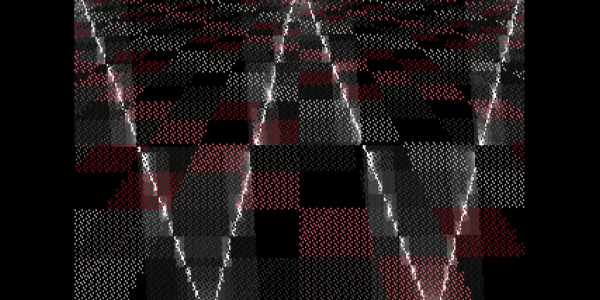
[Chris Combs] recently took the wraps off of an incredible art piece that he calls Road Ahead which uses 336 seven segment LED digits to create an absolutely gorgeous display. With a piece of smoked acrylic to slightly diffuse the orange glow of the LEDs, the end result has a distinctively retro look that we’d gladly spend all day staring at.

For those looking to dig a bit deeper, [Chris] has put together some very impressive documentation over on Hackaday.io that goes into plenty of detail on how he designed and built this beauty. From the design of the PCBs that carry all of the 0.3″ SMD displays to the custom software running on the Raspberry Pi 3 that powers it, there’s no technical stone left unturned.

According to the build log, this is the second version of the display. The first one was housed in a rather attractive wooden enclosure, but as [Chris] explains, that was precisely the problem. He wanted something that looked cold and unfeeling as the nearly 340 digits flashed away with potentially ominous intent. So he ditched the wooden case for a powder coated steel one that looks more like the front panel of a mainframe than something you’d pick up at the craft store.

Another interesting point explained in the write-up is how the Python software is designed to treat the hardware as a contiguous graphical display rather than just an array of independent digits. Grayscale images can be reproduced on the by using PWM to adjust the brightness of each segment’s corresponding “pixel”; though admittedly it takes a bit of imagination to see the intended image with a resolution this low.

This project reminds us of the incredible LED hexdump display we saw not that long ago, down to the PWM trickery for squeezing “graphics” out of these exceptionally non-graphical elements. With any luck, perhaps these are the opening shots in an arms race to see who can build the largest array of multi-segment LED displays.

This Artist Drags His Feet Across Sand And Snow

You may have seen Simon Beck’s work a few years back. The snow artist, known for creating large-scale works of art with nothing but snowshoes, has been creating geometrically inspired fractals and mathematical forms for years. An orienteer and map-maker by day, he typically plans out his works in advance and chooses sites based on their flat terrain. The lack of slopes prevents skiers from traversing the area beforehand and helps with measuring the lines needed to create the drawing.

He starts off by measuring the distance he has to be from the center by using a compass and walking in a straight line towards a point in the distance, making curves based on relative position to other lines. Once the primary lines are made, he measures points along the way using pace counting and joins secondary lines by connecting the points. The lines are generally walked three times to solidify them before filling in the shaded areas. The results are mesmerizing.

He has since expanded to sand art, using the same techniques that gained him fame in ski resorts and national parks on the sandy shores. Unfortunately, tidal patterns, seaweed, and beach debris make it slightly harder to achieve pristine conditions, but he has managed to create some impressive works of art nonetheless.

Continue reading “This Artist Drags His Feet Across Sand And Snow”

Vintage Mini Inkjet Prints On-Demand ASCII Art

Readers of a certain age may fondly remember ASCII art emerging from line printers in a long-gone era of computing; for others, it’s just wonderfully retro. Well, when [Emily Velasco] found a vintage Kodak Diconix 150 inkjet at a local thrift store for $4, she knew what she had to do: turn it into a dedicated ASCII-art machine.

Dating to the mid-1980s, the diminutive printer she scored was an early example of consumer inkjet technology; with only 12 “jets,” it sported a resolution roughly equivalent to the dot-matrix impact printers of the day. [Emily] notes that this printer would have cost around $1000 in today’s money — this is from a time before printer companies started selling the printer itself as a loss leader to make revenue on the back end selling consumables. It seems you can’t escape the razor-and-blades model, though: [Emily] had to pay $16 for a new ink cartridge to revive the $4 printer.

With the new ink in place, and some tractor-feed paper acquired, [Emily] started work on the art generator. The concept is something that might have been sold on late-night TV ads: a “cartridge” you plug into your printer to make ASCII masterpieces. Starting with a stripped-down Centronics printer cable that matches the printer’s port, she added an Arduino nano to store and serve up the art. The user interface is foolproof: a single button press causes a random selection from one of ten ASCII images to be printed. The whole thing is ensconced within a slick 3D printed case.

One of the coolest aspects of this project is the lack of power supply. When she first hooked the Arduino to the printer’s parallel port, [Emily] noticed that it powered right up with no external supply, and in true hacker fashion, just ran with it. Upon reflection, it seems that power is being supplied by the printer status lines, Busy and/or Ack, through the input protection diodes of the Atmega328 on the nano.

We really like this project, and are more than a little bummed we tossed those old printers that were kicking around the Hackaday labs for years. If you still have yours, and would like turn out some rad ASCII art, the code for this project is up on GitHub.

We’re no strangers to [Emily]’s work, but if you aren’t familiar with it, check out her inspiring talk from the 2019 Hackaday Superconference. Meanwhile, don’t miss the excellent video about the ASCII art printer cartridge, after the break.

Continue reading “Vintage Mini Inkjet Prints On-Demand ASCII Art”

Steampunk Motorcycle Runs On Compressed Air, Is Pure Hacking Art

Sometimes it’s ok to sacrifice some practicality for aesthetics, especially for passion projects. Falling solidly in this category is [Peter Forsberg]’s beautiful, barely functional steam punk motorcycle. If this isn’t hacker art, then we don’t know what is.

The most eye-catching part of the motorcycle is the engine and drive train, with most of the mechanical components visible. The cylinders are clear glass tubes with custom pistons, seals, valves and push rods. The crank mechanism is from an old Harley and is mounted inside a piece of stainless steel pipe. Because it runs on compressed air it cools down instead of heating up, so an oil system is not needed.

For steering, the entire front of the bike swings side to side on hinges in the middle of the frame, which is quite tricky to ride with a top speed that’s just above walking speed. It can run for about 3-5 minutes on a tank, so the [Peter] mounted a big three-minute hour glass in the frame. The engine is fed from an external air tank, which he wears on his back; he admits it’s borderline torture to carry the thing for any length of time. He plans to build a side-car to house a much larger tank to extend range and improve riding comfort.

[Peter] admits that it isn’t very good as a motorcycle, but the amount of creativity and resourcefulness required to make it functional at all is the mark of a true mechanical hacker. We look forward to seeing it in its final form.

Continue reading “Steampunk Motorcycle Runs On Compressed Air, Is Pure Hacking Art”

3D-Printed Moiré Illusion May Just Drive You Crazy

Moiré illusions can be visually captivating, particularly when a little rotational motion is thrown in the mix. [Dushyant Ahuja] was a fan of these moving Moiré sculptures he’d seen around the place, and decided to create his own.

The build is based around spinning two spoked discs in opposite directions, such that the spokes create moving Moiré patterns as they turn. To achieve this, the discs were 3D printed, along with a central housing containing two 12 volt gear motors. 3D printed gears are used to allow both discs to rotate about the same axis. Nominally, the motors spin relatively slowly, generating a pleasing, hypnotic effect when turning the discs.

The drivetrain is under the control of an ESP8266, though [Dushyant] notes that to get the basic effect, one need only connect the motors to a 12 volt power supply and let them run. However, future plans involve adding some LEDs for bling, and varying the motor speed to create yet more complex effects. With the microcontroller already installed, upgrades should be a cinch.

Moiré effects are good for everything from guiding ships to taking precision measurements. If you’ve found a new application for these confounding line patterns, be sure to let us know! Video after the break.

Continue reading “3D-Printed Moiré Illusion May Just Drive You Crazy”

A Programming Language That Lets You Code With Pixels

This programming language gives you programs that resemble modern art. It’s fortunately a feature of the language, dubbed Piet after the famed abstract painter Piet Mondrian.

The language uses 20 distinct colors, with the colors cycling from red to yellow to green to cyan to blue to magenta and the lightness cycling from light to normal to dark. The code is formed from graphics made of the recognized colors, with individual pixels holding much of the information. Stacks are used for storing data values, that can exist as integers or as Unicode characters with the proper commands applied.

Numbers in the program are represented by colors, while black blocks indicates edges and white blocks indicate free zones. The interpreter physically slides through blocks in the direction of the Direction Pointer (DP), with hue changes indicating different commands based on the steps of the change.

To execute a program, the Piet language interpreter begins in the upper left codel (or individual code block) of the program, maintaining a DP initially pointed to the right and a Codel Chooser (CC) initially pointed to the left. The DP and CC turn right, left, down, or up depending on the execution.

There is currently a small community of coders developing sample programs, interpreters, IDEs, and compilers for the language. You can check out some of the sample programs here.

Bend It Like Bhoite: Circuit Sculptures Shatter The Bounds Of Flatland

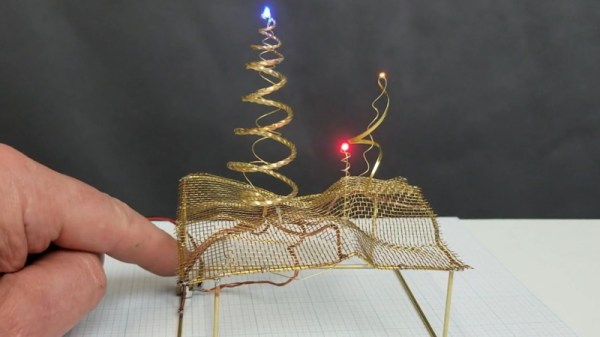
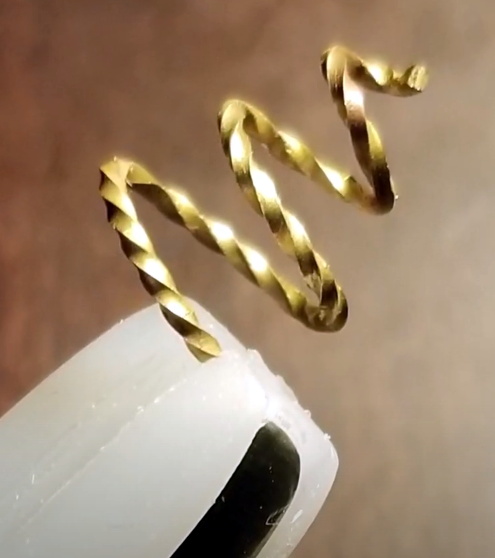
As electronics hobbyists, we live in a somewhat two-dimensional world. Our craft is so centered around the printed circuit board that our design tools are specifically geared to spit out files tailored to the board house, who can then ship us a study in fiberglass and copper. We daub on flux and solder, add components, apply heat, and like magic, our circuits come to life, all within a few millimeters above and below the PCB.

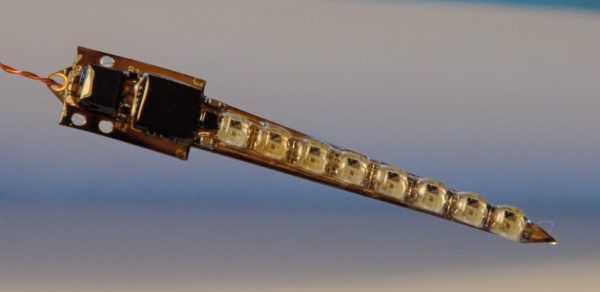
Breaking out of this self-imposed Flatland can be therapeutic. At least that’s how Mohit Bhoite sees his free-form circuit sculptures, which he spoke about at length at the Hackaday Superconference this year. By way of disclosure, I have to admit to being a longtime fan of Mohit’s work, both at his day job as a designer at Particle, and with his spare time hobby of creating sculptures from electronic components and brass wire which can be followed on his Twitter feed. He ended up joining us for a circuit sculpture Hack Chat just before heading to Supercon, too, so not only was I looking forward to meeting him, I was sure his talk would reveal the secrets of his art and give me the inspiration to start doing some of my own. I wasn’t disappointed on either score.

Continue reading “Bend It Like Bhoite: Circuit Sculptures Shatter The Bounds Of Flatland”