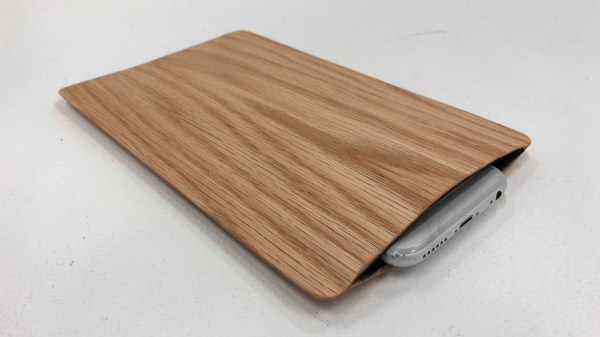
Smartphones are amazing tools, but sometimes they can be an equally amazing time suck. In an effort to minimize how much precious time goes down the drain, [Lance Pan and Zeynep Kirmiziyesil] decided to make a functional and beautiful smartphone sleeve to keep you on task.
Most modern smartphones have some form of Do Not Disturb mode available, but having the phone visible can still be an invitation for distraction. By tucking the phone into an accessible but less visible sleeve, one can reduce the visual trigger to be on the phone while keeping it handy in the even of an emergency.
Once in the sleeve, the NFC tag sandwiched between the felt and wood veneer triggers an automation to put the phone into Do Not Disturb mode. This hack looks like something that you could easily pull off in an afternoon and looks great which is always a winning combination in our book.
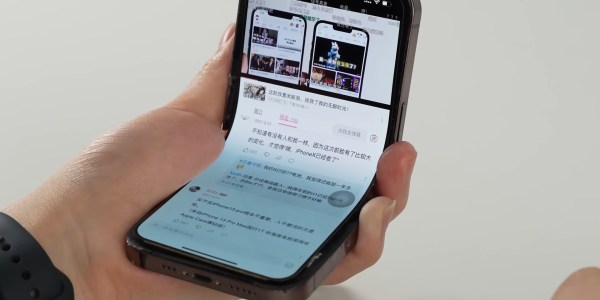
Folding phones are all the rage these days, with many of the major smartphone manufacturer’s having something in this form factor. Apple has been conspicuously absent in this market segment, so [KJMX] decided to take matters into their own hands with the “iPhone V.” (YouTube – Chinese w/subtitles via MacRumors).
Instead of trying to interface an existing folding phone’s screen with the iPhone, these makers delaminated an actual iPhone X screen to use in the mod. It took 37 attempts before they had a screen with layers that properly separated to be both flexible and functional. Several different folding phones were disassembled, and [KJMX] found a Motorola Razr folding mechanism would work best with the iPhone X screen. Unfortunately, since the iPhone screen isn’t designed to fold, it still will fail after a relatively small number of folds.
Other sacrifices were made, like the removal of the Taptic Engine and a smaller battery to fit everything into the desired form factor. The “iPhone V” boasts the worst battery life of any iPhone to date. After nearly a year of work though, [KJMX] can truly claim to have made what Apple hasn’t.
Ever wonder what makes a cellphone’s operating system secure, or what that app you just installed is saying about you behind your back? In a brand new video series, [Jiska] gives us a peek into different topics in smartphone software reverse engineering.
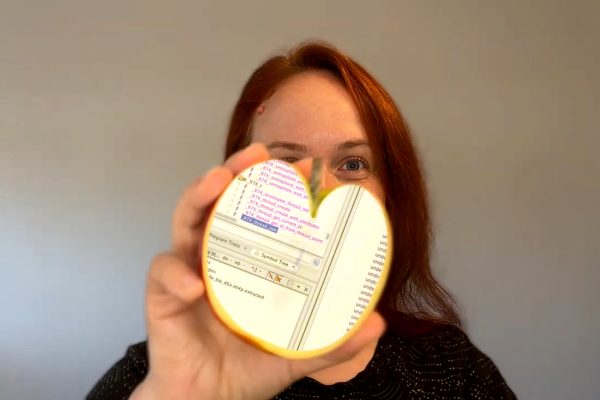
For instance, her latest video, embedded below takes us through some steps to poke at Apple’s RTKit OS, which is the realtime OS that runs inside most of their peripheral devices, including AirPods, but also on their bigger devices too. We don’t know much about RTKit OS, but [Jiska]’s trick in this video is to get a foothold by looking through two different RTKit OS versions and noting which symbols are common — these are probably OS function names. Now you’ve got something to look for.
Each of the videos is short, to the point, and contains nice tips for perhaps the intermediate-to-advanced reverser who is looking to get into phones. Heck, even if you’re not, her demonstrations of the Frida dynamic tracing tool are worth your time.
And if you want a longer introduction into the internals of cellphones, we heartily recommend her talk, “All Wireless Stacks Are Broken“.
While it might seem like mobile phones are special devices, both in their ease of use and in their ubiquity in the modern culture, they are essentially nothing more than small form-factor computers with an extra radio and a few specific pieces of software to run. In theory, as long as you can find that software (and you pay for a service plan of some sort) you can get any computer to work as a phone. So naturally, the Raspberry Pi was turned into one.
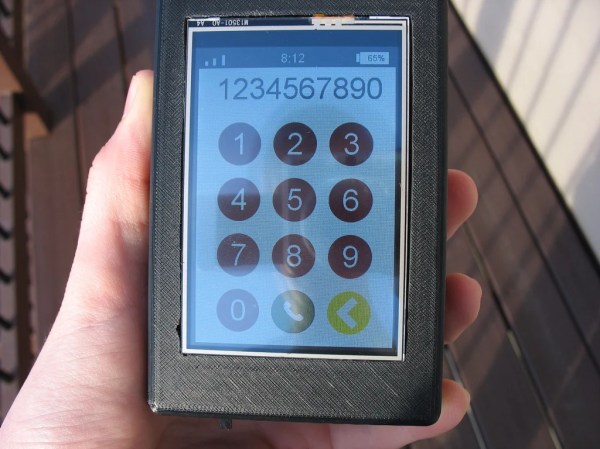
[asherdundas], the phone’s creator, actually found a prior build based around the Raspberry Pi before starting this one. The problem was that it was built nearly a decade ago, and hadn’t been updated since. This build brings some modernization to the antiquated Pi phone, and starts with a 3D printed case. It also houses a touchscreen and a GSM antenna to connect to the cell network. With some other odds and ends, like a speaker and microphone, plus a battery and the software to tie it all together, a modern functional Raspberry Pi phone was created, with some extra details available on the project page.
The phone has the expected features — including calling, texting, and even a camera. A small WiFi USB dongle allows it to connect to the Internet too, allowing it to do all of the internet browsing a modern smartphone might want to do. The only thing that it might be pretty difficult to do is install Android apps, and although there are ways to get Android apps working in Linux, it’s not always strictly necessary to have this functionality.
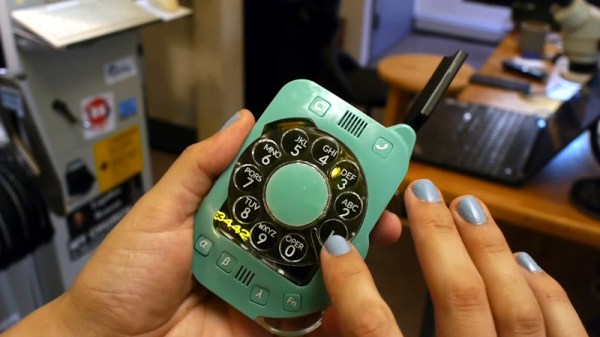
We know the pandemic has screwed with a lot of people’s sense of time, but we doubled checked, and it has indeed been more than two years since the Internet first laid eyes upon the incredible rotary cell phone put together by [Justine Haupt]. We’re happy to report that not only has she continued to develop and improve the phone since the last time it made the rounds, but that the kits for this open source marvel are currently available for preorder.
A lot has happened since this phone last graced the pages of Hackaday. For one thing, it’s now officially known as the Rotary Un-Smartphone. [Justine] has also spun up a small company for the express purposes of putting these kits into production, which clearly speaks to just how much attention the project picked up in mainstream circles.
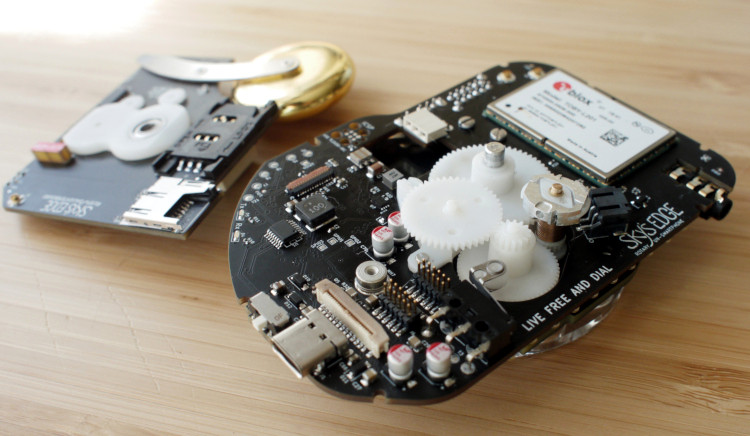
The new rotary mechanism is based on modern components.
In terms of hardware, while the phone might look more or less the same externally, [Justine] says that there’s not a single unchanged component from the previous version. The 3D printed case has given way to a beautiful injection molded enclosure offered in several retro colors, and the rather incongruous rubber ducky antenna has been replaced with an articulated aerial that serves as a kickstand.
Speaking of reception, the original 3G cellular modem has been upgraded to a LTE-compatible model from uBlox, so it should still get a signal for a decade or so before your carrier kicks it off the network. When ordering the kit you can choose between a global version using the TOBY-R200 modem, or a North American variant with the TOBY-R202.
Even the user interface has been spruced up — while the previous model featured a simple LED indicator on the front to show when you were in a call, the new version features an OLED display that will show you the currently dialed number as well as status information such as battery life and signal strength. Some may be disappointed to hear that the authentic Western Electric model 10A rotary dial has been deleted in favor of a custom designed mechanism that uses all modern components, but we can certainly understand why the change had to be made from a production standpoint.
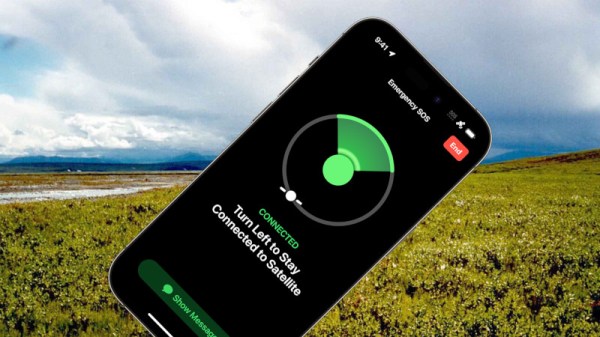
There is always some hype surrounding an Apple product announcement, and while maybe it’s not in the same league as those for the original iPod or iPhone, their iPhone 14 model will include emergency texting by satellite has generated quite a bit of coverage. It’s easy to find a lot about the system from the software end in terms of its interface and even Apple’s use of compression, but what about the radio side? Whose satellite constellation are they using, and how does it work?
As has been widely reported, their communication partner for the service is Globalstar, a provider of satellite data services that like their competitor Iridium have their origins in the 1990s when satellite phones were briefly seen as the Next Big Thing. They have a 24-satellite constellation, and they sell a range of off-the-grid voice, data, paging, tracking, and IoT connectivity services. The Apple emergency texting looks a lot like Globalstar’s Spot texting service. It’s only available in North America for now, we’re guessing because the satellites aren’t smart relays but straightforward transponders, and the network lacks sufficient ground station coverage outside that region.
With all the talk about low-earth-orbit connectivity surrounding services such as SpaceX’s Starlink it’s a bit unexpected to find ourselves back with a satellite constellation using 1990s technology. But we can see that as well as a major win for Globalstar as their service begins to look outdated by comparison to Starlink, it’s a perfect match for Apple in not requiring a complex ground station for low-bandwidth text messages. We expect that there will be some form of exclusivity in the deal, so it will be interesting to see how the larger Android vendors respond.
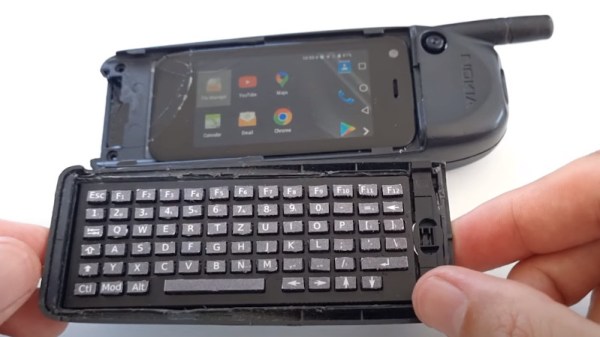
Even though Nokia is largely an afterthought in the phone market now, there was a time when their products represented the state-of-the-art in mobile devices. Some of the their handsets even featured slide-out keyboards and the ability to sent emails; largely unheard of for a device from the late 90s. [befinitiv] was a kid back then and couldn’t afford one of these revolutionary devices, so he built his own modern version that still looks and feels like the original.
To do this he borrowed the case and structure of a Nokia 5110 phone, but modified it to hold a small Android device in the old battery compartment along with a tiny Bluetooth keyboard (which was also built from scratch by [befinitiv]) that connects to the Android phone to mimic the old slide-out style. This isn’t just a case mod, though. He also reverse-engineered the original PCB of the phone and included a Bluetooth module there as well, which allows the phone’s screen and keypad to work mostly as originally intended.
This project goes pretty far to scratch the 90s phone nostalgia itch while still being largely usable as a real phone in the modern world. Assuming you aren’t too hung up on the literal phone aspect, the Notkia project is also an impressive effort to bring new life to these old handsets.