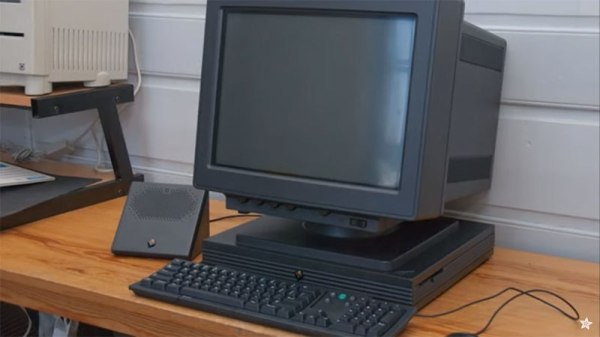
Lady Ada Turns NeXT Equipment Into Something Useful

From the late 80s to the early 90s, [Steve Jobs] wasn’t at Apple. He built another company in the meantime, NeXT Computer, a company that introduced jet black workstations to universities and institutions, developed an incredible emphasis on object-oriented programming, and laid the groundwork for the Unix-ey flavor of Apple’s OS X. Coincidently, there is a lot of old NeXT gear at the Adafruit clubhouse – not that there’s anything wrong with that, we all have our own strange affectations and proclivities. Recently, [Lady Ada] turned one of the strangest components of the NeXT computer ecosystem into something useful: a computer speaker.

The item in question for this build is the NeXT ‘sound box’. When not using the very special NeXT monitor, the NeXT computer connects the monitor, keyboard, and speakers through this odd little box. There are two versions of the NeXT sound box, and peripherals from either version are incompatible with each other. ([Jobs] was known for his sense of design and a desire for a simplified user experience, you know.)

In [Lady Ada]’s initial teardown of the sound box, she discovers a few interesting things about this peripheral. There’s an I2S DAC inside there, connected to an unobtanium DB19 connector. Theoretically, that I2S device could be used to drive the speaker with digital audio. The only problem is the DB19 connector – they’re rare, and [Steve] from Big Mess o’ Wires bought the world’s supply.

Without these connectors, and since it’s only an hour-long show, [Lady Ada] went with the most effective hack. She grabbed a USB audio dongle/card, added a small amplifier, and soldered a few wires onto the power and ground pins of an IC. It’s simple, effective, fast, and turns an awesome looking 30-year-old peripheral into a useful device.
Saving Old Voices By Dumping ROMs

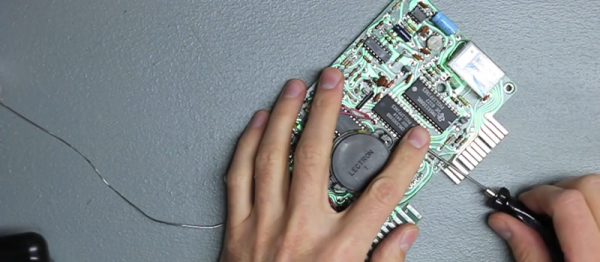
Some people collect stamps. Others collect porcelain miniatures. [David Viens] collects voice synthesizers and their ROMs. In this video, he just got his hands on the ultra-rare Electronic Voice Alert (EVA) from early 1980s Chrysler automobiles (video embedded below the break).

Back in the 1980s, speech synthesis was in its golden years following the development of TI’s linear-predictive coding speech chips. These are the bits of silicon that gave voice to the Speak and Spell, numerous video game machines, and the TI 99/4A computer’s speech module. And, apparently, some models of Chrysler cars.

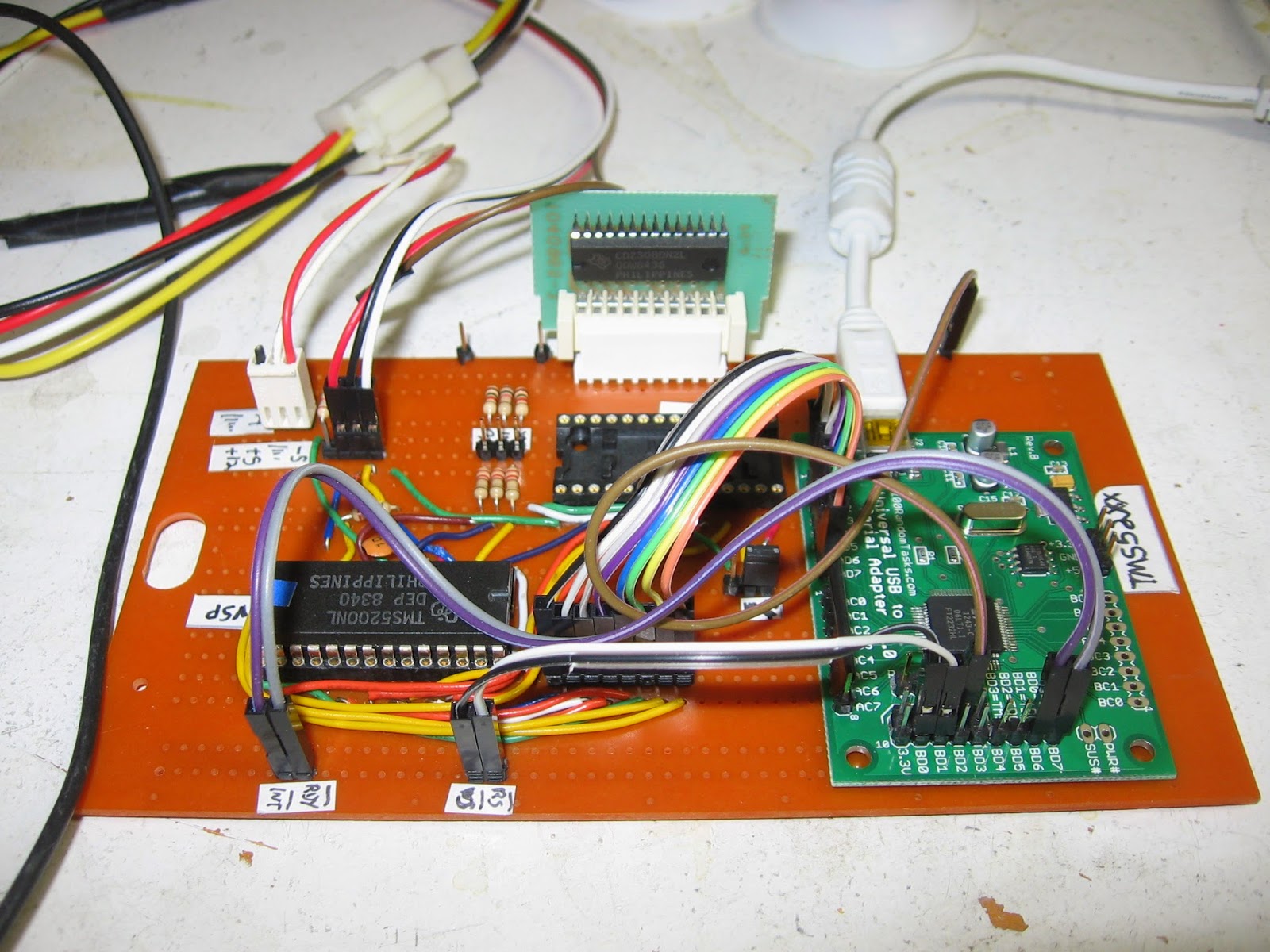
IMG_0695We tracked [David]’s website down. He posted a brief entry describing his emulation and ROM-dumping setup. He says he used it for testing out his (software) TMS5200 speech-synthesizer emulation.

The board appears to have a socket for a TMS-series voice synthesizer chip and another slot for the ROM. It looks like an FTDI 2232 USB-serial converter is being used in bit-bang mode with some custom code driving everything, and presumably sniffing data in the middle. We’d love to see a bunch more detail.

The best part of the video, aside from the ROM-dumping goodness, comes at the end when [David] tosses the ROM’s contents into his own chipspeech emulator and starts playing “your engine oil pressure is critical” up and down the keyboard. Fantastic.

Continue reading “Saving Old Voices By Dumping ROMs”

Why No Plane Parachutes? And Other Questions.

This week I was approached with a question. Why don’t passenger aircraft have emergency parachutes? Whole plane emergency parachutes are available for light aircraft, and have been used to great effect in many light aircraft engine failures and accidents.

But the truth is that while parachutes may be effective for light aircraft, they don’t scale. There are a series of great answers on Quora which run the numbers of the size a parachute would need to be for a full size passenger jet. I recommend reading the full thread, but suffice it to say a ballpark estimate would require a million square feet (92903 square meters) of material. This clearly isn’t very feasible, and the added weight and complexity would no doubt bring its own risks.

Continue reading “Why No Plane Parachutes? And Other Questions.”

Up Your Tiny House Game With Stone Age Hacks

Bare feet, bare hands, and bare chest – if it weren’t for the cargo shorts and the brief sound of a plane overhead, we’d swear the video below was footage that slipped through a time warp. No Arduinos, no CNC or 3D anything, but if you doubt that our Stone Age ancestors were hackers, watch what [PrimitiveTechnology] goes through while building a tile-roofed hut with no modern tools.

The first thing we’ll point out is that [PrimitiveTechnology] is not attempting to be (pre-)historically accurate. He borrows technology from different epochs in human history for his build – tiled roofs didn’t show up until about 5,000 years ago, by which time his stone celt axe would have been obsolete. But the point of the primitive technology hobby is to build something without using any modern technology. If you need a fire, you use a fire bow; if you need an axe, shape a rock. And his 102 day build log details every step of the way. It’s fascinating to watch logs, mud, saplings, rocks and clay come together into a surprisingly cozy structure. Especially awesome if a bit anachronistic is the underfloor central heating system, which could turn the hut into a lovely sauna.

Primitive technology looks like a fascinating hobby with a lot to teach us about how we got to now. But if you’re not into grubbing in the mud, you could always 3D print a clay hut. We’re not sure building an enormous delta-bot is any easier, though.
Continue reading “Up Your Tiny House Game With Stone Age Hacks”

Hams In Space: Project OSCAR

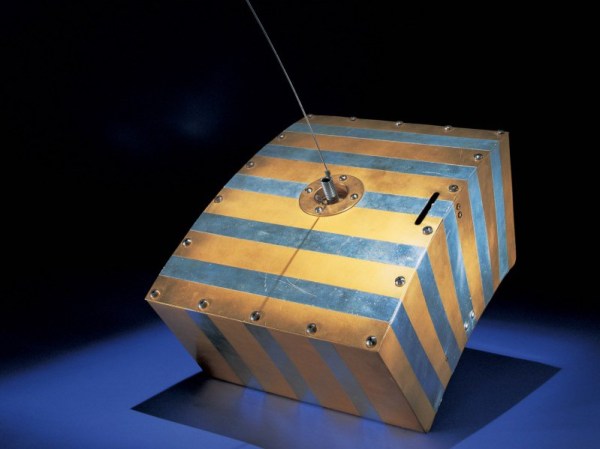
In early December 1961, a United States Air Force rocket took off from Vandenberg Air Force Base in California carrying a special payload. The main payload was a Corona surveillance satellite, but tucked just aft of that spacecraft was a tiny package of homebrew electronics stuffed into something the looked like a slice of cake. What was in that package and how it came to tag along on a top-secret military mission is the story of OSCAR 1, the world’s first amateur radio satellite.

Continue reading “Hams In Space: Project OSCAR”

Rube Slowberg

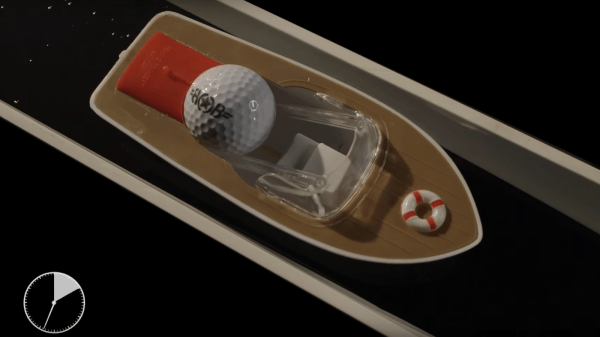
This one was buried in our tips line for a couple of months, but we’re glad it eventually surfaced. [Bob Partington] built the “Rube Slowberg” contraption – it’s billed as the world’s slowest Rube Goldberg Machine. The golf ball that he tee’d off took six weeks to reach it’s rather dramatic end.

Rube Goldberg machines are fascinating, but most often the fun ends quite quickly. [Bob] decided to slow it all down and it took several hacks to get that done. Thankfully for us, the edited video with extensive use of stop-motion and fast forwards brings the chase down to under three minutes.

Check out the video below. It starts with the Golf ball riding a slow boat on molasses, hitching a ride on a Tortoise, running through a series of melting popsicle sticks and then being propelled one tiny bit at a time by a bunch of growing grass. If you are interested is seeing behind the scenes, watch the other video where he talks a little about how he managed to pull it off.

Continue reading “Rube Slowberg”

Building Triodes With Blinker Fluid

The triode is one of the simplest kinds of vacuum tubes. Inside its evacuated glass envelope, the triode really is just a few bits of wire and metal. Triodes are able to amplify signals simply by heating a cathode, and modulating the flow of electrons to the anode with a control grid. Triodes, and their semiconductor cousin the transistor, are the basis of everything we do with electricity.

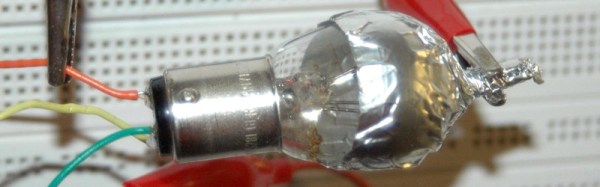
Because triodes are so fantastically simple, they’re the parts most commonly crafted by the homebrew tube artisans of today. You don’t need a glass blowing lathe to make the most basic vacuum tube, though: [Marcel] built one from the light bulb used in a car’s tail light.

The light bulb in your car’s tail light has two filaments inside: one for the normal tail light, and a second one that comes on when you brake. By burning out the dimmer filament, [Marcel] created the simplest vacuum tube device possible. In his first experiment, he turned this broken light bulb into a diode by using the disconnected filament as the anode, and the burning filament as the cathode. [Marcel] attached a 1M resistor and measured 30mV across it. It was a diode, with 30μA flowing.

The triode is just a diode with a grid, but [Marcel] couldn’t open up the light bulb to install a piece of metal. Instead, he wrapped the bulb in aluminum foil. After many attempts, [Marcel] eventually got some amplification out of his light bulb triode.

The performance is terrible – this light bulb triode actually has an “amplification” of -108dB, making it a complete waste of energy and time. It does demonstrate the concept though, even though the grid isn’t between the anode and cathode, and this light bulb is probably filled with argon. It does work in the most perverse sense of the word,  and makes for a very interesting build.