Curing CRT Cataracts Freshens Up Retro Roundy TVs

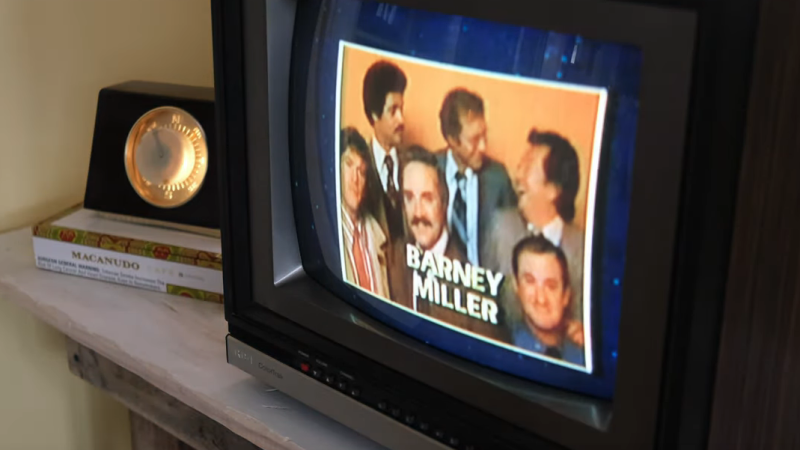
It’s been a long time since the family TV has had a CRT in it, and even longer since that it was using what was basically an overgrown oscilloscope tube. But “roundies” were once a thing, and even back in the early 80s you’d still find them in living rooms on TV repair calls, usually sporting a characteristic and unsightly bullseye discoloration.

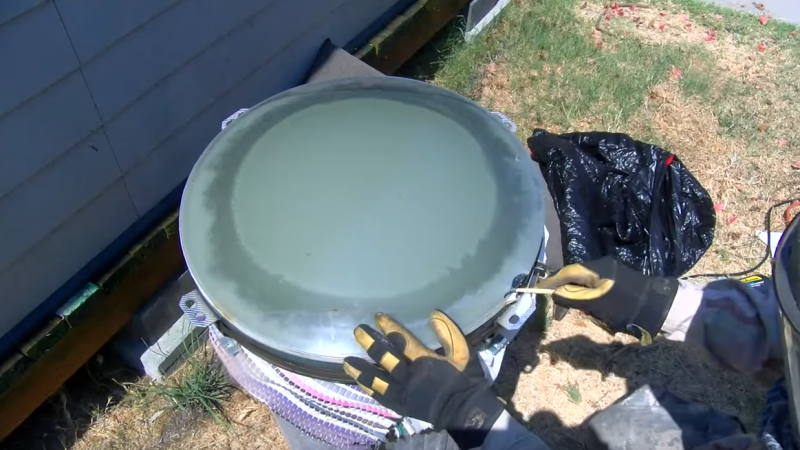
Fast-forward a few decades, and roundy TVs have become collectible enough that curing their CRT cataracts is necessary for restorationists like [shango066], a skill he demonstrates in the video below. The defect comes from the composite construction of CRTs — a safety feature added by television manufacturers wisely concerned with the safety aspects of putting a particle accelerator with the twin hazards of high vacuum and high voltage in the family home. The phosphor-covered face of the tube was covered by a secondary glass cover, often tinted and frosted to improve the admittedly marginal viewing experience. This cover was often glued in place with an epoxy resin that eventually oxidized from the edges in, making the bullseye pattern.

The remedy for this problem? According to [shango066], it’s heat, and plenty of it. After liberating the tube from the remarkably clean TV chassis, he took advantage of a warm summer’s day and got the tube face cooking under a black plastic wrap. Once things were warmed up, more heat was added to really soften the glue; you can easily see the softening progress across the face of the tube in the video below. Once softened, gentle prying with wooden chopsticks completes the job of freeing the safety lens, also in remarkably good shape.

With the adhesive peeled off in an oddly satisfying manner, all that’s left is a thorough cleaning and gluing the lens back on with a little silicone sealant around the edges. We’d love to see the restored TV in operation, but that’s left to a promised future video. In the meantime, please enjoy a look at the retro necessities TV owners depended on in the good old days, which really weren’t all that good when you get down to it.

Continue reading “Curing CRT Cataracts Freshens Up Retro Roundy TVs”
Reverse Time Back To The Days Of RPN

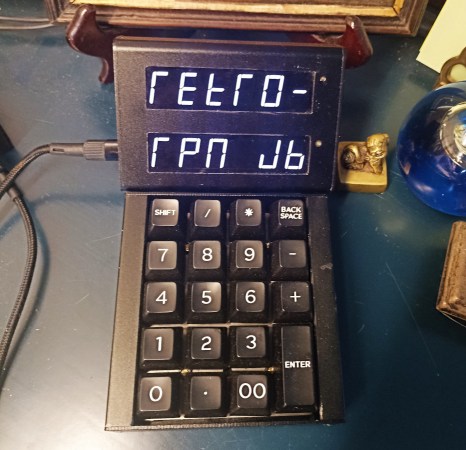
While Texas Instruments maintains dominance in the calculator market (especially graphing calculators), there was a time when this wasn’t the case. HP famously built the first portable scientific calculator, the HP-35, although its reverse-Polish notation (RPN) might be a bit of a head-scratcher to those of us who came up in the TI world of the last three or four decades. Part of the reason TI is so dominant now is because they were the first to popularize infix notation, making the math on the calculator look much more like the math written on the page, especially when compared to the RPN used by HP calculators. But if you want to step into a time machine and see what that world was like without having to find a working HP-35, take a look at [Jeroen]’s DIY RPN calculator.

Since the calculator is going to be RPN-based, it needs to have a classic feel. For that, mechanical keyboard keys are used for the calculator buttons with a custom case to hold it all together. It uses two rows of seven-segment displays to show the current operation and the results. Programming the Arduino Nano to work as an RPN calculator involved a few tricks, though. [Jeroen] wanted a backspace button, but this disrupts the way that the Arduino handles the input and shows it on the display but it turns out there’s an Arudino library which solves some of these common problems with RPN builds like this.

One of the main reasons that RPN exists at all is that it is much easier for the processor in the calculator to understand the operations, even if it makes it a little bit harder for the human. This is because early calculators made much more overt use of a stack for performing operations in a similar way to Assembly language. Rather than learning Assembly, an RPN build like this can be a great introduction to this concept. If you want to get into the weeds of Assembly programming this is a great place to go to get started.

Broadcast TV Simulator Keeps The Nostalgia Flowing

Watch out, Gen X-ers — there’s a nostalgia overload heading your way, courtesy of this over-the-air TV simulator. And it has us feeling a little Saturday morning cartoon-ish, or maybe even a bit Afterschool Special.

[Shane C Mason]’s “FieldStation42” build centers around a period-correct color TV, and rightly so — a modern TV would be jarring here, and replacing the CRT in this irreplaceable TV would be unthinkable. Programming comes via painstakingly collected sitcoms, dramas, news broadcasts, and specials, all digitized and stored on disk and organized by the original networks the programs came from. Python running on a Raspberry Pi does the heavy lifting here, developing a schedule of programs for the week that makes sense for the time of day — morning news and talk, afternoon soaps, the usual family hour and prime time offerings, and finally [Carson] rounding out the day, because that’s all we had for late night.

As for switching between stations, rather than risk damaging the old TV, [Shane] really upped his nostalgia game and found an old antenna rotator control box. These were used to steer the directional antenna toward different transmitters back in the day, especially in fringe areas like the one he grew up in. He added a set of contacts to the knob and a Pi Pico, which talks to the main Pi and controls which “channel” is being viewed. He also added an effect of fading and noise in the video and audio between channels, simulating the antenna moving. The video below shows it in action.

For those who missed the Golden Age of TV, relax; as [Shane] correctly surmises after going through this whole project, Golden Ages only exist in your mind. Things were certainly different with 70s mass media, a fact which this build captures neatly, but that doesn’t mean they were better. Other than Saturday mornings, of course — those were objectively better in every way.

Continue reading “Broadcast TV Simulator Keeps The Nostalgia Flowing”

DOOM On A Volumetric Display

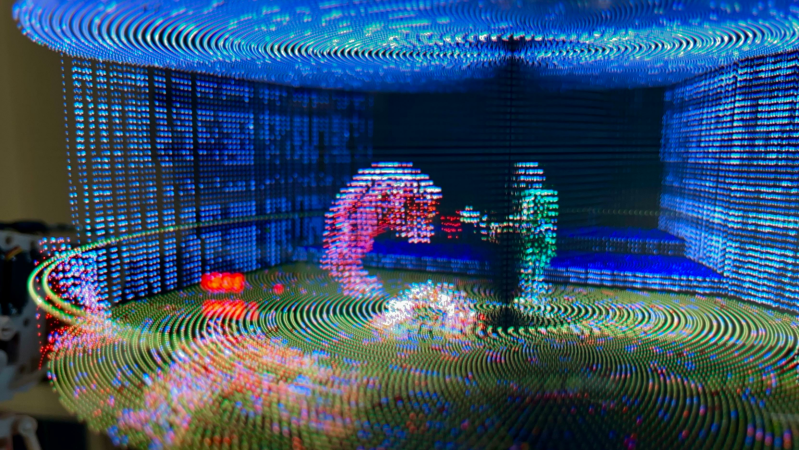
There’s something magical about volumetric displays. They really need to be perceived in person, and no amount of static or video photography will ever do them justice. [AncientJames] has built a few, and we’re reporting on his progress, mostly because he got it to run a playable port of DOOM.

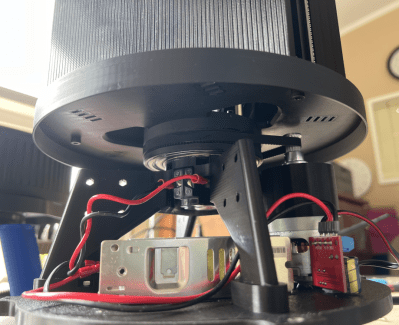
Base view of an earlier version showing the motor drive and PSU

As we’ve seen before, DOOM is very much a 3D game viewed on a 2D display using all manner of clever tricks and optimizations. The background visual gives a 3D effect, but the game’s sprites are definitely very solidly in 2D land. As we’ll see, that wasn’t good enough for [James].

The basic concept relies on a pair of 128 x 64 LED display matrix modules sitting atop a rotating platform. The 3D printed platform holds the displays vertically, with the LEDs lined up with the diameter, meaning the electronics hang off the back, creating some imbalance.

Lead, in the form of the type used for traditional window leading, was used as a counterbalance. A Raspberry Pi 4 with a modified version of this LED driver HAT is rotating with the displays. The Pi and both displays are fed power from individual Mini560 buck modules, taking their input from a 12 V 100 W Mean-Well power supply via a car alternator slip ring setup. (Part numbers ABH6004S and ASL9009  for those interested.) Finally, to synchronise the setup, a simple IR photo interrupter signals the Pi via an interrupt.

Continue reading DOOM On A Volumetric Display”

A Digital Replacement For Your Magic Eye

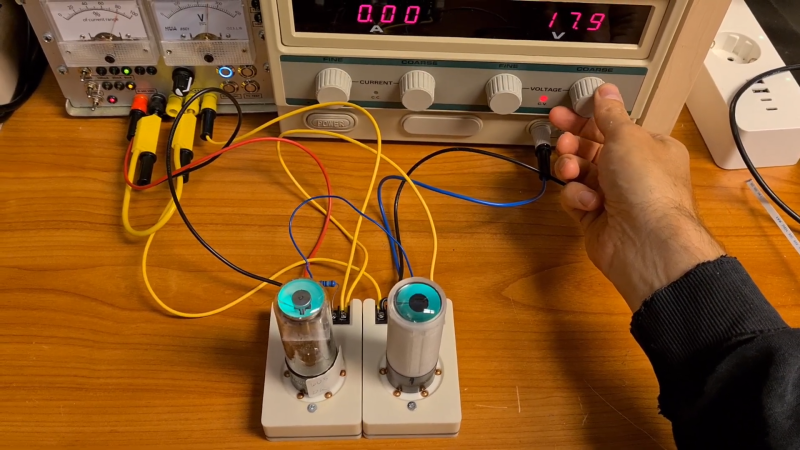
Magic Eye tubes were popular as tuning guides on old-school radio gear. However, the tubes, the 6U5 model in particular, have become rare and remarkably hard to come by of late. When the supply dried up, [Bjørner Sandom] decided to build a digital alternative instead.

The build relies on a small round IPS display, measuring an inch in diameter and with a resolution of 128×115 pixels. One can only presume it’s round but not perfectly so. It was then fitted with a 25mm glass lens in order to give it a richer, deeper look more akin to a real Magic Eye tube. In any case, a STM32F103CBT was selected to drive the display, with the 32-bit ARM processor running at a lovely 72 MHz for fast and smooth updates of the screen.

The screen, controller, and supporting circuitry are all built onto a pair of PCBs and installed in a 3D-printed housing that lives atop a tube base. The idea is that the build is a direct replacement for a real 6U5 tube. The STM32 controller receives the automatic gain control voltage from the radio set it’s installed in, and then drives the screen to behave as a real 6U5 tube would under those conditions.

By virtue of the smart design, smooth updates, and that nifty glass lens, the final product is quite a thing to behold. It really does look quite similar to the genuine article. If you’ve got a beloved old set with a beleagured magic eye, you might find this a project worth replicating. Video after the break.

Continue reading “A Digital Replacement For Your Magic Eye”

Film, As You Have Never Had It Explained Before

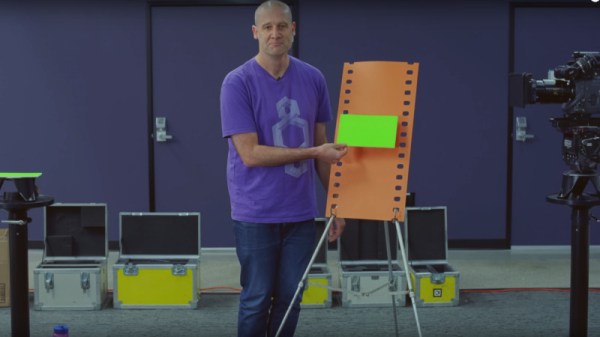
For all the advances in digital photography, there remains a mystique for photographers and filmmakers about chemical film. Using it presents an artistic and technical challenge, and it lends an aesthetic to your work which is difficult to find in other ways. But particularly when it comes to moving pictures, how many of us have ever ventured beyond the Super 8 cartridge? If you’re not lucky enough to have a Spielberg budget, [Stand-Up Maths] is here with a video taking the viewer through the various movie film formats. He claims it’s the first video shot for YouTube in 35mm, and given that his first point is about the costs involved, we can see why.

In particular it serves as an introduction to the various film terms and aspect ratios. We all know what full frame and IMAX are, but do many of us know what they really mean in camera terms. A particularly neat demonstration comes when he has two cameras side by side with the same stock as a split screen, one 35mm and the other 16mm. The cheaper smaller framed format is good quality, but using a profession resolution chart you can see some of the differences clearly. The full film is below the break, and we’d suggest you watch it in the full 4K resolution if you are able to.

Meanwhile, some of us have been known to dabble in 8mm film, and even sometimes shoot footage with it.

Continue reading “Film, As You Have Never Had It Explained Before”

The Trashiest Of Mains Inverters

Switch-mode technology has made inverters which take a low DC voltage and turn it into a usable mains voltage within the reach of everybody. But still, there might be moments when a mains supply is needed and you’re not lucky enough to have AliExpress at your fingertips, and for that, here’s [Rulof] with a mains inverter that is simultaneously awful and awesome. He’s made a rotary converter, from trash and off the shelf parts.

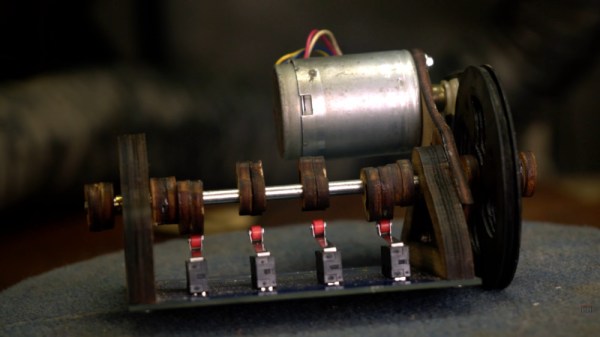
While a switch-mode converter operates using PWM at many times the output frequency for efficiency, we’re guessing that most readers will be familiar enough with how AC works to see how a low frequency converter turns DC into AC. A set of switches repeatedly flip the polarity, and the resulting square wave is fed into a transformer to step up to the final voltage. The switches can be mechanical as with old-style converters that used vibrating reeds or rotary armatures, or they can be electronic using power transistors. In this case they are a set of microswitches actuated by a set of cams on a shaft driven by a small motor, and the transformer comes from a surplus UPS.

We’re guessing that the frequency will be only a few Hz and the microswitches will suffer from switching such an inductive load, but as you can see in the video below the break it does light a mains bulb, and we’re guessing it would be enough to activate most wall-wart switching power supplies. We’re not so sure though about his use of the IEC sockets from the UPS to carry 12 volts, as the current may be a little much for them.

Meanwhile if you thirst for more of this kind of thing, we have you covered.

Continue reading “The Trashiest Of Mains Inverters”